
The Christian life is often misunderstood as a lifelong effort to suppress bad behavior while striving to imitate good behavior. For many believers, discipleship becomes a daily struggle of self-management—trying harder to be patient, more disciplined to be loving, and more determined to resist temptation. Yet the apostle Paul presents a radically different vision of Christian living, one that does not begin with effort, discipline, or law, but with grace and spiritual life.
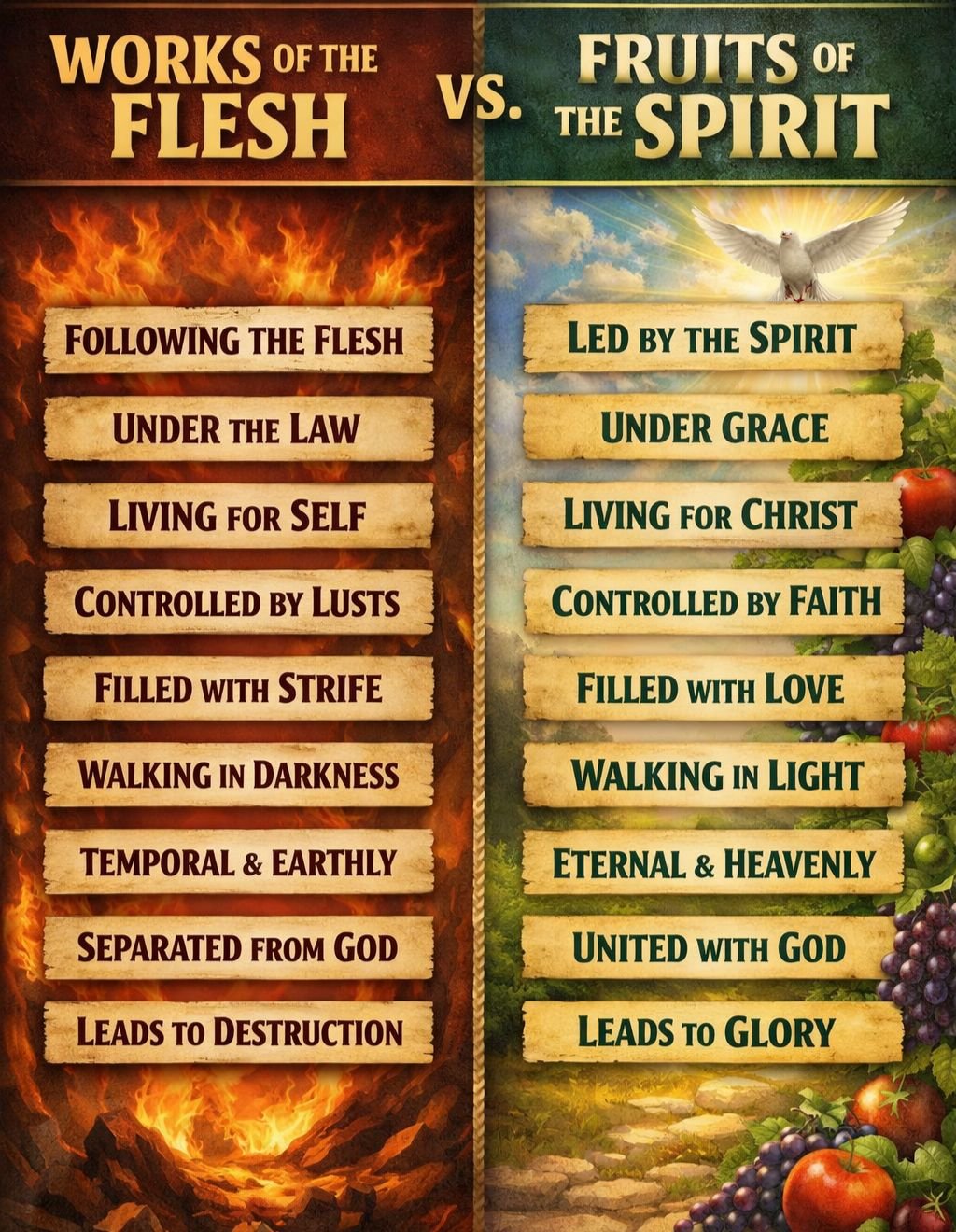
In Galatians chapter five, Paul draws a sharp and deliberate contrast between the “works of the flesh” and the “fruit of the Spirit.” The distinction is more than moral. It is theological. It exposes two fundamentally different ways of living—one rooted in human self-effort and the other flowing from divine life. One is manufactured. The other is grown. One depends on control. The other depends on trust.
Salvation, Paul makes clear, is settled the moment a person believes the gospel. But how a believer walks afterward reveals which power is shaping daily life. The tension between flesh and Spirit is not about losing salvation or earning favor; it is about which influence is being yielded to. Understanding this difference is essential for believers who want to live victoriously under grace rather than remain trapped in cycles of guilt, striving, and spiritual frustration.
Paul begins his argument with a simple but profound instruction: “Walk in the Spirit, and ye shall not fulfil the lust of the flesh.” This statement reframes the entire conversation. Victory over the flesh is not achieved by fighting the flesh directly. It is achieved by walking in something else entirely.
Fleshly living is driven by feelings, impulses, and desires. It reacts quickly and often emotionally. It seeks satisfaction, affirmation, control, and comfort. Even when religious, the flesh remains self-focused, measuring success by visible behavior and personal discipline. Spiritual guidance, by contrast, does not arise from emotion or instinct. Paul writes in Romans that those who are led by the Spirit of God are the sons of God. Spiritual living flows from divine leadership, not human initiative.
The difference is subtle but decisive. Fleshly following asks, “What do I feel like doing?” Spiritual guidance asks, “What does the Spirit desire to produce?” Freedom, Paul insists, does not come from striving harder or imposing stricter rules. It comes from yielding. Yielding is not passivity; it is trust. It is the willingness to let God’s life express itself through the believer rather than forcing moral conformity through effort.
This is why Paul repeatedly contrasts law and grace. The law, though holy and just, has a unique relationship with the flesh. It restrains behavior outwardly but cannot transform the heart inwardly. In fact, Paul argues that the law actually gives the flesh opportunity. “The strength of sin is the law,” he writes elsewhere, not because the law is sinful, but because it exposes desire without providing power.
Under the law, the flesh thrives. Rules provoke rebellion. Commands awaken resistance. The flesh responds either with pride when it succeeds or condemnation when it fails. Grace, however, operates on an entirely different principle. Under grace, believers are not motivated by fear of punishment or hope of reward. They are motivated by identity and love. Paul states plainly that believers are not under the law, but under grace. And again, “If ye be led of the Spirit, ye are not under the law.”
Grace does what law never could. It does not merely restrain outward behavior; it transforms inward desire. It does not demand righteousness; it produces it. This is why Paul never instructs believers to crucify themselves. Instead, he reminds them that they already have been crucified with Christ.
This truth leads directly into the difference between self-centered and Savior-centered living. Fleshly living, even when moral, ultimately revolves around self. Self-improvement, self-discipline, self-image, and self-achievement dominate the spiritual landscape. The believer becomes both the problem and the solution. The result is exhaustion.
Spirit-led living, however, flows from identification with Christ. Paul’s declaration in Galatians—“I am crucified with Christ: nevertheless I live; yet not I, but Christ liveth in me”—is not poetic exaggeration. It is doctrinal reality. The believer does not live to become crucified; the believer lives because the crucifixion has already occurred.
This changes everything. The Christian life is no longer about trying to die to self daily through effort. It is about living from a finished identification. Christ’s death counts as the believer’s death. Christ’s life becomes the believer’s life. The focus shifts from behavior management to life expression.
Nowhere is this contrast clearer than in the battle between lust and faith. James describes lust as desire that conceives and brings forth sin, which ultimately produces death. Lust demands immediate satisfaction. It is restless, urgent, and consuming. Faith, by contrast, rests. Paul writes that believers are justified by faith and therefore have peace with God. Faith trusts God’s sufficiency rather than demanding fulfillment from circumstances or people.
What a believer trusts determines how a believer walks. Lust says, “I must have this now.” Faith says, “God is enough.” Lust seeks control. Faith yields. Lust consumes energy. Faith releases it. The flesh feeds on desire; the Spirit responds to trust.
This internal difference inevitably manifests outwardly in relationships. Paul lists the works of the flesh in Galatians five, and many of them are relational: strife, envy, wrath, divisions, and contentions. Flesh divides. It competes. It compares. It defends itself aggressively and withdraws defensively. Even religious flesh produces factions and rivalries.
The fruit of the Spirit, however, begins with love. Not manufactured love, not forced politeness, but divine love that flows naturally from the Spirit’s presence. Paul reminds the Colossians that love is the bond of perfectness. Unity does not come from agreement alone; it comes from love produced by the Spirit.
This is why fruit cannot be commanded. No branch produces fruit by effort. It produces fruit by remaining connected to the life source. When believers try to force unity or manufacture love, the result is artificial and fragile. When the Spirit is allowed to work, unity grows organically.
Paul’s contrast between darkness and light further illustrates the difference between flesh and Spirit. Before salvation, believers walked in darkness—not merely ignorance, but confusion and concealment. Darkness hides. It distorts perception. It breeds fear and isolation. Flesh prefers darkness because it avoids exposure.
Grace, however, brings believers into light. Paul tells the Ephesians that they were once darkness, but now are light in the Lord. Light does not merely illuminate behavior; it reveals identity. It exposes truth not to condemn, but to clarify. Under grace, believers no longer hide. They live openly as sons and daughters rather than as servants fearing exposure.
This new way of walking inevitably reshapes perspective. Flesh operates with a temporal mindset. It prioritizes what is immediate, visible, and tangible. It measures success by circumstances and comfort. The Spirit, however, directs attention toward eternal realities. Paul writes that believers should look not at the things which are seen, but at the things which are unseen, because the seen are temporary and the unseen are eternal.
Where a believer looks determines how a believer lives. Eternal focus changes daily decisions. It reframes suffering, reshapes priorities, and redefines success. When eternity governs perspective, patience grows and anxiety loses its grip.
Perhaps the most transformative distinction Paul makes is between separation and union. Flesh operates as though God is distant and approval must be earned. It prays from insecurity and serves from obligation. The Spirit operates from union. Paul writes that the believer’s spirit is joined to the Lord, becoming one spirit with Him. This union is not symbolic. It is positional reality.
Position precedes practice. Believers do not walk toward union with Christ; they walk from it. When this truth is misunderstood, Christian living becomes burdensome. When it is understood, obedience becomes relational rather than transactional.
The final contrast Paul draws is between destruction and glory. Fleshly living, even when religious, leads to loss. It may appear productive, but it lacks eternal value. Paul warns that to be carnally minded is death—not loss of salvation, but loss of vitality, peace, and reward.
Spiritual living, by contrast, leads toward glory. Paul describes the hope of glory as Christ living within the believer. Glory is not merely future radiance; it is present transformation. The Spirit works progressively, shaping believers into Christ’s likeness, producing fruit that endures beyond this life.
This is why Paul insists that the Christian life is not about self-reformation. It is about Spirit-transformation. Works are manufactured. Fruit is grown. Works depend on pressure. Fruit depends on life.
The tragedy is that many believers attempt to live under grace while thinking under law. They measure spiritual success by effort rather than dependence. They battle the flesh directly instead of walking in the Spirit. The result is discouragement rather than freedom.
Paul’s message is both liberating and humbling. Victory is not achieved by trying harder, but by trusting deeper. The Spirit does not ask believers to produce fruit; He produces fruit in believers who walk by faith.
The call, then, is not to work for fruit, but to walk. To yield daily. To renew the mind in Pauline truth. To live consciously under grace rather than drifting back into performance-based spirituality.
Believers are free from the law. They are alive in the Spirit. They are destined for glory. When they stop striving and start yielding, fruit follows naturally.
Grace does not lower the standard of holiness. It supplies the power to live it.
And in that truth, the Christian life finally becomes what it was always meant to be—not a struggle for approval, but a walk of life.
Related posts:
 𝗧𝗛𝗘 𝟳 𝗕𝗟𝗘𝗦𝗦𝗜𝗡𝗚𝗦 𝗢𝗙 𝗧𝗛𝗘 𝗛𝗢𝗟𝗬 𝗦𝗣𝗜𝗥𝗜𝗧
 𝗚𝗢𝗗 𝗔𝗡𝗗 𝗠𝗔𝗡: 𝗥𝗜𝗚𝗛𝗧𝗟𝗬 𝗗𝗜𝗩𝗜𝗗𝗘𝗗 𝗗𝗘𝗦𝗜𝗚𝗡
 𝗪𝗢𝗥𝗟𝗗𝗟𝗬 𝗖𝗛𝗥𝗜𝗦𝗧𝗜𝗔𝗡 𝘃𝘀. 𝗦𝗣𝗜𝗥𝗜𝗧𝗨𝗔𝗟 𝗖𝗛𝗥𝗜𝗦𝗧𝗜𝗔𝗡
 𝗧𝗛𝗘 𝗕𝗥𝗔𝗜𝗡 𝗠𝗨𝗦𝗧 𝗕𝗘 𝗪𝗔𝗧𝗘𝗥𝗘𝗗 𝗪𝗜𝗧𝗛 𝗧𝗛𝗘 𝗪𝗢𝗥𝗗 𝗢𝗙 𝗚𝗢𝗗 𝗗𝗔𝗜𝗟𝗬
 𝗟𝗜𝗚𝗛𝗧 𝗦𝗛𝗜𝗡𝗘𝗦 𝗜𝗡 𝗧𝗛𝗘 𝗗𝗔𝗥𝗞𝗡𝗘𝗦𝗦
 𝗚𝗨𝗜𝗟𝗧 𝘃𝘀 𝗚𝗥𝗔𝗖𝗘 — 𝗙𝗥𝗢𝗠 𝗖𝗢𝗡𝗗𝗘𝗠𝗡𝗔𝗧𝗜𝗢𝗡 𝗧𝗢 𝗖𝗢𝗠𝗣𝗟𝗘𝗧𝗜𝗢𝗡
 𝗪𝗛𝗢 𝗜𝗦 𝗝𝗘𝗦𝗨𝗦?
 𝗜𝗡𝗙𝗟𝗨𝗘𝗡𝗖𝗜𝗡𝗚 𝗢𝗧𝗛𝗘𝗥𝗦 𝗧𝗢 𝗛𝗔𝗧𝗘: 𝗧𝗛𝗘 𝗦𝗣𝗜𝗥𝗜𝗧𝗨𝗔𝗟 𝗗𝗔𝗡𝗚𝗘𝗥
 𝗟𝗨𝗦𝗧 𝘃𝘀 𝗟𝗢𝗩𝗘
 𝗙𝗔𝗟𝗦𝗘 𝗙𝗥𝗜𝗘𝗡𝗗𝗦: 𝗧𝗛𝗘 𝗗𝗔𝗡𝗚𝗘𝗥 𝗢𝗙 𝗣𝗥𝗘𝗧𝗘𝗡𝗗𝗘𝗗 𝗙𝗘𝗟𝗟𝗢𝗪𝗦𝗛𝗜𝗣
 𝗧𝗛𝗘 𝗦𝗣𝗜𝗥𝗜𝗧𝗨𝗔𝗟 𝗗𝗨𝗧𝗜𝗘𝗦 𝗢𝗙 𝗧𝗛𝗘 𝗖𝗛𝗥𝗜𝗦𝗧𝗜𝗔𝗡
 𝗥𝗘𝗟𝗜𝗚𝗜𝗢𝗡 𝘃𝘀. 𝗝𝗘𝗦𝗨𝗦: 𝗧𝗛𝗘 𝗚𝗥𝗘𝗔𝗧 𝗗𝗜𝗩𝗜𝗗𝗘
 𝗧𝗛𝗘 𝗧𝗥𝗜𝗖𝗛𝗢𝗧𝗢𝗠𝗬 𝗢𝗙 𝗠𝗔𝗡
 𝗕𝗘𝗪𝗔𝗥𝗘: 𝗦𝗔𝗧𝗔𝗡 𝗕𝗔𝗜𝗧𝗦 𝗛𝗜𝗦 𝗛𝗢𝗢𝗞 𝗪𝗜𝗧𝗛 𝗬𝗢𝗨𝗥 𝗙𝗔𝗩𝗢𝗥𝗜𝗧𝗘 𝗦𝗜𝗡