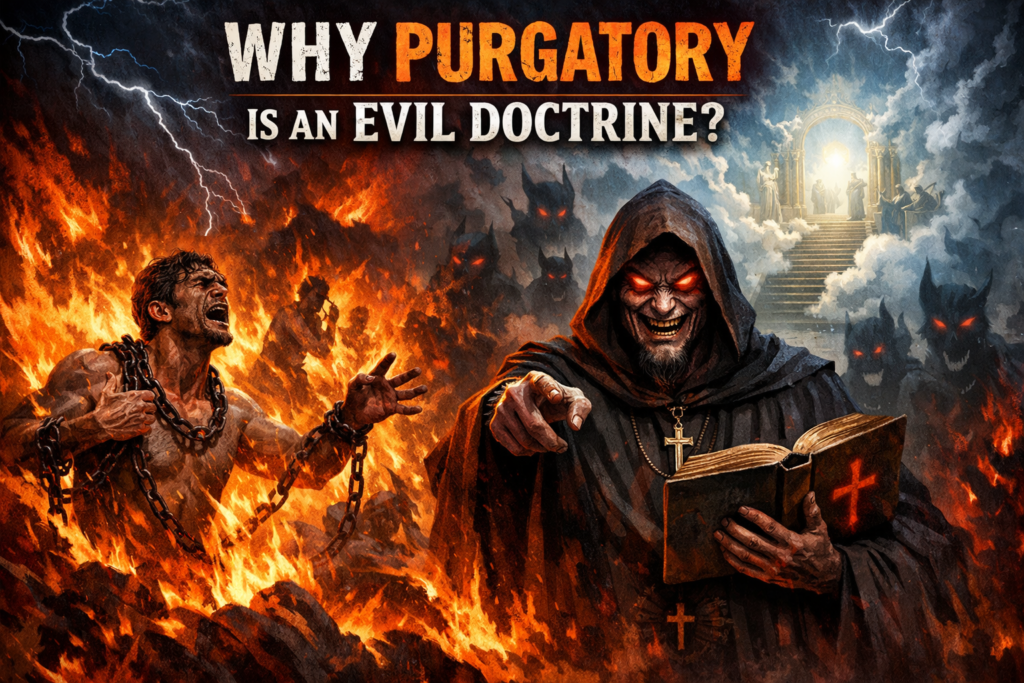
THE SMOKE OF DECEPTION: A FORENSIC AUDIT OF THE PURGATORIAL HERESY
In the grand architecture of human religion, there has never been a scaffold more expertly crafted to keep the souls of men in bondage than the doctrine of Purgatory. It stands as a towering monument to human pride, a middle-ground of misery designed to fill the coffers of a priesthood while draining the hope of the believer. This investigative report asserts that Purgatory is not merely a theological error; it is a spiritual assault—an evil doctrine that seeks to finish what Christ allegedly left undone. According to the diagnostic baseline of the Dispensation of Grace, any teaching that adds a “waiting room of fire” to the finished work of the Cross is a perversion of the highest order. As the Apostle of the Gentiles, Paul, commanded: “Examine yourselves, whether ye be in the faith; prove your own selves” (2 Corinthians 13:5).
The forensic reality is clear: Purgatory is a false hope wrapped in the shroud of religious tradition. It posits that the blood of Christ was a down payment, but that the final installment must be paid by the believer in the currency of suffering. This inquiry will dismantle this Babylonian invention, using the “rightly divided” Word of Truth to expose why this teaching is a direct insult to the Majesty of God and the sufficiency of His Son.
I. THE PERVERSION OF THE PAYMENT: DENYING THE FINISHED WORK
The Forensic Audit of the Atonement
The primary finding of this investigation reveals that Purgatory is, at its core, a rejection of the “Once for All” nature of Christ’s sacrifice. To suggest that a believer must be “further purified” by fire after death is to say that the fire of God’s wrath on Calvary was insufficient to consume our sins.
It Corrupts the Cross. The investigative record in Hebrews 10:10-14 is absolute: “But this man, after he had offered one sacrifice for sins for ever, sat down on the right hand of God… For by one offering he hath perfected for ever them that are sanctified.” If we are “perfected for ever,” there is no residue of sin for a purgatorial flame to address. It Contradicts the Covenant. In Ephesians 1:7, the Spirit declares: “In whom we have redemption through his blood, the forgiveness of sins, according to the riches of his grace.” Redemption means “paid in full.” A debt that is paid in full cannot be collected upon again in the afterlife.
Furthermore, It Cancels the Comfort. The forensic result of justification is peace. “Therefore being justified by faith, we have peace with God through our Lord Jesus Christ” (Romans 5:1). Purgatory replaces this peace with a “fearful looking for of judgment” (Hebrews 10:27). The investigator finds that Purgatory robs the believer of the blessed assurance of salvation, keeping them in a state of spiritual anxiety that denies the very “riches of his grace.”
II. THE PREDICTION OF PAGANISM: THE ANCESTRY OF THE ERROR
Investigating the Babylonian Roots of Purification Fires
This inquiry has traced the lineage of Purgatory, and the results show no origin in the Pauline Epistles. Instead, the tracks lead back to the idolatrous groves of ancient Babylon and the weeping for Tammuz.
It Originated in Idolatry. The investigative report in Ezekiel 8:13-14 highlights the infiltration of pagan rites into the worship of God. Ancient paganism taught that souls must pass through “cleansing fires” to reach the Elysian fields. Rome simply took these pagan superstitions and baptized them with Christian terminology. It Operates in Ignorance. Paul warned the Thessalonians: “But I would not have you to be ignorant, brethren, concerning them which are asleep, that ye sorrow not, even as others which have no hope” (1 Thessalonians 4:13). If Purgatory existed, Paul would have offered instructions on how to pray souls out of it; instead, he offered comfort that the dead are already “with the Lord.”
The investigator also finds that It Offers a False Intercession. By creating a need for post-death purification, the doctrine invents a role for a human priest to offer “Masses for the dead.” This is a direct violation of 1 Timothy 2:5: “For there is one God, and one mediator between God and men, the man Christ Jesus.” Purgatory attempts to bypass the singular mediation of Christ with a system of human ritual.
III. THE PUNISHMENT THAT IS PERMANENT: THE MYTH OF THE MIDDLE GROUND
The Forensic Analysis of Eternal Destinations
The Word of God recognizes two jurisdictions for the soul: Heaven or Hell. The investigator finds no “middle ground” in the forensic evidence of Scripture.
It Distorts Divine Justice. In the account of the rich man and Lazarus (Luke 16:22-26), the Lord Jesus Christ establishes a forensic precedent: “And beside all this, between us and you there is a great gulf fixed: so that they which would pass from hence to you cannot; neither can they pass to us, that would come from thence.” There is no bridge, no transit, and no escape from the finality of death’s decision.
It Disregards the Dispensation. For the Body of Christ, death is an immediate transition. 2 Corinthians 5:8 states: “We are confident, I say, and willing rather to be absent from the body, and to be present with the Lord.” There is no “waiting room” in the Mystery program. To suggest a believer stops at a station of suffering is to Deny the Destination. Paul’s desire was “to depart, and to be with Christ; which is far better” (Philippians 1:23). The investigator find that Purgatory makes departing “far worse” than staying, which contradicts the heart of Pauline revelation.
IV. THE PROFIT OF THE PRIESTHOOD: THE CURRENCY OF FEAR
Investigating the Financial Exploitation of the Purgatorial System
The investigator find that Purgatory is not just a doctrine; it is a commercial enterprise. It is a System of Sale that treats the grace of God as a commodity. In Acts 8:20, Peter rebuked Simon the Sorcerer for thinking that the gift of God could be purchased with money. Yet, Purgatory is the engine that drives the sale of indulgences and “memorial masses.”
It’s a Scheme of Slavery. Paul commanded: “Stand fast therefore in the liberty wherewith Christ hath made us free, and be not entangled again with the yoke of bondage” (Galatians 5:1). Purgatory is the ultimate yoke, keeping the laity in fear of the future and dependent on the religious institution for relief. It is a Substitute for Salvation. It teaches that purification comes through our suffering and our money, rather than Christ’s blood. Titus 3:5 counters this: “Not by works of righteousness which we have done, but according to his mercy he saved us.” The investigator finds that Purgatory sells a “fire extinguisher” for a fire that God never kindled for His children.
V. THE POSITION OF THE PERFECTED: THE BELIEVER’S PRESENT STATUS
A Forensic Deep-Dive into Positional Sanctification
The investigation moves to the present state of the believer. Are we waiting to be cleaned, or are we already clean? The Word of God declares a present-tense reality.
We Are Cleansed by His Blood. 1 John 1:7 declares: “the blood of Jesus Christ his Son cleanseth us from all sin.” Note the word “all.” If the blood cleanses from “all” sin, what is left for the fire to do? To add fire to the blood is to mock the Cross. We Are Complete in His Body. Colossians 2:10 is the believer’s certificate of completion: “And ye are complete in him.” Nothing is pending; nothing is missing.
Furthermore, We Are Confirmed by His Spirit. The investigative record in Ephesians 1:13-14 shows that believers are “sealed with that holy Spirit of promise.” A seal is a mark of ownership and security. The investigator find that the Holy Spirit’s seal is not a temporary tag that can be singed by purgatorial flames; it is a permanent guarantee “until the redemption of the purchased possession.”
VI. THE PROMISE OF PARADISE: THE IMMEDIACY OF REST
Investigating the Lasting Assurance of Christ
The investigation points to the dying words of Christ as the definitive refutation of any “waiting period.”
Immediate Entrance. To the thief on the cross, who had no time for works or purification, Christ said: “Verily I say unto thee, To day shalt thou be with me in paradise” (Luke 23:43). If the thief went from the cross to paradise in a single day, why would a modern believer need centuries of purging?
The believer has an Incorruptible Inheritance. As recorded in 1 Peter 1:4, our inheritance is “reserved in heaven for you.” It is not reserved in a pit of fire. Our Indwelling Identity is that of a “new creature” (2 Corinthians 5:17). God does not send “new creatures” into old fires. The investigator find that our purification is “positional”—we are righteous because we are “in Christ,” and Christ cannot be purged by fire.
VII. THE PROPAGANDA OF THE PERDITION: THE LETHAL LIES
The Forensic Audit of Satanic Deception
Finally, the investigation reveals the architect behind this evil doctrine. Purgatory is a masterpiece of Satanic propaganda. It Misdirects the Multitude. Like the blind leading the blind (Matthew 15:14), millions trust in a second chance after death that will never come.
It Misrepresents the Message. Paul’s warning in Galatians 1:6-9 is severe: anyone preaching “another gospel” is accursed. Purgatory is another gospel—a gospel of works, suffering, and human merit. It Misleads the Mind. Just as the serpent beguiled Eve, so this doctrine corrupts the minds of men from the “simplicity that is in Christ” (2 Corinthians 11:3). The investigator finds that Purgatory is the serpent’s whisper that the Cross was “not quite enough.”
THE INVESTIGATIVE SUMMARY: THE VERDICT OF GRACE
The evidence gathered in this forensic investigation is conclusive: Purgatory is an evil doctrine, born in the darkness of paganism and maintained by the greed of men. It is a direct assault on the Finished Work of Christ and the Pauline revelation of Grace.
The investigative summary identifies the following forensic facts:
- Purgatory Insults the Blood of Christ: By suggesting it needs an assist from fire.
- Purgatory Introduces Babylonian Confusion: By mixing pagan fire-rites with Christian truth.
- Purgatory Instills Bondage and Fear: By stripping the believer of their peace and assurance.
- Purgatory Ignores Pauline Revelation: By adding a “third destination” that the Apostle of Grace never taught.
The final verdict is rendered: The believer in the Body of Christ is saved, sealed, and soon-to-be glorified. We are not waiting to be burned; we are waiting to be “caught up” (1 Thessalonians 4:17). Purgatory is a lie that leads to the ditch of perdition by making men trust in their own suffering rather than the Savior’s.
CALL TO ACTION: STANDING IN THE LIBERTY OF CHRIST
In light of the findings of this report, the investigator issues the following mandates:
- Reject False Doctrines: Cast off any teaching that suggests your salvation is incomplete or that you must suffer for your sins after death.
- Rest in Christ’s Finished Work: Affirm today that the blood of Jesus Christ is sufficient for your every sin, past, present, and future.
- Reach Others with Truth: Use the Word “rightly divided” to liberate those who are trapped in the fear of Purgatory. Show them the “riches of His grace.”
FINAL THOUGHTS: THE ARCHIVE OF THE REDEEMED
- Purgatory denies grace: It is the enemy of the gift.
- Purgatory dishonors Christ: It mocks the “It is Finished.”
- Purgatory destroys assurance: It is the architect of anxiety.
- The believer is complete: No fire required.
- The destination is immediate: Absent from the body, present with the Lord.
The investigator find that the only “fire” the believer’s works will face is at the Judgment Seat of Christ, where our service—not our souls—is evaluated for rewards (1 Corinthians 3:13-15). Our souls are already “passed from death unto life” (John 5:24). Purgatory is a fable of the night; Grace is the light of the day.
Related posts:
 𝗧𝗛𝗘𝗥𝗘 𝗜𝗦 𝗣𝗢𝗪𝗘𝗥 𝗜𝗡 𝗧𝗛𝗘 𝗕𝗟𝗢𝗢𝗗 𝗢𝗙 𝗝𝗘𝗦𝗨𝗦 𝗖𝗛𝗥𝗜𝗦𝗧
 𝗦𝗔𝗟𝗩𝗔𝗧𝗜𝗢𝗡 𝗜𝗦 𝗡𝗢𝗧 𝗬𝗢𝗨𝗥 𝗚𝗢𝗢𝗗 𝗪𝗢𝗥𝗞𝗦𝗜𝗧 𝗜𝗦 𝗚𝗢𝗗 𝗙𝗜𝗡𝗜𝗦𝗛𝗘𝗗 𝗪𝗢𝗥𝗞 𝗢𝗡 𝗧𝗛𝗘 𝗖𝗥𝗢𝗦𝗦
 𝗥𝗜𝗚𝗛𝗧𝗟𝗬 𝗗𝗜𝗩𝗜𝗗𝗜𝗡𝗚 𝗣𝗘𝗧𝗘𝗥 𝗗𝗢𝗖𝗧𝗥𝗜𝗡𝗘 𝘃𝘀 𝗣𝗔𝗨𝗟 𝗗𝗢𝗖𝗧𝗥𝗜𝗡𝗘
 𝗝𝗘𝗦𝗨𝗦 𝗖𝗛𝗥𝗜𝗦𝗧: 𝗧𝗛𝗘 𝗢𝗡𝗟𝗬 𝗦𝗔𝗩𝗜𝗢𝗥
 𝗧𝗛𝗘𝗥𝗘 𝗜𝗦 𝗡𝗢 𝗥𝗘𝗦𝗧 𝗜𝗡 𝗣𝗘𝗔𝗖𝗘 𝗪𝗜𝗧𝗛𝗢𝗨𝗧 𝗖𝗛𝗥𝗜𝗦𝗧
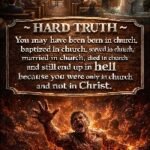 𝗛𝗔𝗥𝗗 𝗧𝗥𝗨𝗧𝗛: 𝗥𝗘𝗟𝗜𝗚𝗜𝗢𝗡 𝗪𝗜𝗧𝗛𝗢𝗨𝗧 𝗖𝗛𝗥𝗜𝗦𝗧 𝗦𝗧𝗜𝗟𝗟 𝗟𝗘𝗔𝗗𝗦 𝗧𝗢 𝗛𝗘𝗟𝗟
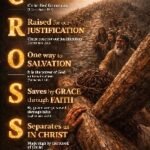 𝗧𝗛𝗘 𝗖𝗥𝗢𝗦𝗦: 𝗚𝗢𝗗’𝗦 𝗣𝗢𝗪𝗘𝗥 𝗙𝗢𝗥 𝗦𝗔𝗟𝗩𝗔𝗧𝗜𝗢𝗡
 𝗟𝗜𝗚𝗛𝗧 𝗦𝗛𝗜𝗡𝗘𝗦 𝗜𝗡 𝗧𝗛𝗘 𝗗𝗔𝗥𝗞𝗡𝗘𝗦𝗦
 𝗧𝗛𝗘 𝗘𝗠𝗣𝗧𝗬 𝗧𝗢𝗠𝗕: 𝗧𝗛𝗘 𝗚𝗥𝗘𝗔𝗧𝗘𝗦𝗧 𝗣𝗥𝗢𝗢𝗙 𝗢𝗙 𝗖𝗛𝗥𝗜𝗦𝗧
 𝗧𝗪𝗢 𝗠𝗜𝗡𝗗𝗦𝗘𝗧𝗦: 𝗙𝗟𝗘𝗦𝗛 𝗢𝗥 𝗖𝗛𝗥𝗜𝗦𝗧
 𝗜𝗚𝗡𝗢𝗥𝗜𝗡𝗚 𝗧𝗛𝗘 𝗧𝗥𝗨𝗧𝗛 𝗗𝗢𝗘𝗦𝗡’𝗧 𝗖𝗛𝗔𝗡𝗚𝗘 𝗧𝗛𝗘 𝗧𝗥𝗨𝗧𝗛
 𝗜 𝗖𝗔𝗡𝗡𝗢𝗧 𝗕𝗘 𝗤𝗨𝗜𝗘𝗧 𝗪𝗛𝗘𝗡 𝗦𝗢𝗨𝗟𝗦 𝗔𝗥𝗘 𝗣𝗘𝗥𝗜𝗦𝗛𝗜𝗡𝗚
 𝗪𝗔𝗥𝗡𝗜𝗡𝗚: 𝗥𝗘𝗝𝗘𝗖𝗧𝗜𝗡𝗚 𝗖𝗛𝗥𝗜𝗦𝗧 𝗜𝗦 𝗥𝗘𝗝𝗘𝗖𝗧𝗜𝗡𝗚 𝗬𝗢𝗨𝗥 𝗢𝗡𝗟𝗬 𝗪𝗔𝗬 𝗧𝗢 𝗛𝗘𝗔𝗩𝗘𝗡
 𝗘𝗔𝗦𝗜𝗘𝗥 𝗙𝗢𝗥 𝗔 𝗖𝗔𝗠𝗘𝗟 𝗧𝗢 𝗚𝗢 𝗧𝗛𝗥𝗢𝗨𝗚𝗛 𝗧𝗛𝗘 𝗘𝗬𝗘 𝗢𝗙 𝗔 𝗡𝗘𝗘𝗗𝗟𝗘