
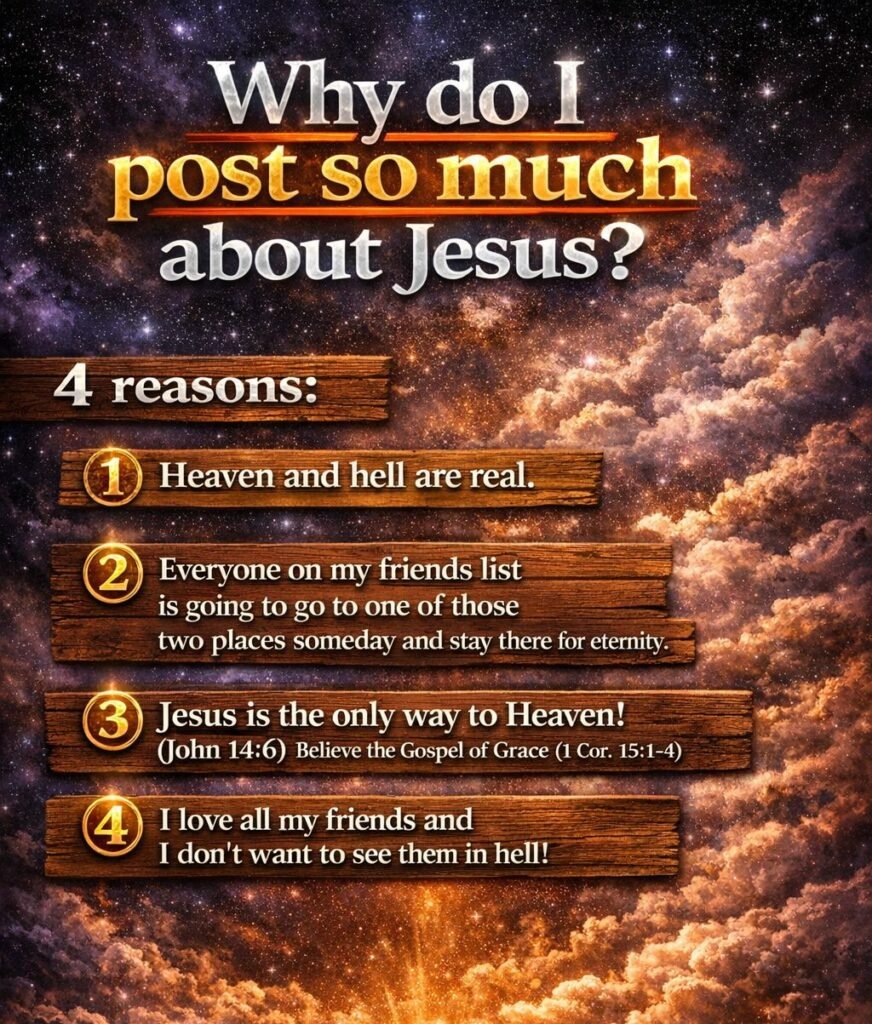
The digital public square, once a repository for localized updates and social connectivity, has morphed into a high-velocity battlefield of competing ideologies. Within this chaotic landscape, a specific behavioral pattern frequently draws the scrutiny of secular observers and religious critics alike: the individual who utilizes their platform for the relentless, unapologetic, and systematic proclamation of the person and work of Jesus Christ. To the casual scroller, this persistent messaging can appear as a narrow obsession, a lack of social awareness, or an intrusive breach of digital etiquette. However, a deep-dive investigative analysis into the motivations behind this behavior reveals a sophisticated theological architecture. For those grounded in the Pauline epistles and the specific “Right Division” of the Word of Truth, this digital boldness is not a manifestation of a religious hobby, but a forensic response to a series of undeniable spiritual realities.
When an individual chooses to occupy their digital real estate with the Gospel of Grace, they are moving according to a blueprint established nearly two millennia ago by the Apostle Paul. In the opening salvos of his letter to the Romans, Paul articulated a professional manifesto that remains the primary data point for this investigation: “For I am not ashamed of the gospel of Christ: for it is the power of God unto salvation to every one that believeth.” To understand why this message dominates the feeds of certain believers, we must dismantle the notion that it is merely a “lifestyle choice.” Instead, we must examine the nine categorical reasons—each rooted in Pauline doctrine—that compel this level of consistent, high-stakes communication.
The Forensic Reality of Inevitable Destinations
The foundational pillar of Gospel-centric communication is the acknowledgment of a fixed eternity. While modern pluralism suggests that the afterlife is a subjective canvas onto which we can paint our own preferences, the biblical record presents a much more binary and forensic reality. The investigative starting point here is not sentiment, but location. The historical accounts in Luke 16 and the prophetic finality of Revelation 20 describe two distinct destinations: a state of eternal joy and a state of everlasting separation from the Creator.
For the student of Pauline doctrine, these destinations are not mere metaphors for “living your best life” or “facing your demons.” They are literal, geographic, and permanent endpoints. The Pauline perspective emphasizes that we currently reside in the “Dispensation of Grace,” a specific administrative window where the “great gulf” between life and death is still open for a change of status. However, once the physical pulse ceases, the data becomes immutable. In this context, posting about Jesus is a navigational warning of the highest order. It is the spiritual equivalent of a lighthouse in a storm; its persistent flashing is not meant to be “annoying,” but to prevent a shipwreck on the rocks of eternal judgment.
The Statistical Certainty of the Human Appointment
A rigorous journalistic look at human demographics reveals a statistic that no amount of medical advancement or transhumanist technology has been able to alter: a 100% mortality rate. The book of Hebrews provides the forensic diagnosis: “It is appointed unto men once to die, but after this the judgment.” This “appointment” is the only universal constant that transcends culture, class, and era.
When a believer utilizes their social media feed to broadcast the message of Christ, they are addressing the one thing they know for a fact about every single follower and friend. From an investigative standpoint, the frequency of these posts is directly proportional to the certainty of the deadline. If everyone you know has an appointment with death and a subsequent appointment with divine judgment, the most professional and compassionate act possible is to provide the legal defense required to survive that judgment. Paul’s motivation was clear: knowing the “terror of the Lord,” he persuaded men. Silence in the face of a universal deadline is not politeness; it is a dereliction of humanitarian duty.
The Exclusive Salvific Claim of the Mediator
The modern world prizes inclusivity, often viewing any claim of “exclusive truth” as a form of intellectual arrogance. Yet, the Pauline revelation is anchored in a specific, singular claim. In 1 Timothy 2:5, the Apostle identifies a unique structural bottleneck in the universe: “For there is one God, and one mediator between God and men, the man Christ Jesus.” This exclusivity is not a human invention but a divine decree.
If Jesus is the only Savior, as argued in both the Petrine and Pauline accounts, then every other proposed path—whether through religious ritual, secular morality, or self-help—is a forensic dead end. The investigative reality behind “posting so much about Jesus” is a commitment to this narrow truth. If there were multiple ways to reach God, then the constant preaching of Christ would be unnecessary and redundant. But if there is only one bridge over the chasm of sin, then the focus must remain exclusively on that bridge. For the believer, “right division” (2 Timothy 2:15) clarifies that while Christ is central to all Scripture, the specific mechanics of salvation for the present age were revealed through Paul.
The Mechanics of the Finished Work
The content of these digital proclamations usually centers on a specific historical and legal transaction. In 1 Corinthians 15:1–4, Paul defines the Gospel with surgical precision: Christ died for our sins according to the Scriptures, He was buried, and He rose again the third day. This is the “Gospel of the Grace of God.” Unlike religious systems that function as an endless treadmill of performance, the Pauline Gospel is a “finished work.”
The investigative insight here is that the debt of sin has been paid in full at the Cross. Salvation today is not a process of earning merit, performing sacraments, or keeping the Mosaic law. It is a legal transfer that occurs the moment a person believes these historical and spiritual facts. Believers post this message frequently because it is the only “news” that can actually alter a person’s eternal standing. It is the announcement that the trial is over, the fine has been paid by another, and the pardon is available. To the believer, this is the most valuable piece of information on the internet.
The Compulsion of Agape Love
A forensic analysis of Paul’s ministry reveals a man driven by a profound emotional and spiritual burden. In Romans 9, he expresses a willingness to be “accursed from Christ” if it meant the salvation of his kinsmen. This is “Agape” love—a sacrificial, selfless concern for the welfare of others that ignores personal cost.
When a believer is criticized for being “obsessed” with Jesus, the critic is often unaware of the underlying psychological driver. It is not a desire to “win” or to be superior; it is a genuine, agonizing concern for the lost. If a person truly believes that their neighbor is heading toward eternal ruin, then “polite silence” is an act of extreme cruelty. Preaching is the ultimate expression of love in a world that is otherwise indifferent to the eternal destiny of the individual.
The Role of the Heavenly Ambassador
The Apostle Paul introduces a specific job description for the believer in the Dispensation of Grace: the “Ambassador for Christ.” In 2 Corinthians 5, he explains that God has committed unto us the “word of reconciliation.” An ambassador is not a freelance commentator; they are a representative of a foreign government.
This redefines the believer’s social media presence. The profile page is not a personal diary; it is an embassy. The consistent posting about Jesus is the fulfillment of a diplomatic commission. The message is simple: “Be ye reconciled to God.” As long as the “Age of Grace” continues, the ambassador’s primary function is to maintain the channel of reconciliation. They do not have the authority to change the message to make it more palatable; they are legally bound to deliver the message exactly as it was given by the Sovereign.
Navigating the Inevitability of Cultural Friction
An investigative look into the “offense” of the Gospel reveals that truth has never been a popular commodity. Paul warned Timothy that “all that will live godly in Christ Jesus shall suffer persecution.” The ridicule, the “unfollows,” and the social “shadow-banning” that occur when one posts about Jesus are not signs of failure; they are forensic confirmations of faithfulness.
The Pauline resolve is to please God rather than men (Galatians 1:10). If the goal were social capital, the believer would post about trends, celebrities, or political outrage. The fact that they continue to post a message that results in social marginalization is proof of their conviction. They are not seeking the applause of the digital crowd; they are seeking the “Well done” of the Master. The opposition of the culture only serves to reinforce the urgency of the message.
The Imminence of the Rapture and the Closing Window
One of the most distinct elements of Pauline doctrine is the “Blessed Hope”—the sudden catching away of the Church. In 1 Thessalonians 4, Paul describes an event that has no prophetic warnings or precursors; it can happen at any moment. When this event occurs, the “Dispensation of Grace” concludes.
This creates a high-stakes investigative scenario. If the opportunity for salvation by grace through faith alone is a temporary offer, then every minute counts. The frequent posting about Jesus is driven by the realization that the “age of the open door” is closing. Once the Body of Christ is removed, the opportunity to believe the Gospel of Grace in its current form ends. Therefore, the believer “redeems the time,” utilizing every pixel of digital space to reach as many people as possible while the offer of grace still stands.
The Vision of Consummate Glory
Finally, the investigator must look at the “end game.” Paul speaks of a glory that is “not worthy to be compared” with the efforts of this present time. For the believer, the result of a life spent proclaiming Christ is not just the salvation of others, but an eternal reward.
Colossians 1:27 identifies “Christ in you, the hope of glory.” This is the internal reality that fuels the external witness. The believer posts about Jesus because they have already tasted the reality of the “new creation.” They are inviting others into a future that includes a glorified body and an eternal inheritance in the heavenly places. To them, the digital feed is a brochure for a country they are already citizens of, and they want as many people as possible to join them there.
The Psychology of Boldness: Defeating the “Shame” Barrier
In our investigative deep-dive, we must address the psychological barrier of “shame” that Paul explicitly mentions in Romans 1:16. Why would someone be “ashamed” of a message that brings life? The answer lies in the world’s sophisticated shaming mechanisms. The Gospel is often labeled as “simplistic,” “outdated,” or “intolerant.”
Pauline doctrine provides the antidote to this shame. It reminds the believer that the Gospel is not an opinion—it is “the power (dunamis) of God.” The believer realizes that they are not carrying a set of religious rules, but the only power source in the universe capable of regenerating a human soul. Once this forensic reality is understood, the shame is replaced by a sense of professional obligation. To have the cure for a terminal disease and not share it out of fear of social embarrassment would be a crime. Posting about Jesus is the act of a “doctor” who has finally found the vaccine and refuses to let the patients die in silence.
The Historical Shift: From Kingdom Sign to Grace Proclamation
A journalistic comparison between the early Acts period and the later Pauline epistles reveals a shift in the nature of the witness. In the early chapters of Acts, the message was accompanied by physical signs and wonders intended to validate the Messiah to Israel. However, as the focus shifted to the “Mystery” revealed to Paul, the “sign” became the Word itself.
Today, we do not post about Jesus to “prove” Him through miracles, but to “preach” Him through doctrine. This requires a different kind of boldness—a boldness rooted in the intellectual and spiritual sufficiency of the Word of God. The investigative reporter finds that those who post the most are often those who have studied the most. Their boldness is not emotional; it is doctrinal. They have “rightly divided” the truth and realized that the “Gospel of the Circumcision” has been superseded by the “Gospel of the Uncircumcision” for this age. This clarity removes all hesitation.
The Digital Marketplace as a Modern Mars Hill
When Paul stood on Mars Hill in Athens (Acts 17), he was engaging with the “social media” of his day—a place where people gathered to hear and tell some new thing. He utilized their own cultural markers to introduce the “Unknown God.” The modern believer sees the digital feed in the same light. It is a place of endless searching, anxiety, and the pursuit of “new things” that never satisfy.
By posting about Jesus, the believer is interrupting the cycle of vanity with a message of substance. They are engaging with the “altars” of modern life—the altars of fitness, politics, and consumerism—and pointing to the only God who can actually fill the void. The frequency of the posts is a reflection of the density of the idols. If the world is posting millions of times a day about things that don’t matter, the ambassador must be equally diligent in posting about the one thing that does.
The Forensic Impact: What Happens When You Post?
What is the actual “yield” of this consistent digital witness? From a Pauline perspective, the impact is twofold. First, it serves as a “savour of death unto death” for some and a “savour of life unto life” for others (2 Corinthians 2:16). The Gospel is a polarizing agent; it forces a decision. Even if no one “likes” the post, the data has been delivered. The seed has been sown.
Second, it builds up the Body of Christ. Many believers are “secret disciples,” afraid to speak out. When they see someone posting boldly and consistently about Jesus, it provides the “mutual faith” Paul spoke of in Romans 1:12. It creates a digital ecosystem of encouragement. The investigator concludes that the “silent majority” of believers are often just waiting for one person to have the courage to break the digital silence.
The Final Investigative Summary: The Logic of the Proclamation
When the question is asked, “Why do you post so much about Jesus?” the answer is not found in a lack of hobbies or a desire for attention. It is found in a forensic, logical, and compassionate response to the Word of God rightly divided.
- It is an act of Intelligence: Recognizing the reality of eternity and the finality of death.
- It is an act of Diplomacy: Fulfilling the role of a heavenly ambassador in a foreign land.
- It is an act of Medicine: Offering the only cure for the terminal condition of sin.
- It is an act of Love: Refusing to let friends face judgment without a defense.
To the world, it is an obsession. To the Pauline believer, it is the only professional use of their influence. The screen will eventually go dark for everyone, and the trends will fade into history. But the “Word of the Lord endureth for ever.” Those who post about Jesus are simply aligning their digital legacy with the only reality that will remain when the internet is gone. They will keep posting, keep preaching, and keep loving—because eternity is too long to be silent, and the Grace of God is too great to be kept a secret.
Summary of Pauline Motivations for Gospel Boldness
| Factor | Pauline Reference | Investigative Reality |
| Urgency | 2 Corinthians 6:2 | The “Age of Grace” is a limited-time offer. |
| Responsibility | 1 Corinthians 9:16 | “Necessity is laid upon me” to preach the Gospel. |
| Clarity | Ephesians 6:19 | Boldness is a gift to be prayed for and exercised. |
| Identity | Galatians 2:20 | The “Self” is dead; Christ’s life must be shown. |
| Focus | Philippians 1:18 | “Christ is preached; and I therein do rejoice.” |
| Destination | Philippians 3:20 | Our citizenship (and loyalty) is in Heaven. |
Conclusion: The Proclamation is the Priority
In the final analysis, the “excessive” posting about Jesus is a direct reflection of a person’s understanding of the “Greatness of the Grace.” If salvation is viewed as a minor religious accessory, the posts will be infrequent. But if salvation is understood as a forensic rescue from eternal death into heavenly glory, the proclamation will be incessant. In the economy of eternity, it is not those who speak too much who are the outliers, but those who know the truth and say nothing at all.
Related posts:
 𝗚𝗢𝗗 𝗔𝗡𝗗 𝗠𝗔𝗡: 𝗥𝗜𝗚𝗛𝗧𝗟𝗬 𝗗𝗜𝗩𝗜𝗗𝗘𝗗 𝗗𝗘𝗦𝗜𝗚𝗡
 𝗧𝗛𝗘 𝗖𝗥𝗢𝗦𝗦: 𝗚𝗢𝗗’𝗦 𝗣𝗢𝗪𝗘𝗥 𝗙𝗢𝗥 𝗦𝗔𝗟𝗩𝗔𝗧𝗜𝗢𝗡
 𝗧𝗛𝗘 𝗕𝗥𝗔𝗜𝗡 𝗠𝗨𝗦𝗧 𝗕𝗘 𝗪𝗔𝗧𝗘𝗥𝗘𝗗 𝗪𝗜𝗧𝗛 𝗧𝗛𝗘 𝗪𝗢𝗥𝗗 𝗢𝗙 𝗚𝗢𝗗 𝗗𝗔𝗜𝗟𝗬
 𝗪𝗛𝗢 𝗦𝗔𝗬𝗦 𝗝𝗘𝗦𝗨𝗦 𝗖𝗛𝗥𝗜𝗦𝗧 𝗜𝗦 𝗚𝗢𝗗?
 𝗧𝗛𝗘𝗥𝗘 𝗜𝗦 𝗣𝗢𝗪𝗘𝗥 𝗜𝗡 𝗧𝗛𝗘 𝗕𝗟𝗢𝗢𝗗 𝗢𝗙 𝗝𝗘𝗦𝗨𝗦 𝗖𝗛𝗥𝗜𝗦𝗧
 𝗕𝗘𝗪𝗔𝗥𝗘: 𝗦𝗔𝗧𝗔𝗡 𝗕𝗔𝗜𝗧𝗦 𝗛𝗜𝗦 𝗛𝗢𝗢𝗞 𝗪𝗜𝗧𝗛 𝗬𝗢𝗨𝗥 𝗙𝗔𝗩𝗢𝗥𝗜𝗧𝗘 𝗦𝗜𝗡
 𝗧𝗪𝗢 𝗧𝗛𝗥𝗢𝗡𝗘𝗦, 𝗧𝗪𝗢 𝗝𝗨𝗗𝗚𝗠𝗘𝗡𝗧𝗦
 𝗧𝗛𝗘 𝗥𝗘𝗩𝗘𝗟𝗔𝗧𝗜𝗢𝗡 𝗢𝗙 𝗧𝗛𝗘 𝗧𝗥𝗜𝗡𝗜𝗧𝗬
 𝗦𝗢𝗢𝗡𝗘𝗥 𝗧𝗛𝗔𝗡 𝗪𝗘 𝗧𝗛𝗜𝗡𝗞
 𝗔𝗟𝗖𝗢𝗛𝗢𝗟 — 𝗗𝗘𝗦𝗧𝗥𝗢𝗬𝗘𝗥 𝗢𝗙 𝗠𝗔𝗡𝗬 𝗟𝗜𝗩𝗘𝗦
 𝗟𝗜𝗙𝗘 — 𝗧𝗛𝗘 𝗚𝗥𝗘𝗔𝗧 𝗘𝗧𝗘𝗥𝗡𝗔𝗟 𝗤𝗨𝗘𝗦𝗧𝗜𝗢𝗡
 𝗪𝗘 𝗦𝗘𝗘 𝗧𝗛𝗘 𝗪𝗢𝗥𝗟𝗗 𝗧𝗛𝗥𝗢𝗨𝗚𝗛 𝗗𝗜𝗙𝗙𝗘𝗥𝗘𝗡𝗧 𝗟𝗘𝗡𝗦𝗘𝗦
 𝗟𝗜𝗚𝗛𝗧 𝗦𝗛𝗜𝗡𝗘𝗦 𝗜𝗡 𝗧𝗛𝗘 𝗗𝗔𝗥𝗞𝗡𝗘𝗦𝗦
 𝗧𝗛𝗘 𝟳 𝗕𝗟𝗘𝗦𝗦𝗜𝗡𝗚𝗦 𝗢𝗙 𝗧𝗛𝗘 𝗛𝗢𝗟𝗬 𝗦𝗣𝗜𝗥𝗜𝗧