The cognitive landscape of the modern era is characterized by a relentless saturation of data, yet for the believer living under the Dispensation of Grace, the fundamental struggle is not the volume of information, but its essence. Forensic analysis of human behavior within the Body of Christ reveals that the mind serves as the primary refinery for spiritual vitality. In this investigative report, we examine the structural impact of mental consumption, contrasting the corrosive properties of the world’s system with the regenerative power of the Word of God. The Pauline revelation establishes a definitive ultimatum: the mind is never a vacuum. It is either a workshop for the Spirit or a playground for the flesh. Romans 8:6 provides the clinical diagnosis for this condition, stating that “to be carnally minded is death; but to be spiritually minded is life and peace.” As we dissect the mechanics of mental nutrition, we find that the direction of a believer’s walk is merely the outward manifestation of an inward diet.
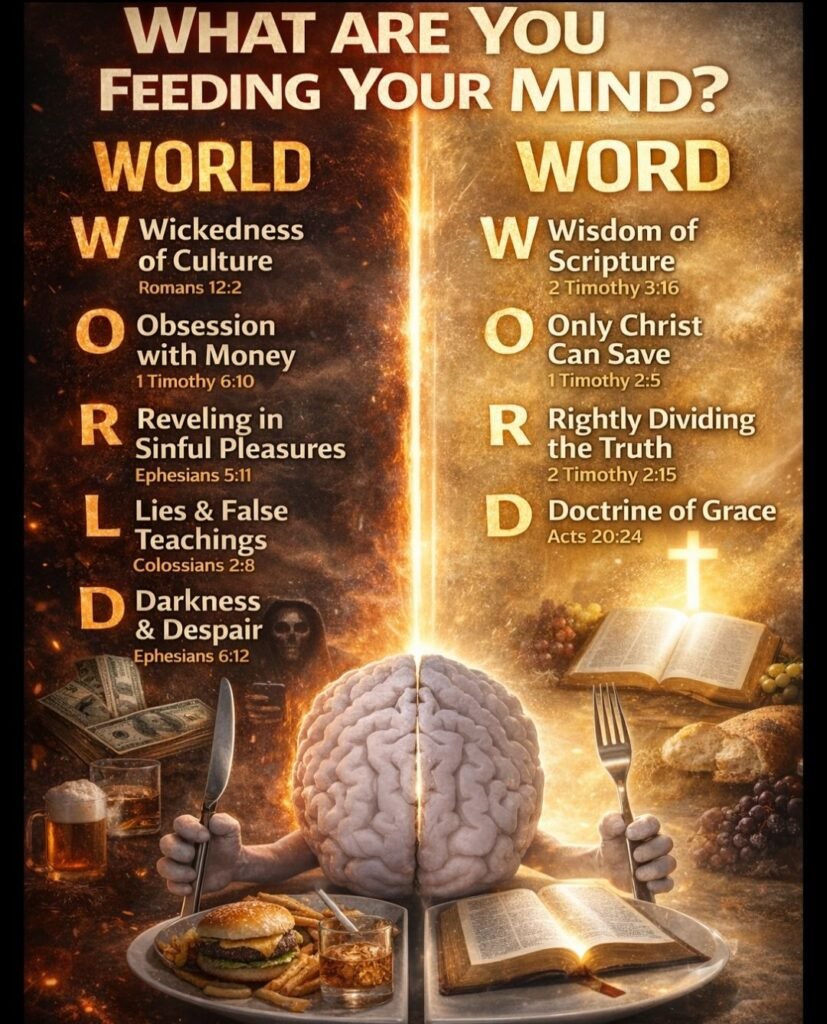
The investigation into worldliness reveals a systematic attempt to compress the believer into a specific, godless mold. Romans 12:2 issues a forensic warning: “And be not conformed to this world: but be ye transformed by the renewing of your mind.” The term “conformed” suggests an external pressure, a wicked culture that seeks to dictate ungodly values through a process of environmental osmosis. This cultural shaping is not accidental; it is a calculated strategy of the “god of this world” to blind the minds of men. These worldly patterns, as identified in Galatians 1:4, are designed to oppose “grace thinking” by tethering the soul to the “present evil world.” When the mind feeds on these patterns, priorities inevitably become warped. The investigative data shows that temporal concerns begin to outweigh eternal realities. 2 Corinthians 4:18 reminds the researcher that “the things which are seen are temporal; but the things which are not seen are eternal.” A mind saturated in worldliness loses its ability to distinguish between a passing shadow and a permanent substance.
The obsession with riches serves as a secondary pollutant in the mental diet of the natural man. In 1 Timothy 6:10, the investigative record is clear: “For the love of money is the root of all evil: which while some coveted after, they have erred from the faith, and pierced themselves through with many sorrows.” Feeding the mind on the pursuit of wealth fuels covetousness rather than the contentment that Paul identifies as “great gain.” This overvaluation of currency leads to a frantic pace where the individual attempts to outrun godliness in favor of material gain. 1 Timothy 6:5 describes those of “corrupt minds” who suppose that “gain is godliness.” This mental inversion suggests that spiritual success is measured by bank balances, a theory that the Pauline doctrine thoroughly repudiates. The consequence of this obsession is the eventual overthrow of faith. The mind becomes so cluttered with the logistical demands of Mammon that it can no longer process the simple sufficiency of the finished work of Christ.
Further investigation into the anatomy of mental decay highlights the danger of reveling in sin. Darkness grows in the soul precisely where discernment has been starved of light. Ephesians 5:11 commands, “And have no fellowship with the unfruitful works of darkness, but rather reprove them.” However, the carnal mind often finds itself rejoicing in iniquity rather than in the truth, as cautioned in 1 Corinthians 13:6. This rejoicing is not merely an action but a mental state where the boundaries of morality are blurred by constant exposure to depravity. When the mind consumes sin as entertainment or a casual curiosity, it begins reproducing darkness in the form of “unfruitful works.” The final stage of this revelry is the resistance of reproof. 1 Timothy 4:2 describes a conscience “seared with a hot iron.” This is the clinical death of discernment; the mind has become so habituated to the forbidden that it can no longer feel the sting of the Spirit’s conviction.
The investigative researcher must also account for the intellectual traps set by lies and false learning. Worldly wisdom often presents itself as sophisticated philosophy, yet Colossians 2:8 warns: “Beware lest any man spoil you through philosophy and vain deceit, after the tradition of men, after the rudiments of the world, and not after Christ.” These “luring philosophies” compete directly with revealed truth. A particularly insidious form of false learning is the mixing of Law and Grace. Galatians 5:4 describes those who are “fallen from grace” because they seek to be justified by the law. This law-mixing error corrupts the mental clarity of the believer, replacing the peace of the Gospel with the anxiety of performance. The investigation suggests that even a small amount of this leavened doctrine spreads quickly through the mental faculty. Galatians 5:9 notes that “a little leaven leaveneth the whole lump.” Once the mind accepts a legalistic premise, the entire structure of grace is compromised.
Darkness, by its very nature, deceives the observer into believing they are walking in safety when they are in fact on the precipice of a fall. Ephesians 6:12 identifies the true combatants in this theater: “For we wrestle not against flesh and blood, but against principalities, against powers, against the rulers of the darkness of this world, against spiritual wickedness in high places.” The battlefield is mental before it is ever moral. These deceptive powers aim to dull the believer’s discernment, resulting in “unstable minds” that are “tossed to and fro, and carried about with every wind of doctrine,” as documented in Ephesians 4:14. A mind that feeds on the darkness of human opinion and demonic deception inevitably leads to a defeated walk. The believer loses the ability to “stand fast” in one spirit, as encouraged in Philippians 1:27. This mental instability is the primary reason for the fractured testimony of many modern assemblies.
Turning to the restorative phase of our investigation, we find that the Word of God wisely nourishes the mind in ways no human philosophy can replicate. 2 Timothy 3:16 serves as the primary dietary guideline: “All scripture is given by inspiration of God, and is profitable for doctrine, for reproof, for correction, for instruction in righteousness.” The Word builds what the world breaks. It provides a divine wisdom that instructs the believer in the mechanics of heavenly living. This process is often described as the “washing of the mind.” Ephesians 5:26 speaks of the “washing of water by the word,” a phrase that implies a sanctification of the thought life. As the mind is rinsed of worldly pollutants, it becomes a well-equipped instrument. The ultimate goal of this nourishment is found in 2 Timothy 3:17: “That the man of God may be perfect, thoroughly furnished unto all good works.” A mind fed on Scripture is a mind prepared for the specific utility of the Master.
Central to the mental diet of the Body of Christ is the realization that only Christ saves and sustains. 1 Timothy 2:5 clarifies the focus of our meditation: “For there is one God, and one mediator between God and men, the man Christ Jesus.” Grace teaching centers the mind on Christ alone, preventing the soul from wandering into the weeds of self-effort or legalism. The objective Gospel—the death, burial, and resurrection of Christ as outlined in 1 Corinthians 15:1-4—must be the staple of our mental consumption. When the believer feeds on the finished work of the cross, they move out of the exhausting cycle of self-effort and into the rest of grace. Galatians 2:16 provides the legal basis for this: “Knowing that a man is not justified by the works of the law, but by the faith of Jesus Christ.” A mind that is occupied with the sufficiency of Christ has no appetite for the crumbs of human merit.
The investigation identifies “Rightly Dividing” as the essential digestive enzyme for spiritual nutrition. 2 Timothy 2:15 commands: “Study to shew thyself approved unto God, a workman that needeth not to be ashamed, rightly dividing the word of truth.” Confusion in the mind of the believer often fades when truth is divided correctly into its proper dispensational categories. Many mental conflicts arise from trying to apply Israel’s law to the Body of Christ’s grace. By recognizing God’s progressive dealings and the distinct “fellowship of the mystery” revealed to Paul (Ephesians 3:9), the believer can reject these contradictions. Romans 6:14 simplifies the mental load: “For sin shall not have dominion over you: for ye are not under the law, but under grace.” Resting in Pauline doctrine provides the believer with their specific “marching orders.” Romans 16:25 links the “stablishing” of the believer to “the revelation of the mystery.” Without right division, the mental diet is a confused mixture that leads to spiritual indigestion.
Finally, the doctrine of grace must dominate the mental landscape if the believer is to achieve a stable and powerful walk. Acts 20:24 records Paul’s commitment to “testify the gospel of the grace of God.” This message is not merely a starting point for salvation but a daily edification for the mind. Acts 20:32 confirms that the “word of his grace… is able to build you up.” Grace-fed minds are stable minds. They understand their distinct calling as members of the Body of Christ, as described in Ephesians 1:22-23. This identity is the anchor of the soul in a world of shifting sand. When the doctrine of grace dominates the mind, it empowers the believer to walk “worthy of the vocation wherewith ye are called” (Ephesians 4:1). The investigation concludes that a mind dominated by grace is a mind that is functionally immune to the bait of the adversary and the pressures of the world.
The synthesis of this investigation reveals that the human mind cannot remain neutral. It is a biological and spiritual processor that is constantly being influenced by what it consumes. If the mind is not filled with the truth of the Word, it will inevitably be filled with the trash of the world. Colossians 3:16 provides the prescriptive solution: “Let the word of Christ dwell in you richly in all wisdom.” The forensic principle is simple: what you feed grows, and what you starve dies. If a believer feeds their carnal nature through worldly media, ungodly philosophy, and material obsession, that nature will grow in dominance. If they starve the flesh and feed the “new man” on the “sincere milk of the word” and the “strong meat” of Pauline doctrine, the spiritual life will flourish.
The call to action for the reader is one of urgent mental reform. The investigative findings suggest that a passive mind is a vulnerable mind. You must stop feeding on the world—this requires a conscious effort to limit exposure to the corrosive elements of wicked culture and worldly priorities. Simultaneously, you must start feeding on the Word. This is more than a casual reading; it is a systematic study and meditation on the truth. Renew your mind daily through the “washing of water by the word.” Stand fast in the liberty of grace, refusing to be entangled again with the yoke of bondage (Galatians 5:1). Share Paul’s gospel boldly, as the clarity of your own mind becomes a beacon for those still trapped in the darkness of the world’s system.
In our final thoughts, we observe that the world distorts the image of God and the nature of man. Riches distract the heart from its true treasure. Sin deceives by offering a pleasure that is fleeting and a consequence that is permanent. Lies corrupt the intellectual foundation of the faith, and darkness blinds the eyes to the light of the glorious Gospel. However, Scripture renews. Christ saves. Right division clarifies. Grace stabilizes. The Choice is daily and the consequences are eternal. “Stand fast therefore in the liberty wherewith Christ hath made us free, and be not entangled again with the yoke of bondage” (Galatians 5:1). The health of your soul depends entirely on what you choose to put on your plate.
The investigative record of the Pauline epistles offers a comprehensive roadmap for mental transformation. It is not enough to simply “try harder”; one must “think better.” This better thinking is only possible when the mind is submitted to the authoritative Word of God. The researcher finds that believers who prioritize the “Word” diet consistently report higher levels of peace, fruitfulness, and stability. Those who continue to snack on the “World” diet remain in a state of spiritual malnutrition, susceptible to every wind of doctrine and every trap of the flesh. The forensic evidence is conclusive: you are what you think, and you think what you eat.
As we close this report, we reflect on the sufficiency of the Word of Christ. It is a complete nutrient for the soul. It addresses the past through the cross, the present through the indwelling Spirit, and the future through the blessed hope of Christ’s return. There is no lack in the Word, just as there is no light in the world. Feed wisely, feed richly, and feed on the truth. Your mind is the most valuable territory you possess; guard it with the Word of God and the power of His grace.