
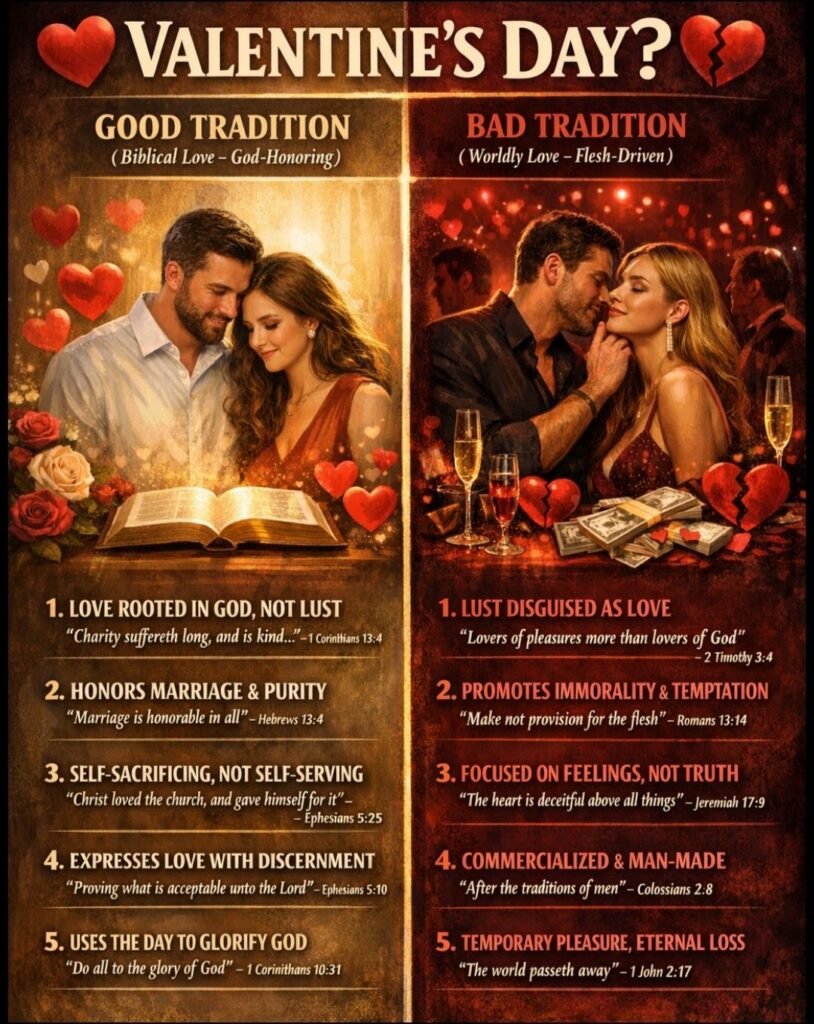
VALENTINE’S DAY: LOVE UNDER GRACE OR LUST UNDER THE FLESH?
Each February, Valentine’s Day arrives with predictable certainty, carrying with it an avalanche of red packaging, romantic symbolism, and cultural expectations about love. What is less predictable is how Christians should respond to it. For some believers, the day is dismissed outright as worldly or pagan. For others, it is embraced uncritically as a harmless celebration of affection. Still others participate with unease, sensing a tension between cultural enthusiasm and biblical restraint.
That tension exists because not every tradition is sinful—and not every celebration is spiritual. Scripture does not offer a direct command regarding Valentine’s Day, nor does it issue a prohibition. Instead, it places the responsibility on the believer’s conscience, shaped by doctrine, discernment, and grace.
The apostle Paul articulated this principle clearly when addressing disputes over observances:
“One man esteemeth one day above another: another esteemeth every day alike. Let every man be fully persuaded in his own mind.”
— Romans 14:5 (KJV)
This statement establishes neither endorsement nor condemnation of special days. Rather, it establishes accountability. In the dispensation of grace, believers are not commanded to keep days, but they are commanded to walk wisely, love biblically, and glorify God in all things. Valentine’s Day therefore becomes a revealing test—not of tradition, but of theology.
At the heart of the discussion lies a more fundamental question: how is love defined? Modern culture speaks incessantly about love, yet rarely pauses to define it. In contemporary usage, love is often reduced to emotion, attraction, passion, or personal fulfillment. It is celebrated as authenticity when followed and labeled repression when restrained. Scripture, however, presents a markedly different definition.
Biblical love—translated as “charity” in the King James Bible—is defined not by feeling but by character. In 1 Corinthians 13, Paul describes love as patient, kind, humble, disciplined, truth-loving, and enduring. It does not seek its own advantage, nor does it rejoice in wrongdoing. This definition is notably absent of passion, chemistry, or self-expression. Instead, it emphasizes restraint, endurance, and moral integrity.
This distinction matters because Valentine’s Day is largely built upon emotional expression. The danger is not affection itself, but affection untethered from truth. Scripture consistently grounds love not in emotion, but in sacrifice. Romans 5:8 identifies the definitive demonstration of love not as a feeling, but as an act: Christ’s death for sinners. Love, in biblical terms, is proven by what it is willing to give up—not by what it seeks to experience.
Moreover, biblical love is portrayed as a conscious decision rather than a spontaneous reaction. Paul instructs believers to “put on charity” in Colossians 3:14, language that implies intentional choice and moral discipline. Love is something practiced, governed by renewed thinking, not something passively experienced.
This biblical framework stands in sharp contrast to how love is portrayed in the modern world. Cultural narratives increasingly redefine love as pleasure and passion. Desire is treated as self-validating, restraint as unnecessary, and boundaries as outdated. Scripture anticipated this shift, warning of a time when people would become lovers of pleasure more than lovers of God. In such an environment, lust is frequently disguised as romance, and fleshly desire is marketed as authenticity.
The elevation of feeling above truth is another hallmark of worldly love. Popular culture encourages people to follow their hearts, yet Scripture warns that the heart is deceitful and unreliable when divorced from truth. When emotion becomes the ultimate authority, discernment collapses. Valentine’s Day often amplifies this problem by encouraging impulsive expression without moral evaluation.
At the center of this distortion is self-love. Modern romantic narratives frequently ask how relationships fulfill personal desires rather than how they cultivate responsibility, faithfulness, and service. Scripture identifies this self-centered orientation as a defining feature of moral decline, describing people as lovers of themselves. Love becomes transactional rather than sacrificial, and intimacy is detached from covenant.
Grace-age doctrine provides a corrective to these distortions. Grace is often misunderstood as permissiveness, but Scripture presents it as instruction. Titus 2 teaches that grace trains believers to deny ungodliness and worldly lusts while living soberly and righteously in the present age. Grace does not relax moral clarity—it sharpens it.
Discernment, therefore, is essential. Believers are instructed to evaluate what pleases God, to walk carefully rather than carelessly. This applies directly to cultural celebrations. Valentine’s Day may be permissible for some believers, but grace demands that participation be examined in light of motive, influence, and outcome. The question is not merely, “Is this allowed?” but “Is this wise?”
Dispensational clarity further sharpens the issue. Under grace, believers are not under law. They are not bound to religious calendars or holy days. Paul explicitly instructs Christians not to be judged regarding observances. Valentine’s Day carries no divine mandate. It does not confer spiritual value, nor does abstention confer righteousness.
Yet liberty is not license. Galatians 5 warns against using freedom as an opportunity for the flesh. Christian liberty exists to enable godly living, not to excuse indulgence. Colossians affirms that believers are complete in Christ; fulfillment is not found in traditions, romance, or celebration, but in union with Him.
These principles become particularly important when considering dating and marriage. Scripture honors marriage as the God-ordained context for sexual intimacy, declaring it honorable and protected. Valentine’s Day often promotes intimacy detached from commitment, reinforcing cultural norms that Scripture does not support.
The New Testament also emphasizes the governance of the mind. Philippians 4 instructs believers to dwell on what is pure and commendable. Romantic imagery and expectations, if unrestrained, can undermine this discipline. Love under grace begins internally, shaped by thought before it is expressed in action.
Marriage itself is presented as a reflection of Christ’s relationship with the church. Husbands are instructed to love sacrificially, as Christ loved the church and gave Himself for it. This model prioritizes responsibility, leadership, and self-giving rather than emotional gratification. Any expression of love that departs from this model—even if culturally celebrated—falls short of biblical love.
Another defining feature of Valentine’s Day is its commercialization. The modern celebration is heavily driven by economic incentives, promoting the idea that love must be demonstrated through spending. Scripture warns against the manipulation of desire for profit, cautioning that people can be made merchandise through covetousness. When affection is measured by gifts rather than character, sincerity is replaced by performance.
Materialism also distorts priorities. The love of money, Scripture warns, produces moral erosion. When financial expenditure becomes the metric of devotion, relationships are pressured to meet artificial standards. The result is often dissatisfaction rather than fulfillment.
Scripture contrasts this with the temporary nature of worldly pleasure. The desires celebrated by culture pass away, while love grounded in truth endures. Commercialized affection offers momentary excitement but little lasting substance.
For believers, the Christian walk is not seasonal. Scripture calls believers to walk in love, walk in light, and walk in wisdom every day. Faithfulness is not heightened by holidays nor suspended by them. Valentine’s Day may come and go, but the call to live wisely remains constant.
Romans 14 provides a final and crucial framework. Each believer will give account of himself to God. Convictions regarding participation must be personal, informed, and sincere. At the same time, believers are instructed to pursue peace and avoid causing others to stumble. Actions are to be done unto the Lord, not unto tradition or pressure.
Ultimately, grace-age love is destiny-focused. It looks beyond temporary thrill toward eternal value. It seeks to edify rather than exploit, to build rather than consume, to glorify God rather than gratify self. Scripture reminds believers that while not all things are expedient, love seeks what is beneficial for others. In all things, God is to be glorified.
Valentine’s Day, then, is neither commanded nor condemned. Its meaning is determined entirely by how—and why—it is observed. Under grace, love must be Christ-centered, guided by truth, and oriented toward God’s glory.
In a culture increasingly confused about love, the Christian responsibility remains clear. Love begins with God. Lust imitates love but destroys truth. Grace teaches restraint. Right division removes confusion. Marriage reflects Christ. Commercialized affection fades. Wisdom governs daily conduct. Conscience answers to God. Eternal love outlasts every holiday.
As Scripture concludes its defining statement on love:
“And now abideth faith, hope, charity, these three; but the greatest of these is charity.”
— 1 Corinthians 13:13 (KJV)
That standard—not sentiment, not culture, not commerce—remains the measure of love under grace.
DEFINITION OF TRUE LOVE – Biblical love is defined by God, not culture.
Charity Defined — God’s love, not emotion 1 Corinthians 13:4–7
Christ Displayed — Love proven by sacrifice Romans 5:8
Choice Directed — Love is a decision, not a feeling Colossians 3:14
DISTORTION OF WORLDLY LOVE – The world redefines love as pleasure and passion.
Lust Disguised — Flesh called “romance” 2 Timothy 3:4
Loss of Truth — Feelings over faith Jeremiah 17:9
Love of Self — Self-gratification exalted 2 Timothy 3:2
DISCERNMENT UNDER GRACE – Grace teaches discernment—not indulgence.
Grace Instructs — Teaches holy living Titus 2:11–12
Grace Discerns — Approves what pleases God Ephesians 5:10
Grace Directs — Walk circumspectly Ephesians 5:15
DISTINCTION OF DISPENSATION – We are not under law, but under grace.
No Holy Days Commanded — Liberty in Christ Colossians 2:16
No Flesh License Given — Freedom is not sin Galatians 5:13
No Legal Bondage — Christ is our sufficiency Colossians 2:10
DIRECTION FOR DATING & MARRIAGE – Love under grace honors purity and commitment.
Marriage Honored — God-ordained union Hebrews 13:4
Mind Governed — Purity begins in thought Philippians 4:8
Model Provided — Christ and the Church Ephesians 5:25
DANGER OF COMMERCIALIZED LOVE – When love is bought, truth is lost.
Merchandised Affection — Love reduced to gifts 2 Peter 2:3
Money Motivation — Profit replaces purity 1 Timothy 6:10
Momentary Pleasure — Short-lived satisfaction 1 John 2:17
DISCIPLINE OF THE BELIEVER’S WALK – Believers must walk wisely in every season.
Walk in Love — As Christ loved us Ephesians 5:2
Walk in Light — Avoid darkness Ephesians 5:8
Walk in Wisdom — Redeeming the time Ephesians 5:16
DECISION OF CONSCIENCE – Every believer answers to the Lord—not tradition.
Personal Conviction — Stand before God Romans 14:12
Peaceful Practice — Avoid stumbling others Romans 14:19
Proper Motive — Done unto the Lord Romans 14:6
DESTINY-FOCUSED LOVE – Grace-age love looks beyond the moment.
Eternal Perspective — Not temporary thrill 2 Corinthians 4:18
Edifying Purpose — Builds others up 1 Corinthians 10:23
Exalting Christ — God glorified in all 1 Corinthians 10:31
CALL TO ACTION – Love biblically, Think discerningly, Live graciously
“Let all your things be done with charity.”
— 1 Corinthians 16:14 (KJV)
CONCLUSION
Valentine’s Day is not commanded—nor is it condemned. What matters is how and why it is observed. Under grace, love must be: Christ-centered, Truth-guided, God-glorifying
FINAL THOUGHTS
Love begins with God. Lust imitates love but destroys truth. Grace teaches restraint. Right division removes confusion. Marriage reflects Christ. Commercial love fades. Walk wisely every day. Follow conscience under grace. Eternal love outlasts every holiday
“And now abideth faith, hope, charity, these three; but the greatest of these is charity.”
— 1 Corinthians 13:13 (KJV)
Related posts:
 𝗚𝗢𝗗’𝗦 𝗟𝗢𝗩𝗘 𝘃𝘀. 𝗩𝗔𝗟𝗘𝗡𝗧𝗜𝗡𝗘’𝗦 𝗟𝗢𝗩𝗘𝗟𝗢𝗢𝗞𝗦 𝗖𝗔𝗡 𝗕𝗘 𝗗𝗘𝗖𝗘𝗜𝗩𝗜𝗡𝗚
 𝗟𝗨𝗦𝗧 𝘃𝘀 𝗟𝗢𝗩𝗘
 𝗜𝗡𝗙𝗟𝗨𝗘𝗡𝗖𝗜𝗡𝗚 𝗢𝗧𝗛𝗘𝗥𝗦 𝗧𝗢 𝗛𝗔𝗧𝗘: 𝗧𝗛𝗘 𝗦𝗣𝗜𝗥𝗜𝗧𝗨𝗔𝗟 𝗗𝗔𝗡𝗚𝗘𝗥
 𝗧𝗛𝗘 𝗣𝗥𝗜𝗢𝗥𝗜𝗧𝗬 𝗢𝗙 𝗧𝗛𝗘 𝗛𝗨𝗦𝗕𝗔𝗡𝗗
 𝗪𝗢𝗥𝗞𝗦 𝗢𝗙 𝗧𝗛𝗘 𝗙𝗟𝗘𝗦𝗛 𝘃𝘀 𝗙𝗥𝗨𝗜𝗧𝗦 𝗢𝗙 𝗧𝗛𝗘 𝗦𝗣𝗜𝗥𝗜𝗧
 𝗘𝗡𝗩𝗬: 𝗧𝗛𝗘 𝗦𝗘𝗘𝗗 𝗢𝗙 𝗠𝗨𝗥𝗗𝗘𝗥
 𝗪𝗢𝗥𝗟𝗗𝗟𝗬 𝗖𝗛𝗥𝗜𝗦𝗧𝗜𝗔𝗡 𝘃𝘀. 𝗦𝗣𝗜𝗥𝗜𝗧𝗨𝗔𝗟 𝗖𝗛𝗥𝗜𝗦𝗧𝗜𝗔𝗡
 𝗙𝗔𝗟𝗦𝗘 𝗙𝗥𝗜𝗘𝗡𝗗𝗦: 𝗧𝗛𝗘 𝗗𝗔𝗡𝗚𝗘𝗥 𝗢𝗙 𝗣𝗥𝗘𝗧𝗘𝗡𝗗𝗘𝗗 𝗙𝗘𝗟𝗟𝗢𝗪𝗦𝗛𝗜𝗣
 𝗚𝗨𝗜𝗟𝗧 𝘃𝘀 𝗚𝗥𝗔𝗖𝗘 — 𝗙𝗥𝗢𝗠 𝗖𝗢𝗡𝗗𝗘𝗠𝗡𝗔𝗧𝗜𝗢𝗡 𝗧𝗢 𝗖𝗢𝗠𝗣𝗟𝗘𝗧𝗜𝗢𝗡
 𝗕𝗢𝗦𝗦𝗬 𝗪𝗜𝗙𝗘 𝘃𝘀. 𝗕𝗜𝗕𝗟𝗜𝗖𝗔𝗟𝗟𝗬 𝗕𝗘𝗛𝗔𝗩𝗜𝗡𝗚 𝗪𝗜𝗙𝗘
 𝗧𝗛𝗘 𝗥𝗔𝗣𝗧𝗨𝗥𝗘: 𝗙𝗢𝗥 𝗕𝗘𝗟𝗜𝗘𝗩𝗘𝗥𝗦, 𝗡𝗢𝗧 𝗥𝗘𝗟𝗜𝗚𝗜𝗢𝗡
 𝗪𝗛𝗢 𝗜𝗦 𝗝𝗘𝗦𝗨𝗦?
 𝗚𝗛𝗢𝗦𝗧𝗦 𝗔𝗥𝗘𝗡’𝗧 𝗗𝗘𝗔𝗗 𝗣𝗘𝗢𝗣𝗟𝗘 — 𝗧𝗛𝗘𝗬’𝗥𝗘 𝗗𝗘𝗠𝗢𝗡𝗦
 𝗧𝗛𝗘 𝗣𝗔𝗨𝗟𝗜𝗡𝗘 𝗣𝗔𝗧𝗧𝗘𝗥𝗡 𝗢𝗙 𝗔 𝗚𝗢𝗗𝗟𝗬 𝗛𝗨𝗦𝗕𝗔𝗡𝗗