A meticulous forensic audit of the Pauline corpus establishes that the believer’s existence in the current dispensation is characterized by a state of persistent, high-stakes spiritual engagement. This investigation, grounded in the specialized administrative revelation given to the Apostle Paul, confirms that the theater of operation is not physical but judicial and doctrinal. The tactical baseline for the Christian life is found in Ephesians 6:11: “Put on the whole armour of God, that ye may be able to stand against the wiles of the devil.” In this economy of grace, the adversary does not focus on the manifestation of physical signs or the manipulation of earthly kingdoms, but rather on the corruption of the mind and the subversion of sound doctrine. The investigative record suggests that a failure to distinguish between the various administrations of God results in a warrior who is functionally unarmed. Therefore, the “whole armour” is not a mystical garment to be visualized through meditation, but a comprehensive body of truth—specifically Pauline doctrine—to be apprehended by the intellect and applied by faith.
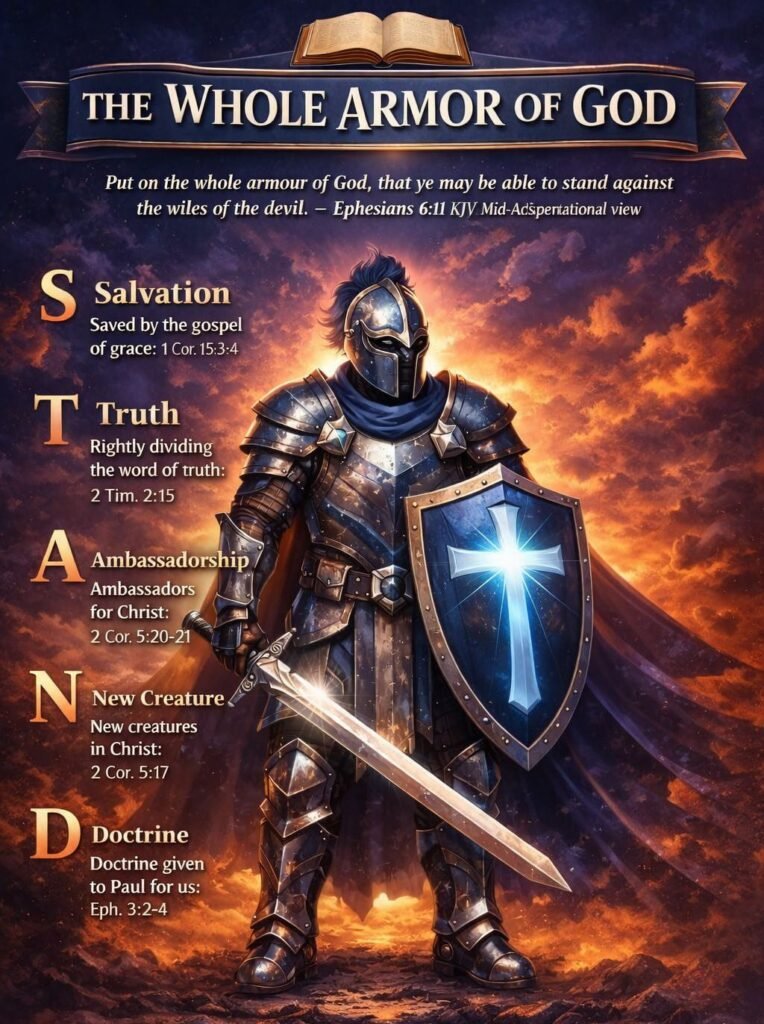
The primary foundational layer of this defensive system is the absolute security of the believer’s salvation. Under the current administration, salvation is not a reward for the diligent but a forensic status granted upon the acceptance of the gospel. 1 Corinthians 15:3–4 defines the core data of this transaction: “how that Christ died for our sins according to the scriptures; And that he was buried, and that he rose again the third day according to the scriptures.” This is a substitutionary work where Christ, who knew no sin, was made to be sin for us, as recorded in 2 Corinthians 5:21. The investigator notes that this armor provides a “Shielded Mind” because it removes the variable of human performance. The sufficiency of the Cross means there is nothing to add and nothing to pay, for the believer is “complete in him” (Colossians 2:10). Furthermore, this salvation includes a permanent seal; Ephesians 1:13 declares that after you believed, “ye were sealed with that holy Spirit of promise.” This sealing provides the standing necessary to fight from a position of victory rather than for a hope of victory. Romans 8:38–39 confirms the durability of this standing, asserting that no external force or height or depth can separate the justified soul from the love of God.
A secondary finding in this doctrinal audit involves the “Belt of Truth,” which the investigator identifies as the systematic practice of rightly dividing the Word. Truth, in the Pauline sense, is not a collection of all biblical texts mashed into a single mandate; it is Scripture understood through the lens of 2 Timothy 2:15: “Study to shew thyself approved unto God, a workman that needeth not to be ashamed, rightly dividing the word of truth.” Without this division, a believer may inadvertently attempt to use armor designed for a different dispensation, such as the Mosaic Law or the kingdom program. Textual accuracy is paramount; the warrior must recognize the words of Paul as the direct commandments of the Lord for the current age (1 Corinthians 14:37). This tactical defense protects the mind from the “tradition of men” and “philosophy and vain deceit” mentioned in Colossians 2:8. The investigative data shows that Satan’s primary lie is to mix grace with works, or to confuse the Body of Christ with the nation of Israel. By anchoring the mind in the timely application of grace, the believer possesses a tactical defense that stops deception at the perimeter of the conscience.
The third pillar of this investigative report analyzes the “Assignment” of the believer, identified in the record as Ambassadorship. 2 Corinthians 5:20 establishes our professional standing: “Now then we are ambassadors for Christ, as though God did beseech you by us: we pray you in Christ’s stead, be ye reconciled to God.” The investigator notes that we are not commissioned to build an earthly kingdom or to reform the political structures of this world. We are foreign representatives of a heavenly government (Ephesians 2:19). This appointment carries a specific authority; the ambassador does not speak his own opinion but delivers the authorized message of the King. This message is the ministry of reconciliation, which emphasizes that God is not imputing trespasses unto men because they were imputed to Christ. This absence from wrath (Romans 5:9–10) is the core of our appeal. The armor in this mission allows the believer to stand firm while proclaiming a message that the world frequently rejects. The investigator finds that the “shoes of the preparation of the gospel of peace” are the ambassador’s mobility, allowing him to navigate a hostile world without losing his footing.
Fourthly, the forensic audit of the Christian warrior identifies the “New Creation” as the essential identity that defines behavior. Satan’s strategy often involves attacking a believer’s sense of identity because if he can make a child of God feel like a slave to sin, he can paralyze their spiritual effectiveness. 2 Corinthians 5:17 provides the definitive ruling: “Therefore if any man be in Christ, he is a new creature: old things are passed away; behold, all things are become new.” This new birth is a creative act of God, not an improvement of the old nature (Ephesians 2:10). The investigator finds that the “Helmet of Salvation” is directly linked to this identity; it protects the head by reminding the warrior that there is “no condemnation to them which are in Christ Jesus” (Romans 8:1). This new nature is nourished by grace and sustained by the reality that “Christ liveth in me” (Galatians 2:20). Because our position is heavenly (Philippians 3:20), we are not of this world, and the armor we wear is designed for the spiritual atmosphere of the “heavenly places” where the true conflict resides.
The fifth and final component of this defense system is the “Doctrine” itself, which acts as the overarching framework for all spiritual resistance. Ephesians 3:2–4 identifies this as the “dispensation of the grace of God” which was revealed to Paul as a “mystery” hidden from previous ages. The investigator finds that doctrine is not an academic pursuit but a life-preserving necessity. Romans 16:25 confirms that the believer is “stablished” according to the preaching of Jesus Christ according to the revelation of the mystery. This mystery doctrine provides stability, ensuring that we are no longer “children, tossed to and fro, and carried about with every wind of doctrine” (Ephesians 4:14). The enemy, as 2 Corinthians 11:3 warns, seeks to “beguile” the mind away from the “simplicity that is in Christ” by introducing a different gospel. Therefore, the daily renewal of the mind through Romans 12:2 is the mechanism by which the armor is maintained and the defense system is kept operational. A mind transformed by truth is a mind that can discern the will of God and the traps of the devil.
The investigative summary concludes that the “Whole Armor of God” is entirely doctrinal and Pauline in its current application. It is not a ritual to be performed or an emotional state to be achieved; it is a body of settled truth to be believed. Ephesians 6:13 emphasizes the objective: “Wherefore take unto you the whole armour of God, that ye may be able to withstand in the evil day, and having done all, to stand.” The investigator notes that the instruction is to “stand,” not to “strive” or to “chase.” Our victory was secured at Calvary; our task is to maintain our position in that victory by refusing to move from the foundation of grace. When a believer is fully armed with salvation, truth, ambassadorship, new creation identity, and sound doctrine, they become a formidable obstacle to the darkness of this world.
A call to action is directed to every workman of the Word. First, prioritize the study of Paul’s epistles, for therein is the specific armor for your generation. Second, practice the art of right division daily, separating that which was for Israel from that which is for the Body of Christ. Third, renew your mind through the intake of grace-centered doctrine, for a mind filled with Law is a mind that is vulnerable to the enemy’s accusations. Fourth, recognize your identity as a New Creation and refuse to let past failures dictate your current standing. Fifth, speak the gospel of grace with the boldness of a heavenly ambassador. The investigator finds that 1 Corinthians 15:58 is the appropriate closing order: “Therefore, my beloved brethren, be ye stedfast, unmoveable, always abounding in the work of the Lord, forasmuch as ye know that your labour is not in vain in the Lord.”
The forensic audit of “Spiritual Standing” (Romans 5:2) reveals that we have “access by faith into this grace wherein we stand.” This standing is the bedrock of the warrior’s confidence. The investigator notes that many “spiritual casualties” occur because believers attempt to fight while standing on the shifting sands of their own feelings or religious traditions. However, the Pauline armor provides shoes that do not slip and a breastplate that cannot be pierced by the arrows of guilt. By resting in the substitutionary death of Christ, the warrior finds that the “breastplate of righteousness” is not his own morality but the very righteousness of God (2 Corinthians 5:21). This provides an impenetrable defense against the “accuser of the brethren,” who seeks to remind the believer of their former sins.
Furthermore, the investigation into “Tactical Defense” indicates that the “Shield of Faith” is uniquely designed to “quench all the fiery darts of the wicked” (Ephesians 6:16). These darts are identified as thoughts of doubt, fear, and condemnation. The investigator concludes that faith is not a feeling of certainty but a volitional trust in the “record” that God has given of His Son. When the enemy whispers that God is angry or that salvation can be lost, the Shield of Faith intercepts these lies with the recorded truth of Romans 8:1 and Ephesians 1:13. The strength of the shield is not in the one holding it, but in the Word of God which serves as its material.
The audit of “Heavenly Citizenship” (Philippians 3:20) shows that the Christian warrior is essentially a “resident alien” on earth. This status determines the rules of engagement. We do not use the carnal weapons of political agitation or physical force. Our warfare is “mighty through God to the pulling down of strongholds; Casting down imaginations, and every high thing that exalteth itself against the knowledge of God” (2 Corinthians 10:4–5). The investigator find that the “strongholds” mentioned here are doctrinal lies and religious systems that keep men in bondage. The armor of God is specifically calibrated to dismantle these intellectual barriers through the clear presentation of the mystery of Christ.
The investigation into “Daily Renewal” (Romans 12:2) highlights that the armor can become “rusty” through neglect of the Word. The Greek terminology suggests a metamorphosis—a complete change of the internal structure of the mind. The investigator notes that a believer who spends more time in the world’s media than in the Pauline epistles will find their “Helmet of Salvation” ill-fitting and their “Sword of the Spirit” dull. To “put on” the armor is a daily cognitive act of reckoning ourselves to be dead indeed unto sin, but alive unto God (Romans 6:11). This reckoning is the tightening of the “Belt of Truth.”
The forensic report concludes that the “evil day” mentioned in Ephesians 6:13 is a reference to the entire present age, which Galatians 1:4 calls “this present evil world.” Therefore, the armor is not for special occasions or occasional crises; it is the permanent uniform of the believer. The investigator find that those who attempt to live the Christian life “in their shirt-sleeves”—without the protection of sound doctrine—quickly fall prey to “the craftiness of men” and “the sleight of hand” of those who lie in wait to deceive. The “whole armour” is required because the attack is comprehensive, targeting the mind, the heart, the feet, and the spirit.
The investigation of “The Sword of the Spirit” (Ephesians 6:17) reveals it as the only offensive weapon in the kit. It is specifically identified as “the word of God.” The investigator notes that in the Greek, this word is rhema, implying the specific, spoken application of Scripture to a situation. Just as Christ countered the adversary with “It is written,” the Pauline warrior counters the lies of the age with the specific truths of the mystery. When the world says “all roads lead to God,” the Sword of the Spirit cuts through with “one Lord, one faith, one baptism” (Ephesians 4:5). When religion says “do to be saved,” the Sword strikes with “by grace are ye saved through faith” (Ephesians 2:8).
Finally, the investigative record on “Prayer” (Ephesians 6:18) identifies it as the communication system that keeps the warrior connected to the Commander. “Praying always with all prayer and supplication in the Spirit” is the method by which the armor is energized. This is not a ritualistic repetition of words, but a constant, Spirit-led communication based on the doctrine in the mind. The investigator concludes that prayer without doctrine is a radio without a signal, and doctrine without prayer is a signal without a radio. Together, they ensure that the Christian warrior remains “more than conquerors through him that loved us” (Romans 8:37).
The summary of the findings is final: The Christian warrior is a doctrinally-centered, grace-oriented ambassador who stands firm in the finished work of Christ. The armor is given, the position is secured, and the victory is certain. “Now unto him that is able to do exceeding abundantly above all that we ask or think, according to the power that worketh in us… Unto him be glory in the church by Christ Jesus throughout all ages, world without end. Amen” (Ephesians 3:20–21). The investigation is closed. Let the warrior stand.