
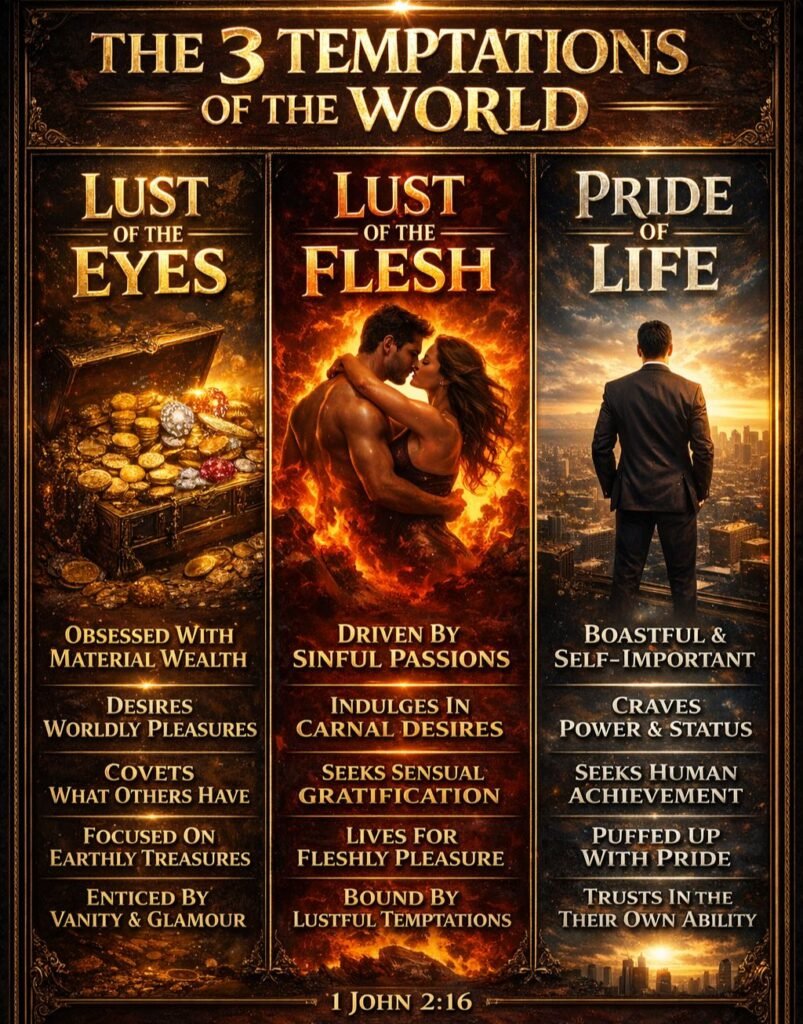
In the hushed corridors of modern consumerism and the digital echo chambers of the twenty-first century, an ancient psychological architecture remains remarkably intact. To the casual observer, the frenetic pace of contemporary life—driven by algorithmic cravings and the relentless pursuit of social validation—appears to be a byproduct of technological acceleration. However, a deeper investigative analysis, grounded in the forensic theological framework provided by the Apostle Paul and the Johannine record, suggests that humanity is currently navigating a sophisticated, three-tiered entrapment system that has remained unchanged since the dawn of human consciousness.
The investigative starting point for understanding this global phenomenon is found in a succinct diagnostic statement recorded nearly two millennia ago: the identification of a world system fueled by the lust of the flesh, the lust of the eyes, and the pride of life. These are not merely moral failings or individual lapses in judgment; they represent the structural integrity of a world system—the kosmos—that operates in a state of perpetual, organized friction against the divine.
To analyze this system, one must first recognize that the “world” is not synonymous with the physical earth or the people inhabiting it. Rather, it is an invisible, strategic arrangement of values, priorities, and desires that seeks to provide an alternative to the sufficiency of God. In the Pauline epistles, this is described as the “course of this world,” a current so pervasive that it requires no effort to follow, only an absence of resistance. It is a system that functions as a closed loop, designed to satisfy appetites it simultaneously works to inflame.
The Biological Impulse: The Lust of the Flesh
The first tier of this system targets the most fundamental aspect of human existence: our biological appetites. The “lust of the flesh” is often misunderstood as being limited to overt sensuality or illicit behavior. In a broader, more investigative sense, it refers to any impulse where the physical body demands to be the ultimate authority. It is the elevation of “feeling” over “fact,” and “appetite” over “altruism.”
The Apostle Paul, writing to the Galatians, provides a stark inventory of these impulses. He does not categorize them as mere biological necessities gone awry, but as a “war” within the human members. The flesh, in this doctrinal context, is the unredeemed humanness that remains susceptible to the gravity of the world system. It is a relentless pull toward self-gratification that promises a peace it can never deliver. The investigative reality of the flesh is that it is never satisfied; it is an economic model based on infinite demand and finite, decaying supply.
In a modern context, this is seen in the commodification of pleasure. Industries are built on the premise that if a desire exists, it must be satiated immediately. This creates a feedback loop where the threshold for satisfaction is constantly raised, leading to a state of spiritual and emotional burnout. Paul’s solution is not a program of self-denial through willpower—which he dismisses as having “no value against the indulgence of the flesh” in his letter to the Colossians—but rather a relocation of the believer’s identity into the Spirit.
The Visual Entrapment: The Lust of the Eyes
If the flesh is the engine of worldly desire, the eyes are the steering wheel. The “lust of the eyes” represents the intellectual and aesthetic component of temptation. It is the internal conviction that what is seen is more real, more valuable, and more necessary than what is unseen. In the Garden of Eden, the failure began when the fruit was perceived as “pleasant to the eyes.” In the temptation of Christ, the enemy displayed “all the kingdoms of the world” in a moment of time, attempting to bypass the cross through the shortcut of visual splendor.
Today, this tier of the world system has been weaponized through the screen. We live in an era of “visual curation,” where the eyes are bombarded with images of curated lifestyles, idealized bodies, and material abundance. This constant stream of visual data is designed to cultivate a sense of “lack.” It is an investigative fact of modern marketing that a consumer must first be made to feel inadequate before they can be sold a solution.
The Johannine warning suggests that the eyes are a gateway. When we look at the world, we are not merely observing objects; we are absorbing a narrative about what constitutes a “good life.” The lust of the eyes convinces the observer that they are the center of the universe and that the world exists to be consumed. Paul counters this visual tyranny by urging believers to “look not at the things which are seen, but at the things which are not seen.” He argues that the visible is temporal—it is literally evaporating—while the invisible is eternal.
The Existential Crisis: The Pride of Life
The final and perhaps most insidious tier is the “pride of life.” If the first two temptations deal with having and feeling, the third deals with being. It is the quest for autonomy, recognition, and self-glory. It is the “narcissism of small differences,” the need to be perceived as superior, more enlightened, or more successful than one’s peers.
The pride of life is the foundational sin of the adversary, who sought to exalt his throne above the stars of God. In human society, it manifests as the construction of personal empires. It is the boasting of one’s accomplishments, the reliance on one’s own intellect, and the refusal to acknowledge a higher authority. The investigative irony of pride is that while it seeks to make the individual “big,” it actually makes them fragile. A life built on the “pride of life” is a life that is one criticism or one failure away from total collapse.
Paul addresses this head-on in his first letter to the Corinthians, asking the piercing question: “What hast thou that thou didst not receive? now if thou didst receive it, why dost thou glory, as if thou hadst not received it?” To the student of Pauline doctrine, the pride of life is a form of intellectual dishonesty. It is a refusal to recognize the contingent nature of human existence.
The Forensic Link: From Eden to the Present
An investigative look at these three temptations reveals a consistent pattern throughout human history. They are the “trinity of evil” that has defined every major civilizational collapse and every individual tragedy.
In the Garden, the woman saw that the tree was “good for food” (Lust of the Flesh), “pleasant to the eyes” (Lust of the Eyes), and “to be desired to make one wise” (Pride of Life). Thousands of years later, when Christ stood in the wilderness, the appeals were identical: “Command these stones to be made bread” (Flesh), “All this power will I give thee… for that is delivered unto me” (Eyes), and “Cast thyself down” to prove divine protection (Pride).
The crucial difference in the wilderness was the response. Where the first Adam succumbed, the Second Adam—the Lord from heaven—met every worldly proposition with the objective truth of Scripture. He did not negotiate with the system; He identified its source and rejected its premise. For the believer living in the Dispensation of Grace, this is the blueprint. We are not called to improve the world system or to “reclaim” its temptations for good; we are called to recognize that the system is structurally incompatible with the life of the Spirit.
The Mechanics of Deception
How does a system so transparently hollow continue to dominate the global consciousness? The answer lies in the investigative reality of spiritual deception. The world does not present itself as an enemy; it presents itself as a benefactor. It offers “freedom” through the indulgence of the flesh, “beauty” through the lust of the eyes, and “purpose” through the pride of life.
However, this “freedom” is actually a form of biological and psychological slavery. Paul writes in Romans that whatever a man yields himself to obey, he becomes a servant of that thing. The man who lives for the lust of the flesh eventually finds that his appetites no longer serve him; he serves his appetites. The woman who lives for the lust of the eyes finds her joy is hostage to the latest trend. The leader who lives for the pride of life finds himself a prisoner to his own reputation.
The prince of this world operates through the “power of the air”—a metaphorical reference to the prevailing cultural atmosphere. He does not need to possess individuals to control them; he only needs to control the environment in which they make their choices. By saturating the culture with these three temptations, he ensures that the natural man will almost always choose the path of least resistance.
The New Nature: A Counter-Cultural Reality
The investigative breakthrough for the believer comes with the realization that the “old man”—the version of ourselves that was hardwired to respond to these temptations—has been dealt with at the Cross. Paul’s doctrine is radical: he does not teach that we should try to suppress the old nature, but that we should reckon it dead.
When a person believes the Gospel of the Grace of God—that Christ died for our sins, was buried, and rose again—they are spiritually “baptized” into Christ. This is not a ritual in water, but a functional placement by the Holy Spirit. The believer is given a new nature that is not of this world. This new nature has no “hook” for the world’s bait. It does not crave the lust of the flesh because it is satisfied by the Spirit. It is not enticed by the lust of the eyes because it has seen the glory of God in the face of Jesus Christ. It cannot be puffed up by the pride of life because it knows that its only boast is in the Cross.
This is the “victory that overcometh the world.” It is not a victory of superior willpower, but a victory of superior satisfaction. The world loses its power not when we fear it, but when we see through it. An investigative journalist looking at the life of a believer standing firm in Pauline truth would see someone who is “in the world, but not of it.” They use the things of this world without “abusing” them—meaning they use them without being used by them.
Guarding the Perimeter: The Role of the Mind
The battleground for these three temptations is the mind. Paul is emphatic: “Be not conformed to this world: but be ye transformed by the renewing of your mind.” The word “conformed” suggests a mold. The world is trying to squeeze every human being into its mold of fleshly desire, visual covetousness, and arrogant self-sufficiency.
Transformation occurs through the intake of “rightly divided” truth. When the mind is saturated with the revelation given to the Body of Christ, the internal “radar” becomes sensitive to worldly deception. The believer begins to see the “lust of the eyes” not as an innocent desire for a new car, but as a strategic attempt to shift their security from Christ to mammon. They see the “pride of life” not as healthy ambition, but as a dangerous exaltation of the self that threatens their dependence on grace.
Vigilance is required because the world system is adaptive. It can clothe itself in religious language, social justice, or traditional values. It can even use “virtue” as a way to feed the pride of life. An investigative approach to one’s own heart reveals that even our “good deeds” can be motivated by a desire for the applause of men (Pride) or a visual display of our own righteousness (Eyes).
The Final Tally: A World in Eclipse
The ultimate investigative conclusion regarding the three temptations of the world is that they are part of a failing enterprise. John writes that “the world passeth away, and the lust thereof.” The Greek word for “passeth away” describes something that is already in the process of disappearing. Like a movie that has ended while the credits are still rolling, the world system is an illusion that has lost its substance.
To invest one’s life in the lust of the flesh, the lust of the eyes, or the pride of life is to buy stock in a company that has already declared bankruptcy. The assets are being liquidated; the end is certain. In contrast, “he that doeth the will of God abideth for ever.”
The Apostle Paul’s final exhortation to the believer is to “set your affection on things above, not on things on the earth.” This is not a call to escapism, but a call to realism. If the world is passing away, the only logical course of action is to tether one’s soul to that which is permanent. The believer’s life is “hid with Christ in God.” From that vantage point, the three temptations of the world lose their luster. They are revealed for what they are: cheap counterfeits of the joy, beauty, and significance that are already ours in Christ.
As we navigate a culture that is increasingly defined by these three pillars of rebellion, the task of the believer is to be a “living epistle.” By walking in the Spirit, we provide the world with the only thing it cannot produce: a human being who is truly free. Free from the tyranny of the body, free from the slavery of the gaze, and free from the burden of the self. This is the triumph of grace over the world.
| Temptation | Target | Modern Manifestation | Biblical Antidote |
| Lust of the Flesh | The Body | Hedonism, addiction, instant gratification. | “Walk in the Spirit” (Galatians 5:16). |
| Lust of the Eyes | The Mind/Desire | Consumerism, envy, social media comparison. | “Set your affection on things above” (Colossians 3:2). |
| Pride of Life | The Ego/Spirit | Narcissism, self-reliance, seeking titles/glory. | “God forbid that I should glory, save in the cross” (Galatians 6:14). |
Related posts:
 𝗧𝗛𝗘 𝗧𝗛𝗥𝗘𝗘 𝗪𝗢𝗥𝗟𝗗𝗟𝗬 𝗟𝗨𝗦𝗧𝗦
 𝗟𝗨𝗦𝗧 𝘃𝘀 𝗟𝗢𝗩𝗘
 𝗚𝗢𝗗 𝗔𝗡𝗗 𝗠𝗔𝗡: 𝗥𝗜𝗚𝗛𝗧𝗟𝗬 𝗗𝗜𝗩𝗜𝗗𝗘𝗗 𝗗𝗘𝗦𝗜𝗚𝗡
 𝗪𝗘 𝗦𝗘𝗘 𝗧𝗛𝗘 𝗪𝗢𝗥𝗟𝗗 𝗧𝗛𝗥𝗢𝗨𝗚𝗛 𝗗𝗜𝗙𝗙𝗘𝗥𝗘𝗡𝗧 𝗟𝗘𝗡𝗦𝗘𝗦
 𝗧𝗛𝗘 𝗧𝗥𝗜𝗖𝗛𝗢𝗧𝗢𝗠𝗬 𝗢𝗙 𝗠𝗔𝗡
 𝗕𝗘𝗪𝗔𝗥𝗘: 𝗦𝗔𝗧𝗔𝗡 𝗕𝗔𝗜𝗧𝗦 𝗛𝗜𝗦 𝗛𝗢𝗢𝗞 𝗪𝗜𝗧𝗛 𝗬𝗢𝗨𝗥 𝗙𝗔𝗩𝗢𝗥𝗜𝗧𝗘 𝗦𝗜𝗡
 𝗧𝗛𝗘 𝗕𝗥𝗔𝗜𝗡 𝗠𝗨𝗦𝗧 𝗕𝗘 𝗪𝗔𝗧𝗘𝗥𝗘𝗗 𝗪𝗜𝗧𝗛 𝗧𝗛𝗘 𝗪𝗢𝗥𝗗 𝗢𝗙 𝗚𝗢𝗗 𝗗𝗔𝗜𝗟𝗬
 𝗧𝗛𝗘 𝟳 𝗕𝗟𝗘𝗦𝗦𝗜𝗡𝗚𝗦 𝗢𝗙 𝗧𝗛𝗘 𝗛𝗢𝗟𝗬 𝗦𝗣𝗜𝗥𝗜𝗧
 𝗪𝗢𝗥𝗞𝗦 𝗢𝗙 𝗧𝗛𝗘 𝗙𝗟𝗘𝗦𝗛 𝘃𝘀 𝗙𝗥𝗨𝗜𝗧𝗦 𝗢𝗙 𝗧𝗛𝗘 𝗦𝗣𝗜𝗥𝗜𝗧
 𝗟𝗜𝗚𝗛𝗧 𝗦𝗛𝗜𝗡𝗘𝗦 𝗜𝗡 𝗧𝗛𝗘 𝗗𝗔𝗥𝗞𝗡𝗘𝗦𝗦
 𝗧𝗛𝗘 𝗛𝗢𝗟𝗬 𝗧𝗥𝗜𝗡𝗜𝗧𝗬
 𝗧𝗛𝗘 𝗥𝗘𝗩𝗘𝗟𝗔𝗧𝗜𝗢𝗡 𝗢𝗙 𝗧𝗛𝗘 𝗧𝗥𝗜𝗡𝗜𝗧𝗬