
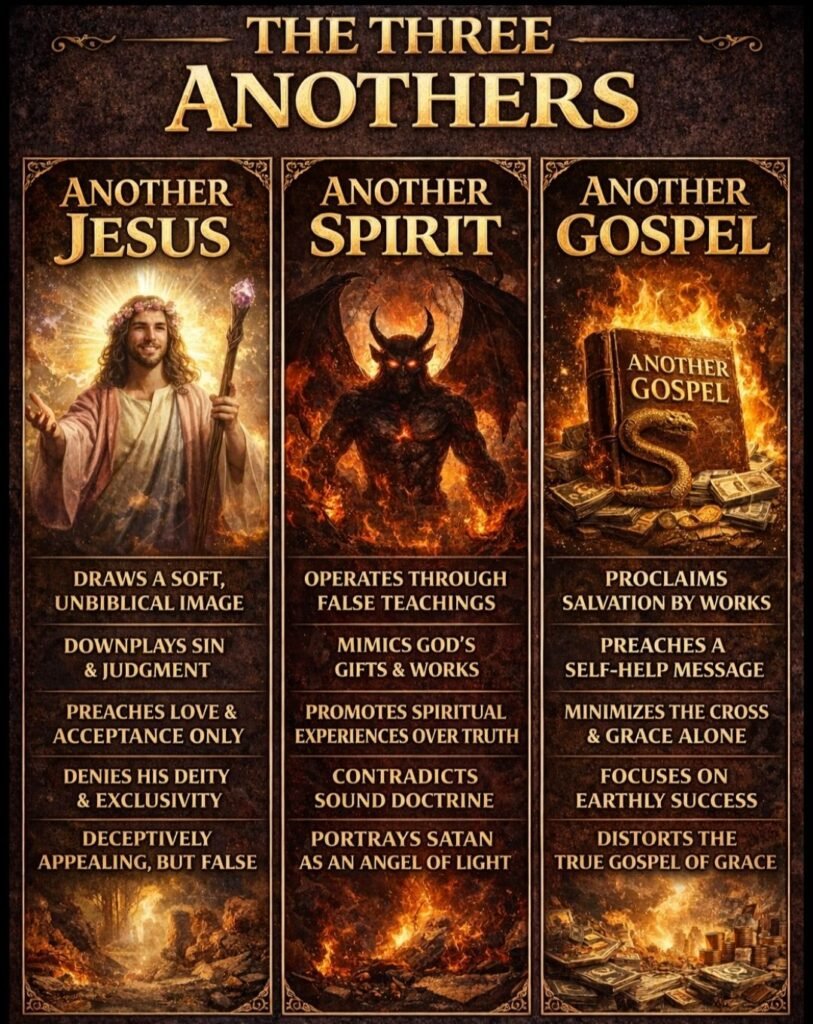
THE THREE “ANOTHERS”
Counterfeits That Corrupt Christ, Confuse Believers, and Condemn the Careless
“But I fear, lest by any means, as the serpent beguiled Eve through his subtilty, so your minds should be corrupted from the simplicity that is in Christ.”
— 2 Corinthians 11:3 (KJV)
Introduction: When the Greatest Threat Looks Spiritual
Christianity has never lacked opposition. From its earliest days, the faith faced persecution, mockery, and outright violence. Yet the Apostle Paul identified a more dangerous threat—one not external, but internal. The greatest danger to the Church, he warned, would not always come from pagan Rome or hostile governments, but from teachings that look Christian, sound spiritual, and use biblical language—while quietly replacing truth with error.
Paul did not warn the Corinthians about atheism. He warned them about substitutes.
In one of the most sobering passages of the New Testament, Paul expressed fear—not anger, not irritation, but fear—that believers could be “corrupted” away from the simplicity that is in Christ. The corruption he described did not involve abandoning Jesus outright, but accepting another Jesus, another spirit, and another gospel (2 Cor. 11:4).
These “three anothers” are not minor theological variations. According to Paul, they carry eternal consequences. They distort Christ, counterfeit spiritual power, and replace saving grace with messages that cannot justify the sinner. They promise life but deliver confusion. They attract crowds but strip the cross of its power.
In every generation, the Church must face an uncomfortable truth: not everything labeled “Christian” is Christ-honoring, and not every message preached from a pulpit leads to salvation.
This article examines the three counterfeits Paul warned about—why they are persuasive, how they operate, and why discernment is not optional but essential for believers living in the present dispensation of grace.
Another Jesus: A Christ Reimagined to Please Men
The first counterfeit Paul identifies is not an attack on Jesus’ name, but a redefinition of His person. “Another Jesus” is not an obvious impostor. He uses the same vocabulary, appears compassionate, and is often presented as loving and inclusive. Yet this Jesus lacks the power to save because he is not the Jesus of Scripture.
A Personality Without Power
Modern presentations of Jesus increasingly emphasize personality over authority. He is portrayed as gentle but never righteous, accepting but never confronting, affirming but never correcting. In this reimagined version, Jesus becomes a therapeutic figure whose primary role is emotional comfort rather than spiritual redemption.
This “soft” Jesus avoids uncomfortable truths—sin, judgment, repentance, and wrath. He is celebrated as tolerant but stripped of holiness. While compassion is magnified, truth is minimized. The result is a Christ who makes people feel better about themselves without ever dealing with the sin that separates them from God.
Paul warned the Corinthians that receiving “another Jesus” was not harmless spiritual diversity—it was a departure from saving truth (2 Cor. 11:4). A Jesus who never addresses sin cannot deliver sinners. A Jesus who never judges cannot justify. A Jesus who never confronts pride cannot save the lost.
Preaching Without Propitiation
One of the clearest indicators of another Jesus is the treatment of the cross. In many contemporary messages, Calvary is reduced to a symbol of love rather than the place of payment. Blood atonement is uncomfortable, substitutionary death is dismissed as outdated, and divine wrath is reframed as metaphorical.
Scripture, however, is unambiguous. Christ was set forth as a propitiation—a wrath-satisfying sacrifice—through faith in His blood (Rom. 3:25). Remove propitiation, and the cross loses its saving power. Replace substitution with sentiment, and the gospel becomes inspiration rather than redemption.
A Jesus who did not die for sins cannot forgive sins. Compassion alone cannot cancel guilt. Without the shedding of blood, there is no remission (Heb. 9:22).
A Person Without Preeminence
Another Jesus is often presented as admirable but not authoritative, spiritual but not supreme. His deity is questioned, His exclusivity rejected, and His lordship diluted. He becomes one voice among many rather than the head of all things.
Paul insisted that Christ must have the preeminence (Col. 1:18). To deny His uniqueness is to dethrone Him. To suggest that Jesus is merely one path among many is not tolerance—it is theological rebellion.
A Christ who does not reign cannot redeem. A Jesus reduced to a moral teacher cannot reconcile sinners to God.
Another Spirit: Power Detached from Truth
The second counterfeit Paul exposes involves spiritual experience. “Another spirit” does not deny supernatural power—it claims it. Yet the source and purpose of that power are misaligned with Scripture.
Power Without Purity
In an age obsessed with experience, spiritual authenticity is often measured by sensation rather than Scripture. Emotional highs, physical manifestations, and dramatic encounters are equated with divine approval, even when doctrine is absent or distorted.
John warned believers to test the spirits, not embrace every supernatural claim (1 John 4:1). The Holy Spirit never contradicts the Word He inspired. Any power that bypasses biblical truth, minimizes doctrine, or elevates experience above revelation is suspect—regardless of how impressive it appears.
True spiritual power produces holiness, clarity, and submission to Christ—not confusion, excess, or doctrinal instability.
Producing Without Proof
Paul acknowledged that false spiritual power can look convincing. Satan himself masquerades as an angel of light (2 Cor. 11:14). Counterfeit spirituality often imitates God’s work while quietly replacing His truth.
Signs alone are never proof of divine origin. Scripture—not sensation—is the standard. When spiritual claims are disconnected from sound doctrine, the result is deception disguised as revival.
The Spirit of God leads believers into truth, not away from it. He magnifies Christ, not personalities. He confirms Scripture, not substitutes for it.
Promotion Without Protection
Another spirit often draws believers away from Pauline revelation, redirecting focus toward legalism, mysticism, or experiential elitism. The result is confusion, insecurity, and spiritual bondage rather than liberty.
Paul issued a severe warning: even if an angel from heaven preaches a different message, let him be accursed (Gal. 1:8). Spiritual authenticity is not proven by intensity but by fidelity to the gospel committed to Paul for the Church.
Another Gospel: A Message That Cannot Save
The third and most dangerous counterfeit is “another gospel.” Unlike obvious heresy, this message often includes biblical language, moral instruction, and religious activity—yet fails to save because it alters the terms of salvation.
Proclamation Without Payment
Another gospel often replaces grace with effort. Faith is supplemented with obedience, rituals, perseverance, or performance. Salvation becomes a process rather than a finished work.
Paul dismantled this error decisively: salvation is by grace through faith, not of works (Eph. 2:8–9). Any message that adds human contribution to Christ’s finished work nullifies grace and robs the cross of its sufficiency.
A gospel that demands payment from the sinner denies the payment Christ already made.
A Program Without Pardon
Many modern religious systems function as self-improvement programs. They promise better marriages, financial success, emotional healing, or personal fulfillment—while avoiding the uncomfortable realities of sin, judgment, and redemption.
Paul described the message of the cross as foolishness to the world (1 Cor. 1:18). When the gospel is reshaped to appeal to human ambition, it ceases to confront the human condition. Without pardon, there is no peace with God.
Perversion Without Peace
Perhaps the most tragic counterfeit gospel is one that removes assurance. By denying eternal security, it replaces faith with fear and rest with anxiety. Believers are left unsure of their standing, constantly striving to maintain salvation through performance.
Paul reminded the Corinthians that the gospel by which they were saved is the message they must stand in (1 Cor. 15:1–4). Salvation that can be lost is not good news—it is perpetual probation.
True grace produces confidence, not terror. The gospel secures, it does not threaten.
Conclusion: Why Discernment Is No Longer Optional
The danger of the three “anothers” is not that they reject Christianity outright, but that they imitate it closely enough to deceive the careless. Another Jesus looks compassionate. Another spirit feels powerful. Another gospel sounds practical. Yet none can save, sanctify, or justify.
Paul’s solution was not retreat, silence, or tolerance—but discernment. Believers are commanded to rightly divide the word of truth (2 Tim. 2:15), to stand fast in liberty (Gal. 5:1), and to refuse any substitute that diminishes Christ’s finished work.
The issue is not preference. It is truth.
Call to Action
The Church must recover courage—not to chase trends, but to guard truth.
Reject counterfeits.
Refuse experience over Scripture.
Return to Pauline clarity.
Believe the gospel of grace.
Stand in liberty.
Hold sound doctrine.
“Stand fast therefore in the liberty wherewith Christ hath made us free.”
— Galatians 5:1 (KJV)
Final Thoughts
Another Jesus cannot save.
Another spirit cannot sanctify.
Another gospel cannot justify.
There is one Christ, one Spirit, and one gospel that saves to the uttermost.
One cross.
One gospel.
One faith.
Preach Christ—not counterfeits.
— Romans 16:25
Related posts:
 𝗙𝗔𝗟𝗦𝗘 𝗙𝗥𝗜𝗘𝗡𝗗𝗦: 𝗧𝗛𝗘 𝗗𝗔𝗡𝗚𝗘𝗥 𝗢𝗙 𝗣𝗥𝗘𝗧𝗘𝗡𝗗𝗘𝗗 𝗙𝗘𝗟𝗟𝗢𝗪𝗦𝗛𝗜𝗣
 𝗚𝗢𝗗 𝗔𝗡𝗗 𝗠𝗔𝗡: 𝗥𝗜𝗚𝗛𝗧𝗟𝗬 𝗗𝗜𝗩𝗜𝗗𝗘𝗗 𝗗𝗘𝗦𝗜𝗚𝗡
 𝗜𝗡𝗙𝗟𝗨𝗘𝗡𝗖𝗜𝗡𝗚 𝗢𝗧𝗛𝗘𝗥𝗦 𝗧𝗢 𝗛𝗔𝗧𝗘: 𝗧𝗛𝗘 𝗦𝗣𝗜𝗥𝗜𝗧𝗨𝗔𝗟 𝗗𝗔𝗡𝗚𝗘𝗥
 𝗧𝗛𝗘 𝗨𝗡𝗛𝗢𝗟𝗬 𝗧𝗥𝗜𝗡𝗜𝗧𝗬
 𝗪𝗛𝗢 𝗜𝗦 𝗝𝗘𝗦𝗨𝗦?
 𝗝𝗘𝗦𝗨𝗦 𝗖𝗛𝗥𝗜𝗦𝗧: 𝗧𝗛𝗘 𝗢𝗡𝗟𝗬 𝗥𝗜𝗦𝗘𝗡 𝗥𝗘𝗗𝗘𝗘𝗠𝗘𝗥
 𝗧𝗛𝗘 𝟳 𝗕𝗟𝗘𝗦𝗦𝗜𝗡𝗚𝗦 𝗢𝗙 𝗧𝗛𝗘 𝗛𝗢𝗟𝗬 𝗦𝗣𝗜𝗥𝗜𝗧
 𝗧𝗛𝗘 𝗥𝗔𝗣𝗧𝗨𝗥𝗘: 𝗙𝗢𝗥 𝗕𝗘𝗟𝗜𝗘𝗩𝗘𝗥𝗦, 𝗡𝗢𝗧 𝗥𝗘𝗟𝗜𝗚𝗜𝗢𝗡
 𝗧𝗛𝗘 𝗗𝗢𝗖𝗧𝗥𝗜𝗡𝗘 𝗢𝗙 𝗧𝗛𝗘 𝗧𝗥𝗜𝗡𝗜𝗧𝗬
 𝗪𝗢𝗥𝗟𝗗𝗟𝗬 𝗖𝗛𝗥𝗜𝗦𝗧𝗜𝗔𝗡 𝘃𝘀. 𝗦𝗣𝗜𝗥𝗜𝗧𝗨𝗔𝗟 𝗖𝗛𝗥𝗜𝗦𝗧𝗜𝗔𝗡
 𝗧𝗥𝗨𝗘 𝗦𝗨𝗖𝗖𝗘𝗦𝗦: 𝗪𝗛𝗘𝗡 𝗬𝗢𝗨𝗥 𝗡𝗔𝗠𝗘 𝗜𝗦 𝗪𝗥𝗜𝗧𝗧𝗘𝗡 𝗜𝗡 𝗛𝗘𝗔𝗩𝗘𝗡
 𝗧𝗛𝗘 𝗕𝗥𝗔𝗜𝗡 𝗠𝗨𝗦𝗧 𝗕𝗘 𝗪𝗔𝗧𝗘𝗥𝗘𝗗 𝗪𝗜𝗧𝗛 𝗧𝗛𝗘 𝗪𝗢𝗥𝗗 𝗢𝗙 𝗚𝗢𝗗 𝗗𝗔𝗜𝗟𝗬
 𝗪𝗢𝗥𝗞𝗦 𝗢𝗙 𝗧𝗛𝗘 𝗙𝗟𝗘𝗦𝗛 𝘃𝘀 𝗙𝗥𝗨𝗜𝗧𝗦 𝗢𝗙 𝗧𝗛𝗘 𝗦𝗣𝗜𝗥𝗜𝗧
 𝗧𝗛𝗘 𝗧𝗥𝗜𝗖𝗛𝗢𝗧𝗢𝗠𝗬 𝗢𝗙 𝗠𝗔𝗡