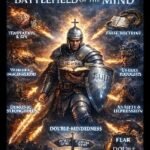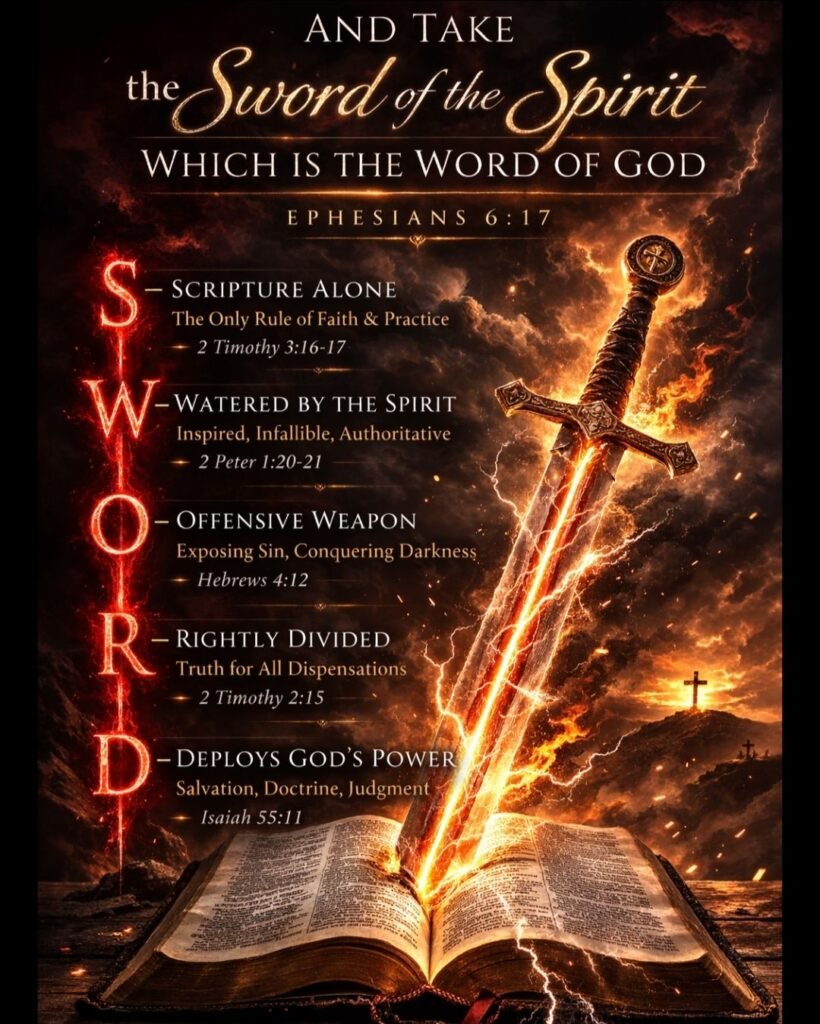
A forensic examination of the spiritual theater described in the Pauline corpus identifies a singular, paradoxical instrument of warfare: a weapon that is simultaneously biological in its living power and judicial in its sharp execution. In the strategic manual provided in Ephesians 6, the investigator notes an exhaustive list of defensive equipment—the girdle, the breastplate, the sandals, the shield, and the helmet—yet the inventory reveals only one offensive implement. This is the “sword of the Spirit, which is the word of God” (Ephesians 6:17). Within the current administration of the Grace of God, the Body of Christ is not mobilized against flesh and blood, nor is it commissioned to utilize the carnal weaponry of political persuasion or physical force. Rather, the professional audit of 2 Corinthians 10:4 confirms that “the weapons of our warfare are not carnal, but mighty through God to the pulling down of strong holds.” The focal point of this inquiry is the mechanical and spiritual efficacy of the Scripture as the ultimate authority in the believer’s arsenal.
An investigative baseline must be established regarding the source and nature of this instrument. A clinical review of 2 Timothy 3:16 declares that “all scripture is given by inspiration of God.” The Greek term behind “inspiration” suggests a divine exhalation, indicating that the text is not merely a record of human religious experience but is God-breathed in its origin. This supreme authority is not subject to the evolving metrics of human wisdom or the fluctuations of ecclesiastical tradition. The investigative data in 2 Peter 1:21 clarifies the production process: “For the prophecy came not in old time by the will of man: but holy men of God spake as they were moved by the Holy Ghost.” Thus, the Sword is not a human invention but a Spirit-forged reality. It is a settled authority, as Psalm 119:89 records that the Word is “for ever settled in heaven,” providing a fixed point of reference in a world of doctrinal instability.
The sufficiency of this weapon is a critical data point for the professional believer. 2 Timothy 3:17 indicates that the purpose of the inspired Word is “that the man of God may be perfect, throughly furnished unto all good works.” This suggests a total equipment package; the investigator finds no need for supplemental revelation, mystical experiences, or psychological frameworks to complete the believer’s readiness. The Word is superior to the most sophisticated human philosophies, for as 1 Corinthians 1:25 notes, “the foolishness of God is wiser than men.” The authority of the Sword is absolute, serving as the final rule for faith and practice in the present dispensation.
A specialized audit of the Sword’s operation reveals that it is a word wrought by the Spirit, maintaining a perpetual link between the Author and the text. The investigator observes that the Holy Spirit does not work independently of the Word, nor does the Word operate as a dead letter without the Spirit’s illumination. In the Pauline economy, the Spirit that guided the writing (2 Peter 1:20-21) is the same Spirit that witnesses within the believer (Romans 8:16). 1 Thessalonians 2:13 provides the mechanical evidence of this operation, noting that the word of God “effectually worketh also in you that believe.” It is an active, energetic force that penetrates the human psyche to reveal the “deep things of God” (1 Corinthians 2:10).
However, the investigation notes a significant barrier to the entry of this truth: the natural state of the human intellect. 1 Corinthians 2:14 reports that “the natural man receiveth not the things of the Spirit of God: for they are foolishness unto him: neither can he know them, because they are spiritually discerned.” This necessitates a spiritual interface. The Spirit-wrought Word requires a Spirit-led mind. The professional investigator concludes that spiritual growth is not a matter of mere academic accumulation but of spiritual discernment facilitated by the indwelling Teacher.
The investigative report shifts to the offensive capabilities of the Sword against the backdrop of global deception. The Word is uniquely designed to expose sin and defeat the sophisticated “wiles of the devil” (Ephesians 6:11). Hebrews 4:12 provides a clinical description of the Sword’s sharpness: “For the word of God is quick, and powerful, and sharper than any twoedged sword, piercing even to the dividing asunder of soul and spirit, and of the joints and marrow, and is a discerner of the thoughts and intents of the heart.” Unlike a physical blade that strikes the exterior, this spiritual weapon performs an internal forensic surgery, separating truth from error and motive from action.
In the field of doctrinal defense, the Sword is used to “oppose false doctrine” and “convince the gainsayers” (Titus 1:9). The investigation finds that the primary method of spiritual warfare is the confrontation of lies with the specific, documented truth of God. 2 Corinthians 10:5 outlines the tactical objective: “Casting down imaginations, and every high thing that exalteth itself against the knowledge of God, and bringing into captivity every thought to the obedience of Christ.” The Sword does not merely parry attacks; it overthrows the strongholds of human pride and religious error. It is the light that overpowers darkness, fulfilling the promise of John 8:32 that “ye shall know the truth, and the truth shall make you free.”
A pivotal segment of this forensic inquiry involves the “right division” of the Word, a procedural requirement that determines the success or failure of the believer’s combat. 2 Timothy 2:15 commands: “Study to shew thyself approved unto God, a workman that needeth not to be ashamed, rightly dividing the word of truth.” The investigator observes that while all Scripture is for us, not all Scripture is to us or about us in a primary administrative sense. To fail to rightly divide is to attempt to use the Sword with a blunt edge. The professional auditor must distinguish between God’s program for Israel under the Law and His program for the Body of Christ under Grace.
The investigation identifies the “Revelation of the Mystery” as the specific sharpening stone for the Pauline believer. Paul declares in Ephesians 3:2-3 that he was given the “dispensation of the grace of God” and that “by revelation he made known unto me the mystery.” This mystery—the fact that Jew and Gentile are joint-heirs in one body—was “hid in God” during the prophetic ages. Recognizing this distinction is essential for doctrinal clarity. Romans 11:25 warns against being “wise in your own conceits” by ignoring the temporary blindness of Israel. A rightly divided Sword rests in the “gospel of the grace of God” (Acts 20:24) and remains grounded in the foundational data of 1 Corinthians 15:1-4: that Christ died for our sins, was buried, and rose again.
The final phase of this inquiry analyzes how the Word deploys the power of God into the human experience. Romans 1:16 identifies the gospel as “the power of God unto salvation to every one that believeth.” The Word is the delivery system for this power. It acts as a spiritual nutrient, with 1 Peter 2:2 encouraging the believer to “desire the sincere milk of the word, that ye may grow thereby.” As an instrument of direction, it serves as a “lamp unto my feet, and a light unto my path” (Psalm 119:105). The investigator concludes that the Word is not a passive document but a potent agent that accomplishes exactly what the Almighty intends. Isaiah 55:11 confirms this administrative certainty: “So shall my word be that goeth forth out of my mouth: it shall not return unto me void, but it shall accomplish that which I please.”
The summary of these findings indicates that the world’s reliance on politics, human persuasion, and psychological manipulation is an inferior strategy. The believer’s weapon is different in kind and superior in effect. The Sword of the Spirit reveals truth, defeats deception, saves the lost, strengthens the saint, and proclaims the absolute supremacy of Jesus Christ. The professional conclusion is clear: the greatest asset the Body of Christ possesses is the Word of God, specifically when it is rightly divided according to the Pauline revelation.
A call to action is issued to every “workman” in the faith. The evidence demands a commitment to daily study (2 Timothy 2:15). One must believe the gospel with clinical certainty (1 Corinthians 15:1-4) and stand ready to defend the truth against the encroachment of false doctrine (Titus 1:9). In an era of escalating deception, the believer is encouraged to look for the “blessed hope” (Titus 2:13) and to share the Word with professional boldness (2 Timothy 4:2). Take up the Sword—not with hesitation, but with the confidence that it is the very breath of God.
The final thoughts of this investigation reiterate that the believer without the Word is effectively unarmed in a lethal conflict. Conversely, the believer who wields the Word with dispensational precision is positioned for perpetual victory. The Scripture is the supreme authority, the Spirit-wrought truth, the offensive weapon against error, and the deployment of God’s own power. It is the living, breathing, cutting edge of the New Creation. Stand fast, therefore, having the Sword in hand and the Truth in heart.
The investigation further notes that the “Word of God” is not merely the written text, but is ultimately personified in the Lord Jesus Christ. However, in our present dispensation, the written Word is the only objective access we have to the mind of Christ. 1 Corinthians 2:16 asks, “who hath known the mind of the Lord?” and answers, “But we have the mind of Christ.” This mind is codified in the Pauline epistles. To ignore the epistles is to ignore the tactical orders of our commanding officer. The professional investigator finds that a high “Scriptural IQ” is directly correlated with a high “Spiritual Victory” rate.
The clinical audit also highlights the “preservation” of the Word as a key factor in its authority. If the Sword had been corrupted through the centuries, its judicial edge would be lost. But the investigator relies on the promise of Psalm 12:6-7: “The words of the LORD are pure words… Thou shalt keep them, O LORD, thou shalt preserve them from this generation for ever.” This forensic certainty allows the believer to trust the King James Bible as a reliable and sharp instrument for the 21st-century spiritual conflict.
Furthermore, the investigation into the “conscience” adds another layer to the Word’s efficacy. In Titus 1:15, Paul speaks of those whose “mind and conscience is defiled.” The Word of God acts as a purifying agent for the conscience. By aligning human thought with divine truth, the defilement of legalism and worldliness is washed away. The investigator concludes that a “Word-saturated” conscience is the primary defense against the “seared” conscience described in 1 Timothy 4:2. The power of the Word is thus the power of mental and moral restoration.
The geopolitical and dispensational implications of the Word are also significant. In the current “dispensation of the mystery,” the Word of God is the great equalizer. It is not limited to a single nation or ethnic group. Colossians 3:11 declares that in this new man, “there is neither Greek nor Jew… Barbarian, Scythian, bond nor free: but Christ is all, and in all.” The Sword of the Spirit cuts through the “middle wall of partition” (Ephesians 2:14), offering a universal authority to a global body of believers. The investigator finds that the Word is the only truly international law in the spiritual realm.
The investigation also touches upon the “victory over the spirit of the age.” 1 John 4:4 reminds us, “Greater is he that is in you, than he that is in the world.” This “He” operates through the “Word of truth” (2 Corinthians 6:7). The investigator notes that the spirit of the age is characterized by “relativism” and “subjectivism,” where truth is whatever the individual feels. The Sword of the Spirit shatters this subjectivity by providing “objective truth.” It is not “my truth” or “your truth,” but “the truth.” This objective reality is the only firm ground upon which a believer can stand in a collapsing culture.
The final summary of this forensic audit reiterates that the Sword of the Spirit is the indispensable tool for the Body of Christ. It is the authority that settles all disputes, the spirit that empowers all growth, the weapon that defeats all lies, and the power that achieves all divine purposes. The investigator observes that to neglect the Word is to voluntarily surrender to the enemy. But to take up the Sword is to join the ranks of the “more than conquerors” (Romans 8:37).
As the forensic report closes, it reminds the reader that the Word of God is “living and active” (Hebrews 4:12). It is not a museum piece or a historical artifact. It is a sharp, contemporary, and lethal weapon. Ensure your grip on the Sword is firm, your understanding is rightly divided, and your heart is fully submitted to its authority. The investigation is finished, but the battle continues. Take the Sword.
The call to the ministry of the Word remains the highest calling of the present age. We are not called to entertain, to social-work, or to philosophize. We are called to “preach the word; be instant in season, out of season; reprove, rebuke, exhort with all longsuffering and doctrine” (2 Timothy 4:2). The investigator concludes that the only remedy for a dying world is the life-giving Word. The door of grace is open, and the Sword is in the hand of the church.
The investigative findings are complete. The record stands as a testimony to the supreme authority, the Spirit-wrought nature, the offensive power, and the dispensational clarity of the Word of God. The believer is equipped with a perfect weapon for an imperfect world. The Sword reveals truth; the Spirit empowers the blow; the right division ensures the accuracy; and the power of God secures the victory. Stand fast in this truth and wield the Sword with the professional excellence of a child of God.
The investigation observes that the term “Sword of the Spirit” implies a dual ownership. It is the Spirit’s sword, but we are commanded to “take” it. This indicates a cooperative engagement. The Spirit provides the power, but the believer provide the hand and the will. The investigator finds that this “taking” is done through the discipline of study and the submission of faith. When the believer speaks the Word, the Spirit strikes the blow. It is the ultimate synergy of the heavenly and the earthly.
Finally, the forensic audit notes that the Sword provides the basis for the believer’s “hope.” Romans 15:4 explains that “whatsoever things were written aforetime were written for our learning, that we through patience and comfort of the scriptures might have hope.” This hope is not a wish; it is a clinical certainty based on the documented promises of God. The investigator concludes that the believer’s emotional stability is directly tied to their Scriptural foundation. The Sword that fights the enemy also comforts the soul.
The report is closed. The truth is established. The Sword is sharp. The grace is sufficient. Trust the Word and live in the power of the Spirit. “For the word of God is not bound” (2 Timothy 2:9). The forensic record is sealed by the Spirit, and the believer is complete in the knowledge of the Truth.