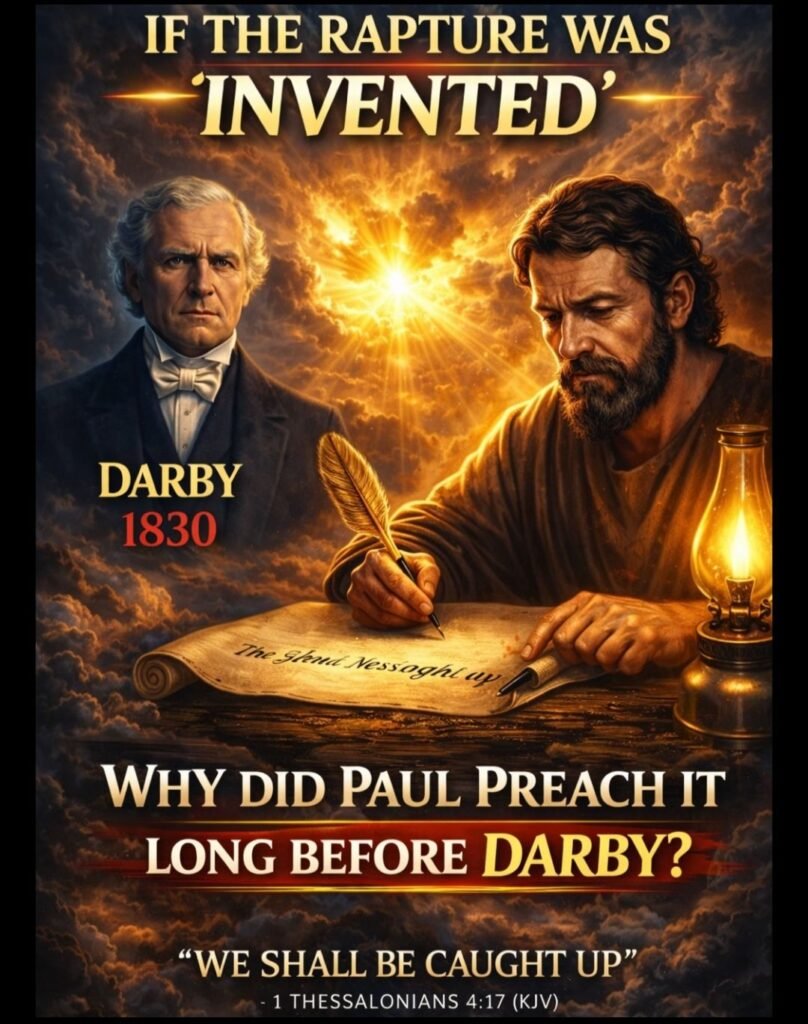
To investigate the origins of the snatching away of believers, one must navigate a dense thicket of historical skepticism and theological accusation. For over a century, a persistent narrative has circulated within academic and ecclesiastical circles suggesting that the concept of the Rapture was a nineteenth-century fabrication, an ideological novelty birthed in the mind of John Nelson Darby and disseminated through the Plymouth Brethren. This claim, however, rests upon a fundamental category error that confuses the systematic popularization of a doctrine with its actual inception. When the historical record is subjected to a forensic examination of the primary source documents—specifically the Koine Greek manuscripts of the first century—a different reality emerges. The doctrine was not a Victorian invention; it was a Pauline revelation. The Apostle Paul, writing nearly eighteen hundred years before Darby, detailed a specific, cataclysmic event that functioned as a centerpiece of the “mystery” truth entrusted to him. By analyzing the structural mechanics of the Pauline epistles, it becomes clear that the “catching away” was an integral component of the dispensation of grace, designed specifically for the Body of Christ and distinct from any previously recorded prophetic program.
The premise that Darby invented the Rapture relies on the silence of church history, yet silence is not an absence of truth; it is often merely a lack of emphasis. To find the source, one must bypass the medieval commentators and the Reformers, moving directly to the foundational correspondence of the early church. In 1 Thessalonians 4:15, Paul introduces his discourse with a claim of direct authority: “For this we say unto you by the word of the Lord.” This is the first investigative marker. Paul is not speculating or drawing from existing Jewish traditions of a conquering Messiah. He is heralding a specific promise. He uses the term harpazo—translated as “caught up”—to describe a sudden, forceful removal of living believers from the terrestrial plane to a celestial meeting. This was not a vague hope of a general resurrection at the end of time, but a personal expectation for those he addressed as “we which are alive and remain.” Paul did not treat this as a distant possibility but as a pressing reality of the apostolic age, placing himself within the cohort of those who might experience this transformation without ever passing through the gates of physical death.
The investigative trail leads next to the nature of the revelation itself. In Galatians 1:11–12, Paul explicitly denies that his doctrine was filtered through human tradition or apostolic consensus in Jerusalem. He asserts that he received his message by “the revelation of Jesus Christ.” This private briefing from the ascended Lord is what sets Pauline doctrine apart from the synoptic accounts of the kingdom. While the disciples in the four Gospels were focused on an earthly kingdom and the fulfillment of Old Testament prophecy, Paul was being introduced to a “mystery” that had been “kept secret since the world began.” The Rapture fits perfectly within this framework of mystery truth. It was a detail hidden from the prophets and even from the twelve apostles during Christ’s earthly ministry. If a doctrine is hidden in the mind of God and then revealed to a specific steward, it cannot be characterized as an invention of a later teacher. Darby did not create the Rapture any more than Columbus created the Americas; he simply encountered what had already been mapped by Paul.
The principle of the “mystery” is central to the investigative conclusion that the Rapture is a distinct Pauline truth. In 1 Corinthians 15:51, Paul writes, “Behold, I shew you a mystery; We shall not all sleep, but we shall all be changed.” In the biblical lexicon, a mystery is not something difficult to understand, but something previously unrevealed. If the Rapture were merely a part of the established Second Coming prophecy, Paul could not have labeled it a mystery. The Old Testament is replete with descriptions of the Day of the Lord, the return of the Messiah to the Mount of Olives, and the judgment of the nations. However, it contains no mention of a meeting in the air or a momentary transformation of the living. By defining this event as a mystery, Paul distinguishes it from the public, visible return of Christ to the earth. This distinction provides the forensic evidence that the Rapture is a unique procedural event, one that was absent from the prophetic timeline until the dispensation of grace was committed to the Apostle to the Gentiles.
Further investigation reveals that the intended audience of this event is as specific as the event itself. The Rapture is not a general human experience, nor is it the final chapter of Israel’s national history. It is a doctrine for the Body of Christ. Paul emphasizes in 1 Corinthians 12:13 that believers are baptized into one body by the Spirit, a concept that was non-existent under the Law of Moses. This Body of Christ has a heavenly calling and a heavenly citizenship. Unlike Israel, which was promised a land, a throne, and a kingdom on earth, the Body of Christ is promised a position in “heavenly places.” Consequently, the removal of this Body from the earth is a functional necessity of its design. The people involved are those who have trusted the Pauline gospel—the message of Christ’s death, burial, and resurrection as a completed work of grace. Because the Church is a “new creature” with no part in the Old Testament covenants, its exit strategy is naturally different from the restoration of the Davidic monarchy.
The placement of this event relative to the “wrath to come” serves as a vital piece of evidence in the investigative puzzle. In 1 Thessalonians 1:10, Paul describes believers as those who “wait for his Son from heaven… which delivered us from the wrath to come.” The internal logic of Pauline doctrine suggests a deliverance that is not merely spiritual or metaphorical, but physical and preventative. In 1 Thessalonians 5:9, he reinforces this: “For God hath not appointed us to wrath, but to obtain salvation by our Lord Jesus Christ.” If the Church were to endure the global judgments described in the Apocalypse, Paul’s words would be misleading. The removal of the Body before the onset of the Day of the Lord is a prerequisite for the integrity of the dispensation of grace. The Rapture acts as a jurisdictional boundary; once the ambassadors are withdrawn, the period of diplomatic grace ends, and the legal judgments of the prophetic program resume.
The procedure of the Rapture further separates it from the public return of Christ. Paul describes the event as occurring “in a moment, in the twinkling of an eye” (1 Corinthians 15:52). This is a sudden, secret transformation. It is not characterized by the slow, visible descent of Christ to the earth where “every eye shall see him.” Instead, it is a meeting in the clouds, a private rendezvous between the Head and the Body. In this procedure, Christ comes for His saints to bring them to His Father’s house, rather than coming with His saints to establish a kingdom. This sudden disappearance of the Church would explain the shift in the global stage as the “restrainer” mentioned in 2 Thessalonians 2 is taken out of the way, allowing the man of sin to be revealed. The mechanics of the Rapture are designed for speed and selectivity, emphasizing the distinct nature of the Church’s departure.
The purpose of the “catching away” is the completion of the Body of Christ. In Ephesians 1:22–23, the Church is defined as “the fulness of him that filleth all in all.” There is a specific number of believers that constitutes the fullness of the Gentiles, after which the current dispensation must conclude. The Rapture serves as the closing bracket for this era. Once the Body is complete, it is translated to its heavenly position, allowing the focus of divine dealings to shift back to Israel. This structural continuity is found in Romans 11:25–26, where Paul explains that “blindness in part is happened to Israel, until the fulness of the Gentiles be come in. And so all Israel shall be saved.” The Rapture is the mechanism that facilitates this transition, moving the Church from the earthly theater so that the “Deliverer shall come out of Sion.” Without the Rapture, the programs of Israel and the Church would overlap in a way that creates theological static; with it, the “rightly divided” design remains intact.
The emotional resonance of the doctrine provides a final, subjective proof. Paul concludes his primary discourse on the subject by instructing believers to “comfort one another with these words” (1 Thessalonians 4:18). This is an investigative anomaly if the Rapture were merely a part of the terrifying Day of the Lord. Prophetic judgment, characterized by fire, darkness, and wrath, is never presented as a source of comfort for a grieving soul. However, the promise of a sudden reunion with Christ and the resurrection of loved ones who have “fallen asleep” is a message of supreme hope. This “blessed hope” (Titus 2:13) is what sustained the early believers through Roman persecution. It was not the hope of surviving the Antichrist, but the hope of seeing the Savior. The tone of Pauline teaching is consistently one of confidence and courage, predicated on the reality that the believer’s destination is not the grave or the tribulation, but the presence of the Lord.
Ultimately, the historical record shows that John Nelson Darby did not invent the Rapture; he publicized what had been penned by Paul. The fact that the doctrine was obscured during centuries of institutional church history does not invalidate its scriptural origin. Truth is often buried under the weight of human tradition, but it remains truth nonetheless. In 2 Timothy 2:2, Paul instructed Timothy to commit these things to “faithful men, who shall be able to teach others also.” This chain of transmission was interrupted as the church moved toward a more kingdom-centric, earthly hierarchy, but the words of 1 Thessalonians remained in the canon. Darby’s contribution was the “right division” of the scriptures, which allowed the buried Pauline mystery to be rediscovered and restored to its proper place. The Rapture is not a modern innovation; it is an ancient revelation, a central pillar of the grace program, and the imminent expectation of every believer who recognizes the unique calling of the Body of Christ.
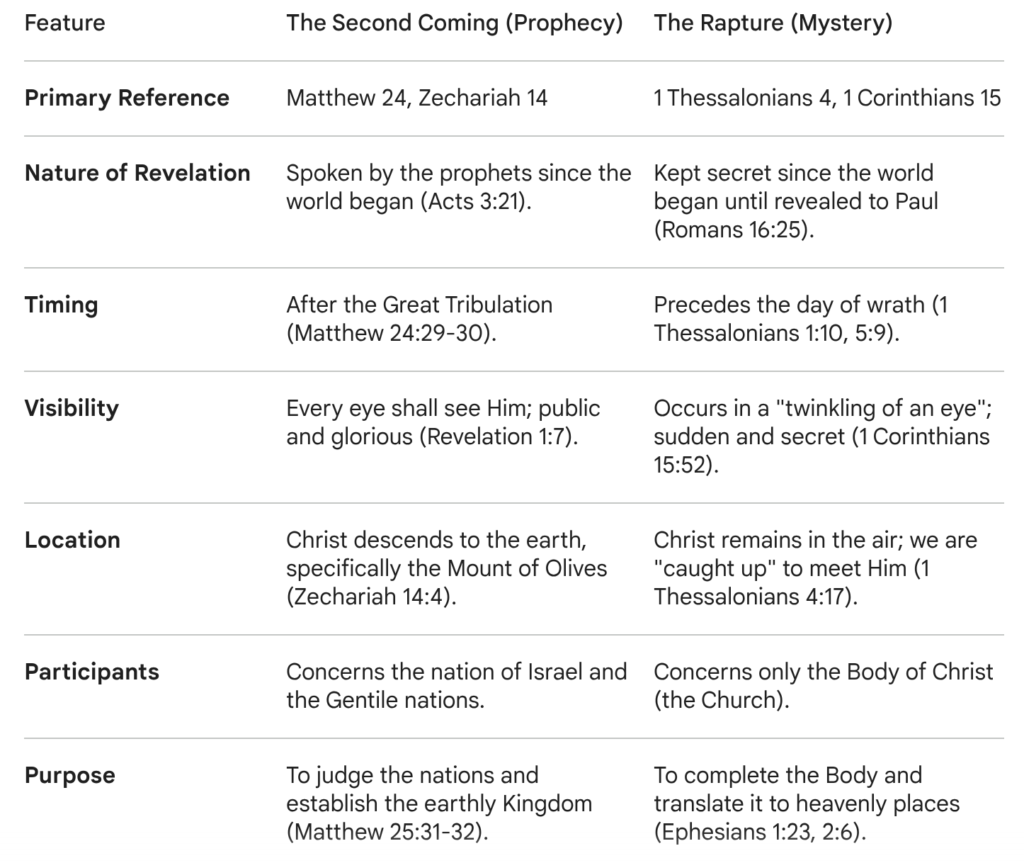
To gain total clarity on why the Rapture is a distinct, Pauline revelation rather than a “later invention,” one must compare the specific details of Christ’s return as described in the prophetic books versus the mystery truth revealed in Paul’s epistles.
The primary investigative challenge is that traditional theology often lumps all “end times” events into a single occurrence. However, when we apply the principle of “right division,” we see two different programs, with two different purposes, for two different groups of people.
The Doctrinal Comparison: Prophecy vs. Mystery
The table below highlights the forensic distinctions that prove the Rapture (the mystery) and the Second Coming (the prophecy) cannot be the same event.
The Mechanistic Distinction: “With” vs. “For”
One of the most profound investigative findings in Paul’s writing is the direction of travel. In the prophetic Second Coming, Christ is coming with His saints who are already in heaven (Jude 1:14) to take over the earth. In the Pauline Rapture, Christ is coming for His saints to take them off the earth.
This distinction is not a minor detail; it is a structural necessity. If the Church is “not appointed to wrath,” it must be removed before the “Day of the Lord” begins. The Day of the Lord is a time of darkness and judgment for an unbelieving world; the Rapture is a “blessed hope” for a believing Body.
Why the Discovery Matters
When critics claim John Nelson Darby invented this in 1830, they are overlooking the fact that Darby was simply the first in centuries to stop mixing the labels. By separating Israel’s earthly destiny from the Church’s heavenly calling, the Rapture becomes the only logical conclusion for how the Dispensation of Grace ends.
If the Body of Christ is a “new creature” not found in the Old Testament, it cannot be found in the Old Testament’s “Time of Jacob’s Trouble” (Jeremiah 30:7). It must have its own exit, which Paul revealed as the “mystery” of the catching away.
Related posts:
 𝗚𝗢𝗗 𝗔𝗡𝗗 𝗠𝗔𝗡: 𝗥𝗜𝗚𝗛𝗧𝗟𝗬 𝗗𝗜𝗩𝗜𝗗𝗘𝗗 𝗗𝗘𝗦𝗜𝗚𝗡
 𝗧𝗛𝗘 𝗕𝗥𝗔𝗜𝗡 𝗠𝗨𝗦𝗧 𝗕𝗘 𝗪𝗔𝗧𝗘𝗥𝗘𝗗 𝗪𝗜𝗧𝗛 𝗧𝗛𝗘 𝗪𝗢𝗥𝗗 𝗢𝗙 𝗚𝗢𝗗 𝗗𝗔𝗜𝗟𝗬
 𝗧𝗛𝗘 𝗗𝗢𝗖𝗧𝗥𝗜𝗡𝗘 𝗢𝗙 𝗧𝗛𝗘 𝗥𝗔𝗣𝗧𝗨𝗥𝗘
 𝗧𝗛𝗘 𝗥𝗔𝗣𝗧𝗨𝗥𝗘: 𝗙𝗢𝗥 𝗕𝗘𝗟𝗜𝗘𝗩𝗘𝗥𝗦, 𝗡𝗢𝗧 𝗥𝗘𝗟𝗜𝗚𝗜𝗢𝗡
 𝗧𝗛𝗘 𝟳 𝗕𝗟𝗘𝗦𝗦𝗜𝗡𝗚𝗦 𝗢𝗙 𝗧𝗛𝗘 𝗛𝗢𝗟𝗬 𝗦𝗣𝗜𝗥𝗜𝗧
 𝗝𝗘𝗦𝗨𝗦 𝗖𝗛𝗥𝗜𝗦𝗧 𝗧𝗛𝗘 𝗠𝗘𝗦𝗦𝗜𝗔𝗛 𝗣𝗥𝗢𝗩𝗘𝗡 𝗪𝗜𝗧𝗛 𝗔𝗕𝗦𝗢𝗟𝗨𝗧𝗘 𝗖𝗘𝗥𝗧𝗔𝗜𝗡𝗧𝗬 𝗕𝗬 𝗗𝗔𝗡𝗜𝗘𝗟 𝟵
 𝗙𝗥𝗢𝗠 𝗣𝗥𝗢𝗣𝗛𝗘𝗖𝗬 𝗧𝗢 𝗠𝗬𝗦𝗧𝗘𝗥𝗬. 𝗧𝗛𝗘 𝗞𝗘𝗬 𝗧𝗢 𝗨𝗡𝗗𝗘𝗥𝗦𝗧𝗔𝗡𝗗𝗜𝗡𝗚 𝗦𝗖𝗥𝗜𝗣𝗧𝗨𝗥𝗘 – 𝗚𝗢𝗗 𝗜𝗦 𝗡𝗢𝗧 𝗧𝗛𝗘 𝗔𝗨𝗧𝗛𝗢𝗥 𝗢𝗙 𝗖𝗢𝗡𝗙𝗨𝗦𝗜𝗢𝗡!