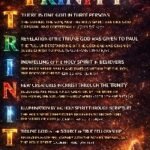
A meticulous forensic audit of the Pauline epistles reveals a structural complexity within the nature of the Almighty that transcends human philosophical categories. While the specific term “Trinity” does not appear within the lexicon of the Authorized Version, the investigative data confirms that the reality of the triune Godhead is an foundational pillar of the current Administration of Grace. In 2 Corinthians 13:14, the Apostle Paul provides a formal benediction that serves as a primary evidentiary exhibit: “The grace of the Lord Jesus Christ, and the love of God, and the communion of the Holy Ghost, be with you all. Amen.” This statement does not merely list titles; it identifies three distinct Persons operating in a unified judicial and redemptive capacity. Under the framework of progressive revelation, the mystery of the Godhead—partially veiled in the Old Testament shadows—has reached full doctrinal clarity through the Pauline revelation. Ephesians 3:5 confirms that this truth is “now revealed unto his holy apostles and prophets by the Spirit.” The investigator finds that the Godhead is not a committee of three gods, nor a single person playing three roles, but one eternal essence existing in three distinct, co-equal Persons.
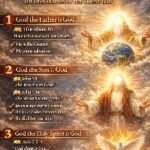
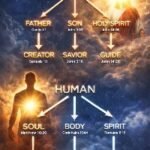
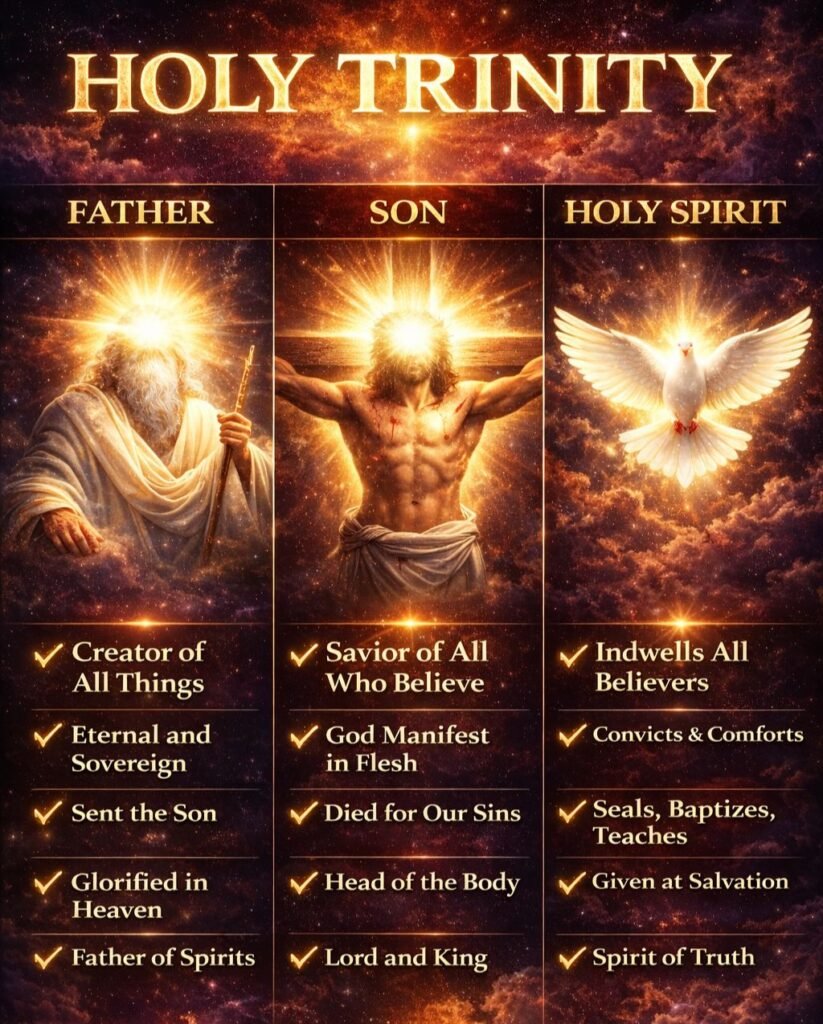
The first category of this investigative report addresses the Sovereign Father, who is identified as the source, planner, and administrative architect of the redemptive program. 1 Corinthians 8:6 establishes the ontological baseline: “But to us there is but one God, the Father, of whom are all things, and we in him.” The forensic record indicates that the Father functions as the Sender in the mission of reconciliation. Galatians 4:4 documents the timing of this mission: “But when the fullness of the time was come, God sent forth his Son, made of a woman, made under the law.” This confirms that the Father possesses the supreme authority to commission the Son for the work of the cross. Furthermore, Ephesians 1:11 attributes the “purpose of him who worketh all things after the counsel of his own will” to the Father. He is the sovereign agent in salvation, having “predestinated us unto the adoption of children by Jesus Christ to himself” (Ephesians 1:5). Romans 8:29–30 further details the Father’s foreknowledge and the sequence of calling, justification, and glorification, proving that the plan of the ages originates within His divine counsel.
The second primary data point in this audit focuses on the Substitute Son, who is God manifest in the flesh to achieve the judicial requirements of redemption. 1 Corinthians 15:3–4 defines the core data of the Gospel: that Christ died for our sins, was buried, and rose again. The investigator finds that the Son’s efficacy as a Savior is rooted in His sinless nature. 2 Corinthians 5:21 provides the legal summary: “For he hath made him to be sin for us, who knew no sin; that we might be made the righteousness of God in him.” As the sacrificial substitute, the Son did not merely offer a tribute; He offered Himself. Romans 5:8 declares, “But God commendeth his love toward us, in that, while we were yet sinners, Christ died for us.” This act was a ransom, a “testimony in due time” (1 Timothy 2:6), which satisfied the righteous demands of the Father’s law. Following the completion of this objective work, the Son is now “seated on the right hand of God” (Colossians 3:1), exercising universal headship over the Body of Christ.
The third area of inquiry involves the Sealing Spirit, the Person of the Godhead responsible for the immediate and permanent application of salvation to the believer. The investigative record in Ephesians 1:13 reveals a specific mechanical process: “In whom ye also trusted, after that ye heard the word of truth, the gospel of your salvation: in whom also after that ye believed, ye were sealed with that holy Spirit of promise.” This seal is not a temporary mark but a judicial guarantee of ownership. Ephesians 4:30 warns the believer not to “grieve the holy Spirit of God, whereby ye are sealed unto the day of redemption.” The Spirit serves as the internal witness, as Romans 8:16 states, “The Spirit itself beareth witness with our spirit, that we are the children of God.” Beyond security, the Spirit supplies the necessary power for the believer’s inner life. Ephesians 3:16 records the Pauline prayer that the believer would be “strengthened with might by his Spirit in the inner man.” The Holy Spirit is thus the administrative agent of the Godhead on earth during this present dispensation.
A critical forensic distinction must be made regarding the separate Persons of the Godhead to avoid the doctrinal error of modalism. The investigator notes that Father, Son, and Spirit are distinct in identity, not merely names for different functions. At the baptism of Christ (Matthew 3:16–17), a clear manifestation of three Persons occurs simultaneously: the Son is in the water, the Spirit descends like a dove, and the Father speaks from heaven. John 14:16–17 provides further verbal evidence from the Son Himself: “And I will pray the Father, and he shall give you another Comforter… even the Spirit of truth.” The use of the word “another” (allos) in the Greek text implies another of the same kind, yet distinct from the Speaker. 1 Corinthians 12:4–6 highlights the distinction in operation: “Now there are diversities of gifts, but the same Spirit. And there are differences of administrations, but the same Lord. And there are diversities of operations, but it is the same God which worketh all in all.” This record proves that while they work in perfect harmony, their roles and identities remain distinct within the unity of the Godhead.
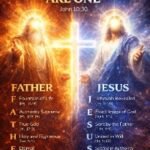
Despite this distinction of Persons, the investigation confirms a Single Godhead, maintaining the monotheistic baseline established in the Old Testament. Deuteronomy 6:4 declares, “The LORD our God is one LORD.” The Pauline revelation does not contradict this but clarifies it. Colossians 2:9 states with clinical precision: “For in him dwelleth all the fullness of the Godhead bodily.” This indicates that the Son is not a partial deity but possesses the entire divine essence. Romans 1:20 notes that the “eternal power and Godhead” are clearly seen through the creation, pointing to a singular divine nature. John 10:30 records the Son’s claim to essential unity: “I and my Father are one.” This unity is not merely a unity of purpose but a unity of essence. Ephesians 1:17 refers to “the God of our Lord Jesus Christ, the Father of glory,” showing that even in the distinct relationship between Father and Son, there is a singular revealed glory that defines the Almighty.
The sixth category of this audit explores the Saving Harmony of the Trinity. The investigation finds that salvation is a cooperative effort of the entire Godhead. Titus 3:5–6 provides a summary of this triune involvement: “Not by works of righteousness which we have done, but according to his mercy he saved us, by the washing of regeneration, and renewing of the Holy Ghost; Which he shed on us abundantly through Jesus Christ our Saviour.” Here, the Father (the “He” who saves), the Spirit (the agent of renewal), and the Son (the channel of the shedding) work as a single unit. Ephesians 1:3–14 provides a chronological breakdown: the Father planned salvation before the foundation of the world (v. 4), the Son purchased salvation through His blood (v. 7), and the Spirit provides the guarantee by sealing the believer (v. 13). The forensic conclusion is that salvation is a “finished work” because it is backed by the total resources and combined will of the Trinity.
Finally, the investigation addresses the Service Empowered by the Triune God. The believer’s life is not lived in human strength but by the power of the indwelling Godhead. Acts 1:8 establishes the source of this power: “But ye shall receive power, after that the Holy Ghost is come upon you.” Ephesians 5:18 commands the believer to “be filled with the Spirit,” which results in a life of worship and submission. This submission is directed toward the Son, who is the “head of the body, the church” (Colossians 1:18). Ultimately, this life of service is offered to the Father as a “living sacrifice” (Romans 12:1). The believer acts as an “ambassador for Christ” (2 Corinthians 5:20), representing the interests of the heavenly kingdom on earth. The investigator finds that the believer is actually “complete in him” (Colossians 2:10), possessing all the spiritual resources of the Father, Son, and Spirit for every good work.
The summary of this investigative record confirms that the Trinity is not a logical contradiction to be solved, but a divine perfection to be believed. It is one God existing in three Persons, working toward one saving purpose. The Godhead is the source of all grace, the achiever of all redemption, and the sealer of all believers. To deny the Trinity is to dismantle the very mechanism of the Gospel. The investigator concludes that a “rightly divided” understanding of the Word (2 Timothy 2:15) leads inevitably to the recognition of the Father’s love, the Son’s sacrifice, and the Spirit’s presence.
A call to action is issued for the reader to move from theoretical acknowledgment to forensic reliance. Believe the Gospel as defined by the Pauline record (1 Corinthians 15:1–4). Rightly divide the Word to see the distinct operations of the Godhead in this present dispensation. Defend the sound doctrine of the Trinity against the encroachment of modern Unitarianism or modalistic confusion. The clarity of the Godhead is the clarity of your salvation.
The investigation into the “Communion of the Holy Ghost” (2 Corinthians 13:14) reveals that the believer is never alone in the spiritual conflict. The word “communion” (koinonia) implies a shared life and partnership. The investigator notes that the Spirit does not merely visit the believer but inhabits the believer as a “temple of the Holy Ghost” (1 Corinthians 6:19). This indwelling is the bridge between the believer’s earthly experience and the Father’s heavenly throne. Because the Spirit knows the “deep things of God” (1 Corinthians 2:10), He is able to communicate the Father’s love and the Son’s grace directly to the believer’s heart.
Furthermore, the audit of the “Equality of the Godhead” identifies that while there is an administrative order (the Son submits to the Father, the Spirit testifies of the Son), there is no ontological hierarchy. Each Person is fully God. Philippians 2:6 states that Christ Jesus “thought it not robbery to be equal with God.” Likewise, the Holy Spirit is called “the Spirit of God” (Romans 8:9) and “the Spirit of Christ” (Romans 8:9) interchangeably, showing His shared nature with both. The investigator finds that any attempt to demote the Son or the Spirit to a “lesser god” status is a direct violation of the Scriptural data.
The social forensic report on the “Unity of the Spirit” (Ephesians 4:3) indicates that the Trinity is the model for the local assembly. Ephesians 4:4–6 lists the “seven ones” of Christian unity: “There is one body, and one Spirit… One Lord, one faith, one baptism, One God and Father of all.” The investigator notes that the unity of the Body of Christ is rooted in the unity of the Godhead. Just as the Father, Son, and Spirit are one in essence yet distinct in Person, the Church is to be one in purpose while composed of many distinct members. A failure to understand the Trinity often results in a failure to maintain the “unity of the Spirit in the bond of peace.”
The investigation also explores the “Revealed Mystery of Godliness.” 1 Timothy 3:16 declares, “And without controversy great is the mystery of godliness: God was manifest in the flesh, justified in the Spirit, seen of angels, preached unto the Gentiles, believed on in the world, received up into glory.” This investigative find shows the Trinity in action throughout the earthly mission of Christ. The Son (God manifest in the flesh) was vindicated by the Spirit and ultimately returned to the Father in glory. The Trinity is the engine of the entire mystery of godliness.
The forensic audit of “Intercessory Prayer” provides a final practical look at the Trinity. In the Pauline framework, the believer prays to the Father, in the name of the Son (Ephesians 5:20), and by the power of the Spirit (Ephesians 6:18). Romans 8:26–27 notes that the Spirit “maketh intercession for us with groanings which cannot be uttered,” while Romans 8:34 notes that Christ also “maketh intercession for us” at the right hand of God. The investigator finds that the believer is surrounded by divine advocacy, with two Persons of the Godhead actively representing their needs before the third.
The investigation concludes with a summary of the “One Divine Purpose.” From the planning in eternity past to the final reconciliation of all things, the Trinity works in perfect sync. Ephesians 1:10 identifies the goal: “That in the dispensation of the fullness of times he might gather together in one all things in Christ.” The Father’s plan, the Son’s purchase, and the Spirit’s power are all directed toward this ultimate exaltation of the Godhead. The investigator finds that the Trinity is the beginning and the end of all theological inquiry.
The final thoughts of this report emphasize that the Trinity is not an academic puzzle but a relational reality. To know the “love of God” is to know the Father. To know the “grace of the Lord Jesus Christ” is to know the Son. To know the “communion of the Holy Ghost” is to know the Spirit. This Triune God is for us, with us, and in us. The case is closed. The evidence is overwhelming. One God, three Persons, one divine purpose.
The investigator reminds the reader that “God is not the author of confusion” (1 Corinthians 14:33). The complexity of the Trinity does not lead to confusion for the believer who rests in the clear declarations of Scripture. Instead, it leads to a deeper adoration of the “King eternal, immortal, invisible, the only wise God” (1 Timothy 1:17). The Trinity is the cornerstone of a “sound mind” and a “sound faith.” Believe the record, stand in the grace, and walk in the Spirit.
Final Assessment: The Pauline record presents the Trinity as a settled judicial fact. The Father is the Origin, the Son is the Manifestation, and the Spirit is the Application. They are one in nature, one in will, and one in glory. Any deviation from this triune framework results in a distorted Gospel and a compromised salvation. The Body of Christ stands secure because it is held by the hand of the Father, the hand of the Son, and the seal of the Spirit.
The report suggests that the “simplicity that is in Christ” (2 Corinthians 11:3) includes a simple, childlike faith in the Godhead as He has revealed Himself. We do not need to explain the “how” to benefit from the “who.” The Great Eternal God has made Himself known to us through the Lord Jesus Christ. Let this investigation be the foundation for your worship and the anchor for your soul. The Triune God is your God forever and ever. Amen.
The investigation into the “Work of the Godhead” in the current dispensation concludes with the observation that the Trinity is the only source of true “spiritual blessings in heavenly places” (Ephesians 1:3). These blessings are planned by the Father, provided by the Son, and positioned by the Spirit. The believer is invited to “rejoice in the Lord alway” (Philippians 4:4), knowing that the entire Godhead is committed to their eternal welfare. The evidence is final. The verdict is glory.