The Architecture of Cultural Transformation and the War of Narratives
Introduction: The Invisible Battlefield
In the traditional theater of war, victory is measured by territory seized, infrastructure destroyed, and the capitulation of armed forces. However, in the 20th and 21st centuries, a more sophisticated and insidious form of warfare has emerged—one that targets the mind, the spirit, and the cultural fabric of a nation. This is Ideological Subversion.
Ideological subversion is a strategic process by which a society’s foundational beliefs, moral compass, and national identity are systematically undermined. The goal is not to destroy a country through kinetic force, but to transform it from within, leading to a political and cultural shift that favors an external or radical internal interest. While the term gained mainstream notoriety during the Cold War through the chilling testimonies of Soviet defectors like Yuri Bezmenov, its mechanics remain startlingly relevant in an era of social media algorithms, deepfakes, and hyper-polarization.
As Bezmenov famously stated in a 1984 interview:
“The simplest way to explain ideological subversion is to change the perception of reality of every American, to such an extent that despite an abundance of information, no one is able to come to sensible conclusions in the interest of defending themselves, their families, their community, and their country.”
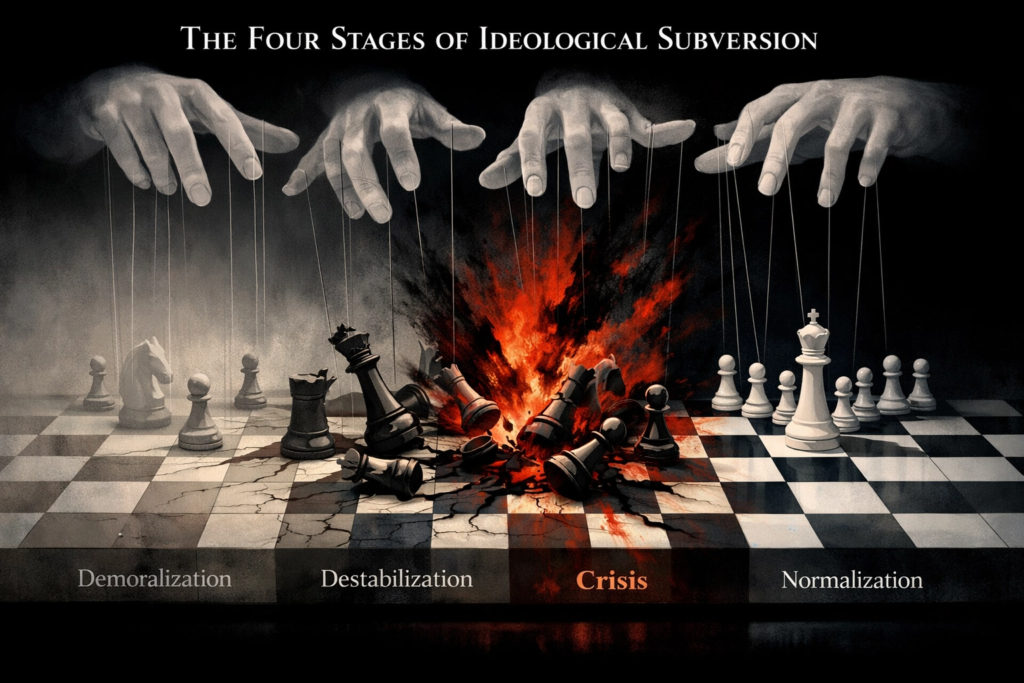
This article explores the four structural pillars of this process—Demoralization, Destabilization, Crisis, and Normalization—analyzing how ideas can be more potent than any weapon of mass destruction.
1. Defining Ideological Subversion
A Historical and Academic Perspective
The concept of winning a war without firing a shot is not a modern invention. In the 5th century BC, Sun Tzu argued in The Art of War that “the supreme art of war is to subdue the enemy without fighting.” Similarly, Niccolò Machiavelli noted in The Prince that a ruler’s power rests as much on the perception of the populace as it does on the strength of his fortresses.
In the modern context, scholars categorize ideological subversion as “non-kinetic warfare” or “active measures” (aktivnyye meropriyatiya). As historian Christopher Andrew detailed in The Sword and the Shield (2000), the KGB and other intelligence agencies during the Cold War spent roughly 85% of their budgets not on James Bond-style espionage, but on “active measures”—disinformation, front organizations, and the psychological grooming of influential figures in the West.
The Mechanism of “Active Measures”
Unlike traditional propaganda, which seeks to sell a specific lie, ideological subversion seeks to destroy the very concept of truth. It operates on the principle that if you can decouple a population from its history, its values, and its logic, the nation will eventually collapse under its own weight.
2. Stage One: Demoralization
The Long Game (15 to 20 Years)
Demoralization is the foundation of subversion. It is the longest phase, typically requiring 15 to 20 years to complete. Why this specific timeframe? Because it is the minimum number of years required to educate one generation of students.
The objective of demoralization is to re-educate a population to perceive reality through a specific ideological lens that is antithetical to their existing social structure. This is achieved by infiltrating the “soft” sectors of society:
- Education: Replacing classical education and objective history with radical social theories and historical revisionism.
- Media: Prioritizing sensationalism, outrage, and partisan narratives over objective reporting.
- Religion and Culture: Undermining traditional moral structures and replacing them with a sense of “moral relativism.”
Methods and Psychological Impact
During this phase, the target population is subjected to a constant barrage of information designed to make them feel ashamed of their heritage. When a nation is demoralized, its citizens lose the ability to distinguish between right and wrong, or even between fact and opinion.
Characteristics of a Demoralized Society:
- Moral Relativism: The belief that no culture or value system is inherently “better” or “truer” than another, leading to a paralysis of national will.
- Loss of Patriotism: National symbols, holidays, and heroes are re-characterized as symbols of oppression or failure.
- Generational Alienation: A profound “values gap” is created between parents and children, ensuring that the cultural wisdom of the past is not passed down.
By the end of this stage, Bezmenov argued, even if you presented a demoralized person with “authentic information, with documents, with pictures,” they would refuse to believe it until the “boot of the soldier” kicks them in the rear.
3. Stage Two: Destabilization
Once the moral and intellectual defenses of a nation have been softened, the subverter moves to Destabilization. If demoralization targets the mind, destabilization targets the systems.
The Structural Attack
This phase is much shorter, usually taking two to five years. The focus shifts from abstract culture to concrete institutions:
- Economy: Fostering policies that lead to hyperinflation, massive debt, or dependence on foreign adversaries.
- Defense and Security: Weakening the military through budget cuts or internal ideological purges, while undermining the legitimacy of local law enforcement.
- Social Fragmentation: Exploiting existing ethnic, religious, or class fault lines. Instead of seeking common ground, “identity politics” are weaponized to ensure that the populace is too busy fighting one another to notice the crumbling of the state.
Case Study: The Weimar Republic
The transition from the 1920s to the 1930s in Germany serves as a haunting historical example. Following the demoralization of WWI defeat, the Weimar Republic entered a period of extreme destabilization. Hyperinflation wiped out the middle class, and political paramilitaries fought in the streets. Because the state’s pillars—economy and security—were destabilized, the population became desperate for any order, no matter how radical.
4. Stage Three: Crisis
The third stage is Crisis. This is the tipping point where the structural integrity of the nation fails. A crisis can be a natural event that is exploited, or it can be a manufactured explosion of the tensions built up during the destabilization phase.
The Tipping Point
A crisis usually lasts only six to eight weeks, but it changes the trajectory of a nation forever. It often manifests as:
- Revolutionary Upheaval: Mass civil unrest or a violent coup.
- Economic Collapse: A sudden market crash that leaves the population unable to secure basic necessities.
- Political Gridlock: A total failure of the government to function, leading to a “power vacuum.”
During a crisis, the psychological state of the population shifts from confusion to terror and desperation. When people are afraid for their lives and their livelihoods, they stop caring about “abstract” concepts like freedom of speech or constitutional checks and balances. They begin to scream for a “strongman” or a “new system” to restore order at any cost.
5. Stage Four: Normalization
The final stage is Normalization. This term is a grim piece of Orwellian doublespeak. It does not mean a return to the “old normal”; it means the acceptance of a new reality—usually a more authoritarian one.
The New Status Quo
Normalization occurs when the “liberators” or the radical actors who capitalized on the crisis take permanent control. The chaos of the crisis stage is forcibly ended, often through the suppression of the very radicals who helped start the subversion (as they are no longer useful and now pose a threat to the new regime).
Characteristics of Normalization:
- Institutional Consolidation: The media, the courts, and the schools are fully aligned with the new state ideology.
- Restriction of Liberties: Emergency powers granted during the crisis become permanent features of the law.
- Historical Erasure: The past is rewritten to justify the present. As Winston Churchill noted, “A nation that forgets its past has no future.” In the normalization stage, the past is not forgotten; it is systematically deleted or altered.
Bezmenov pointed to the Soviet invasion of Czechoslovakia in 1968. After the “Prague Spring” created a crisis, Soviet tanks moved in to “normalize” the situation. To the regime, “normalcy” meant total compliance and the absence of dissent.
6. Modern Manifestations: The Digital Front
In the 21st century, ideological subversion has been “turbocharged” by technology. We no longer need KGB agents to infiltrate university faculties when algorithms can achieve the same results in microseconds.
The Algorithm as Subverter
Social media platforms are designed to maximize engagement, and nothing drives engagement like outrage. This creates a “feedback loop of demoralization”:
- Echo Chambers: Users are fed information that confirms their biases, deepening social fragmentation.
- Bot Networks: Foreign and domestic actors use automated accounts to amplify extremist voices, making fringe opinions appear mainstream.
- Deepfakes and Disinformation: When the public can no longer trust the evidence of their own eyes and ears (video/audio), the “demoralization” stage is effectively complete.
According to a 2019 report by the Oxford Internet Institute, organized social media manipulation has been detected in over 70 countries. The battlefield has shifted from the physical world to the “Infosphere.”
7. Resisting Subversion: The Path to Resilience
If ideological subversion thrives on ignorance, confusion, and division, then the cure lies in the opposite qualities.
Strategies for National Immunity
- Critical Thinking and Media Literacy: Teaching citizens not what to think, but how to analyze sources, recognize logical fallacies, and identify emotional manipulation.
- Historical Literacy: A population that understands its own history—both the triumphs and the failures—is much harder to demoralize through revisionism.
- Civic Engagement: Strengthening the “middle layers” of society (churches, clubs, local charities, and community boards) reduces the social isolation that subverters exploit.
- Moral Courage: The willingness to stand up for objective truth, even when it is socially unpopular, is the ultimate defense against normalization.
Conclusion: The War of Ideas
The four stages of ideological subversion—Demoralization, Destabilization, Crisis, and Normalization—provide a chilling roadmap of how a civilization can be undone from within. This process is not a conspiracy theory; it is a documented methodology of psychological warfare that has been used by various regimes throughout the 20th and 21st centuries.
Understanding these stages is not an exercise in paranoia, but an exercise in awareness. In an age where information is weaponized, the most patriotic act a citizen can perform is to maintain a clear mind, a commitment to truth, and an unwavering respect for the foundational values that protect human liberty.
Ideological subversion only works when we are unaware that it is happening. By shining a light on the process, we strip it of its power.
Sources & References
- Bezmenov, Yuri. Love Letter to America, W.I.B. Publications, 1984.
- Andrew, Christopher & Mitrokhin, Vasili. The Sword and the Shield: The Mitrokhin Archive and the Secret History of the KGB, Basic Books, 2000.
- Oxford Internet Institute. The Global Disinformation Order: 2019 Global Inventory of Organised Social Media Manipulation, University of Oxford, 2019.
- Sun Tzu. The Art of War, translated by Lionel Giles.
- Machiavelli, Niccolò. The Prince.
Related posts:
 𝗧𝗛𝗥𝗘𝗘 𝗦𝗧𝗔𝗚𝗘𝗦 𝗢𝗙 𝗦𝗣𝗜𝗥𝗜𝗧𝗨𝗔𝗟 𝗚𝗥𝗢𝗪𝗧𝗛
 𝗪𝗛𝗘𝗡 𝗡𝗔𝗧𝗜𝗢𝗡𝗦 𝗥𝗜𝗦𝗘… 𝗧𝗛𝗘 𝗣𝗥𝗢𝗣𝗛𝗘𝗧𝗦 𝗔𝗟𝗥𝗘𝗔𝗗𝗬 𝗦𝗣𝗢𝗞𝗘
 𝗪𝗛𝗢 𝗜𝗦 𝗧𝗛𝗘 𝗔𝗡𝗧𝗜𝗖𝗛𝗥𝗜𝗦𝗧?
 𝗧𝗛𝗘 𝗙𝗢𝗨𝗥 𝗛𝗢𝗥𝗦𝗘𝗠𝗘𝗡 𝗢𝗙 𝗕𝗢𝗢𝗞 𝗢𝗙 𝗥𝗘𝗩𝗘𝗟𝗔𝗧𝗜𝗢𝗡
 𝗪𝗛𝗬 𝗗𝗢 𝗜 𝗣𝗢𝗦𝗧 𝗦𝗢 𝗠𝗨𝗖𝗛 𝗔𝗕𝗢𝗨𝗧 𝗝𝗘𝗦𝗨𝗦?
 𝗘𝗫𝗣𝗟𝗢𝗥𝗜𝗡𝗚 𝗧𝗛𝗘 𝗥𝗘𝗦𝗨𝗟𝗧𝗦 𝗢𝗙 𝗔 𝟱-𝗗𝗔𝗬 𝗙𝗔𝗦𝗧𝗜𝗡𝗚 𝗝𝗢𝗨𝗥𝗡𝗘𝗬
 𝗧𝗛𝗘 𝗕𝗥𝗔𝗜𝗡 𝗠𝗨𝗦𝗧 𝗕𝗘 𝗪𝗔𝗧𝗘𝗥𝗘𝗗 𝗪𝗜𝗧𝗛 𝗧𝗛𝗘 𝗪𝗢𝗥𝗗 𝗢𝗙 𝗚𝗢𝗗 𝗗𝗔𝗜𝗟𝗬
 𝗙𝗢𝗨𝗥 𝗦𝗧𝗔𝗚𝗘𝗦 𝗢𝗙 𝗦𝗣𝗜𝗥𝗜𝗧𝗨𝗔𝗟 𝗚𝗥𝗢𝗪𝗧𝗛
 𝗪𝗛𝗢 𝗜𝗦 𝗝𝗘𝗦𝗨𝗦?
 𝗚𝗘𝗡𝗘𝗦𝗜𝗦 𝟭𝟬:𝟭 𝗧𝗢 𝟯𝟮 𝗢𝗥𝗜𝗚𝗜𝗡 𝗢𝗙 𝗧𝗛𝗘 𝗡𝗔𝗧𝗜𝗢𝗡𝗦 𝗢𝗥 𝗧𝗔𝗕𝗟𝗘 𝗢𝗙 𝗧𝗛𝗘 𝗡𝗔𝗧𝗜𝗢𝗡𝗦
 𝗧𝗛𝗘 𝗪𝗢𝗥𝗟𝗗 𝘃𝘀 𝗧𝗛𝗘 𝗪𝗢𝗥𝗗
 𝗧𝗛𝗘 𝗗𝗔𝗬 𝗧𝗛𝗘 𝗩𝗘𝗜𝗟 𝗪𝗔𝗦 𝗧𝗢𝗥𝗡
 𝗝𝗘𝗦𝗨𝗦 𝗖𝗛𝗥𝗜𝗦𝗧: 𝗧𝗛𝗘 𝗢𝗡𝗟𝗬 𝗥𝗜𝗦𝗘𝗡 𝗥𝗘𝗗𝗘𝗘𝗠𝗘𝗥
 𝗪𝗛𝗢 𝗪𝗘𝗥𝗘 𝗧𝗛𝗘 𝗡𝗘𝗣𝗛𝗜𝗟𝗜𝗠?