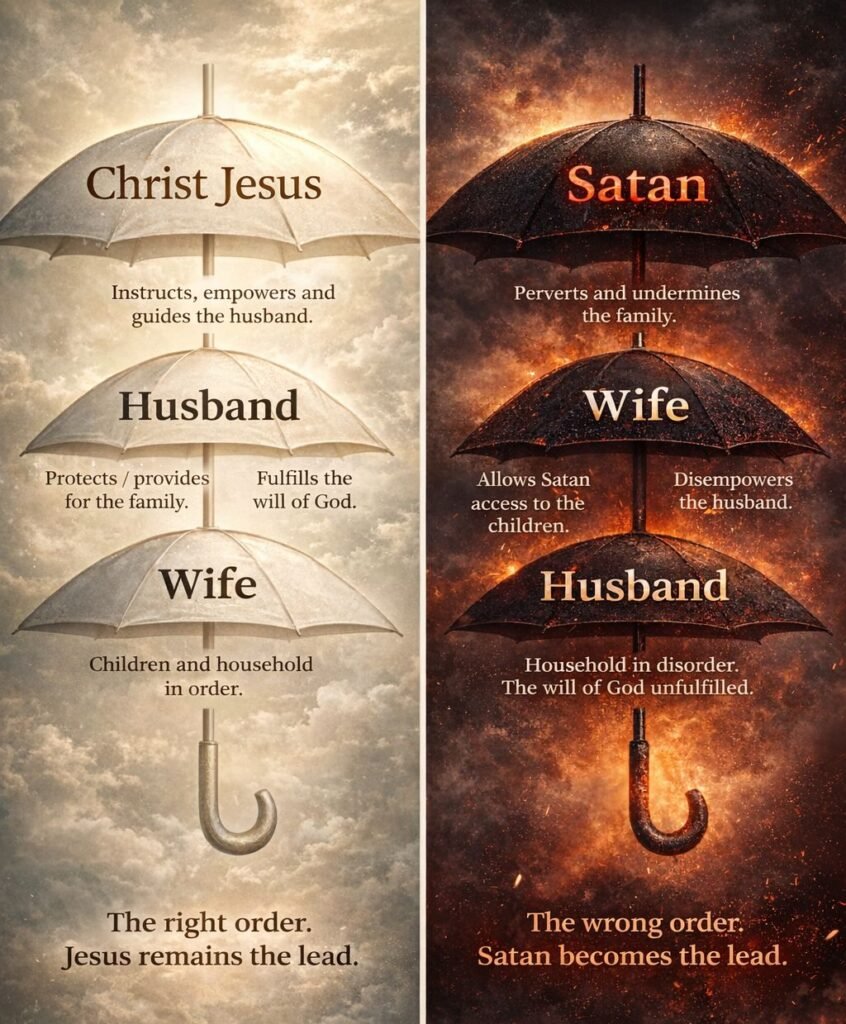
In the specialized field of spiritual forensics, a rigorous examination of the human household reveals a structural blueprint that is not of biological origin, but of divine decree. The investigative data suggests that the stability of the domestic unit is directly proportional to its alignment with a specific, celestial hierarchy. According to the Pauline revelation, which governs the current Administration of Grace, the family is not a social experiment subject to cultural evolution, but a judicial and spiritual institution designed to mirror the relationship between the Head and the Body. The diagnostic baseline for this inquiry is established in Ephesians 5:23, which records with clinical precision: “For the husband is the head of the wife, even as Christ is the head of the church: and he is the saviour of the body.” Under a dispensational framework, the evidence indicates that while the world promotes a egalitarianism that often results in structural entropy, the Word of God mandates a “Divine Order” to ensure the protection, peace, and spiritual health of the home. 1 Corinthians 14:33 provides the overarching principle for this administrative audit: “For God is not the author of confusion, but of peace, as in all churches of the saints.”
A foundational pillar of this investigation begins with the identification of Christ as the absolute center and supreme head of the familial structure. Colossians 1:18 establishes the ontological requirement for this arrangement: “And he is the head of the body, the church: who is the beginning, the firstborn from the dead; that in all things he might have the preeminence.” The forensic record indicates that when Christ is denied this preeminence, the home loses its spiritual orientation. As the ultimate spiritual authority, He possesses all power in heaven and in earth (Matthew 28:18), meaning that any authority exercised within the home is a delegated authority that must remain accountable to Him. The investigator notes that a Christ-centered home is characterized by the rich indwelling of His Word, as Colossians 3:16 instructs the inhabitants to “let the word of Christ dwell in you richly in all wisdom.” Furthermore, the data suggests that Christ functions as the sustainer of the unit; Colossians 1:17 asserts that “by him all things consist.” Without this centralizing force, the domestic elements naturally drift toward conflict and fragmentation.
The investigative report shifts to the role of the husband, who is identified as the earthly head of the domestic government. This headship is not categorized as a license for domination, but as a burden of responsibility. Ephesians 5:23 clarifies the husband’s position as a reflection of Christ’s headship over the Church. The audit of his duties reveals a requirement for sacrificial love, a standard set by the Savior Himself. Ephesians 5:25 mandates: “Husbands, love your wives, even as Christ also loved the church, and gave himself for it.” This level of affection is not emotional but volitional, requiring the husband to prioritize the spiritual and physical welfare of his wife above his own interests. Additionally, the investigator finds a stern administrative warning in 1 Timothy 5:8 regarding the husband’s role as a provider: “But if any provide not for his own, and specially for those of his own house, he hath denied the faith, and is worse than an infidel.” This leadership must be exercised with the humility described in Philippians 2:3–4, where “each esteem other better than themselves.” Biblical headship is therefore a form of servant-leadership, where the husband protects the home by first submitting himself to the authority of Christ.
The third primary data point in this audit focuses on the wife as a wise and essential support within the divine order. Ephesians 5:22 provides the judicial instruction: “Wives, submit yourselves unto your own husbands, as unto the Lord.” The investigator notes that this submission is a voluntary alignment with God’s design for harmony, rather than an admission of inferiority. A clinical review of Proverbs 31 reveals the immense strength and wisdom of a godly wife, who “openeth her mouth with wisdom; and in her tongue is the law of kindness” (Proverbs 31:26). Her role is to strengthen the husband’s leadership and provide watchful care over the household. Ephesians 5:33 emphasizes the necessity of respect: “and the wife see that she reverence her husband.” This reverence builds the husband’s confidence and stabilizes the home’s emotional environment. Just as the Church finds its completion and glory in Christ, the wife is the glory of the husband, acting as the heart and nurturer of the domestic sanctuary.
The investigation further identifies the “Protection of the Family” as a direct byproduct of honoring this divine hierarchy. Psalm 127:1 issues the baseline warning: “Except the LORD build the house, they labour in vain that build it: except the LORD keep the city, the watchman waketh but in vain.” Spiritual protection is achieved through the systematic application of prayer and the Word. Philippians 4:6 provides the tactical directive for the household: “Be careful for nothing; but in every thing by prayer and supplication with thanksgiving let your requests be made known unto God.” The forensic record suggests that when the husband acts as the spiritual guard—declaring as Joshua did, “as for me and my house, we will serve the LORD” (Joshua 24:15)—the home is shielded from external spiritual incursions. Unity acts as a force multiplier; Ecclesiastes 4:12 notes that “a threefold cord is not quickly broken.” When the husband, wife, and Christ are in alignment, the family is fortified against the “wiles of the devil.”
The audit of “Order in the Household” reveals that structure is a fundamental attribute of the Divine character. 1 Corinthians 14:40 commands: “Let all things be done decently and in order.” This order is not merely aesthetic but functional. In a structured home, children thrive and are preserved from the confusion of role reversal. Ephesians 6:4 instructs fathers to “bring them up in the nurture and admonition of the Lord,” a task that is significantly eased when the child observes a clear, loving hierarchy between the parents. The investigator notes that clear roles prevent the domestic “noise” that leads to chaos. James 3:18 confirms that “the fruit of righteousness is sown in peace of them that make peace.” When God’s order is prioritized, the home transitions from a theater of conflict to a refuge of tranquility, where each member can focus on their specific spiritual growth without the distraction of power struggles.
The forensic examination must also address the necessity of “Resisting Satan’s Disorder.” The adversary is identified as a primary threat to the domestic unit. 1 Peter 5:8 warns: “Be sober, be vigilant; because your adversary the devil, as a roaring lion, walketh about, seeking whom he may devour.” The investigation find that Satan’s primary tactic is the subversion of God’s design. By promoting role reversal and undermining the husband’s headship or the wife’s support, the enemy creates a spiritual “breach” in the home. Romans 1:25 describes the root of this disorder: “Who changed the truth of God into a lie.” The investigator notes that whenever the divine order is rejected, the home becomes vulnerable to division. Ephesians 4:3 emphasizes the defensive need to “endeavour to keep the unity of the Spirit in the bond of peace.” Resisting the devil requires a total reliance on God’s power and a refusal to negotiate with the world’s definitions of the family (James 4:7).
The final phase of this spiritual audit focuses on the “Strengthened Family in Christ.” A home that adheres to the divine order is not merely preserved, but it is energized for service. Ephesians 3:16 provides the prayer for this internal fortification: “That he would grant you… to be strengthened with might by his Spirit in the inner man.” Growth occurs through shared faith and the intake of Pauline doctrine. Colossians 3:16 describes a home where the word of Christ dwells richly, manifesting in a life of worship and mutual edification. The investigation concludes that sacrificial love acts as the “bond of perfectness” (Colossians 3:14). Homes built on this foundation are resilient against the inevitable storms of life. Matthew 7:24–25 provides the case study of the wise man who built his house upon the rock: “and the rain descended, and the floods came, and the winds blew, and beat upon that house; and it fell not: for it was founded upon a rock.”
The summary of this investigative record confirms that the divine order is a simple but high-performance system: Christ leads the husband, the husband leads the wife with sacrificial love, and the wife supports the husband with wisdom and respect. When this sequence is maintained, the children receive a clear moral and spiritual compass. The investigator notes that the rejection of this order is the primary cause of domestic insolvency in the 21st century. The case for a return to the Pauline family structure is overwhelming. By aligning with the blueprints of the Architect, the family transitions from a state of survival to a state of spiritual dominion.
A call to action is issued for all households within the Body of Christ. First, make Christ the undisputed center of your domestic policy (Colossians 3:17). Second, husbands must audit their hearts to ensure they are leading with love and not with an iron fist (Ephesians 5:25). Third, wives must choose the path of wise support, recognizing the power of a respectful presence (Ephesians 5:33). Fourth, the family must establish a regular rhythm of prayer and Bible study to maintain spiritual hygiene (Philippians 4:6). Finally, the investigator recommends a firm commitment to the Word of God as the final authority for all household disputes (Psalm 119:105).
The investigative findings regarding “Sacrificial Love” show that it is the most effective lubricant for domestic friction. 1 Corinthians 13:4–7 defines this love: it “suffereth long, and is kind; envieth not… seeketh not her own.” The investigator finds that when the husband applies this type of love, the wife’s submission becomes a natural response rather than a forced duty. Conversely, when the wife offers respect, the husband is empowered to lead with greater confidence and care. This “virtuous cycle” is the engine of a healthy home. The forensic auditor notes that “charity,” or selfless love, is the highest virtue that binds the family members together in perfect unity.
Furthermore, the investigation into “Dispensational Clarity” indicates that the instructions in Ephesians and Colossians are specifically tailored for the Church today. We do not look to the tribal laws of Israel for our domestic policy, but to the grace-based instructions of Paul. This means that our relationships are governed by the principle of “mutual edification” and “growth in Christ.” The investigator finds that the family is the primary training ground for the spiritual life. If a man cannot rule his own house well, how can he take care of the church of God? (1 Timothy 3:5). This question highlights the critical nature of the family as the bedrock of the entire spiritual community.
The forensic report concludes that the “Divine Order” is not an ancient relic of a patriarchal society, but a timeless spiritual technology designed for human flourishing. The investigator finds that homes that ignore this order consistently experience higher levels of stress and spiritual decay. In contrast, homes that honor the hierarchy of Christ-Husband-Wife experience a measurable increase in peace and spiritual productivity. The choice is between the “confusion” of the world and the “peace” of the Almighty. The investigator closes the case with the observation that the family is God’s greatest masterpiece, provided it is kept within the frame He designed for it.
The final word of this investigation is a reminder of the “High Calling” of the home. The family is the living laboratory of the Gospel. By the way a husband loves his wife and a wife respects her husband, the world sees a physical representation of the mystery of Christ and the Church. The investigator encourages every family member to “walk worthy of the vocation wherewith ye are called” (Ephesians 4:1). The order is set. The instructions are clear. The victory is available to those who obey.
Related posts:
 𝗧𝗛𝗘 𝗣𝗥𝗜𝗢𝗥𝗜𝗧𝗬 𝗢𝗙 𝗧𝗛𝗘 𝗛𝗨𝗦𝗕𝗔𝗡𝗗
 𝗧𝗛𝗘 𝗣𝗔𝗨𝗟𝗜𝗡𝗘 𝗣𝗔𝗧𝗧𝗘𝗥𝗡 𝗢𝗙 𝗔 𝗚𝗢𝗗𝗟𝗬 𝗛𝗨𝗦𝗕𝗔𝗡𝗗
 𝗪𝗛𝗢 𝗪𝗘𝗥𝗘 𝗧𝗛𝗘 𝗡𝗘𝗣𝗛𝗜𝗟𝗜𝗠?
 𝗙𝗥𝗢𝗠 𝗣𝗥𝗢𝗣𝗛𝗘𝗖𝗬 𝗧𝗢 𝗠𝗬𝗦𝗧𝗘𝗥𝗬. 𝗧𝗛𝗘 𝗞𝗘𝗬 𝗧𝗢 𝗨𝗡𝗗𝗘𝗥𝗦𝗧𝗔𝗡𝗗𝗜𝗡𝗚 𝗦𝗖𝗥𝗜𝗣𝗧𝗨𝗥𝗘 – 𝗚𝗢𝗗 𝗜𝗦 𝗡𝗢𝗧 𝗧𝗛𝗘 𝗔𝗨𝗧𝗛𝗢𝗥 𝗢𝗙 𝗖𝗢𝗡𝗙𝗨𝗦𝗜𝗢𝗡!
 𝗚𝗢𝗜𝗡𝗚 𝗧𝗢 𝗧𝗛𝗘 𝗚𝗢𝗦𝗣𝗘𝗟𝗦 𝗜𝗡𝗦𝗧𝗘𝗔𝗗 𝗢𝗙 𝗣𝗔𝗨𝗟’𝗦 𝗚𝗢𝗦𝗣𝗘𝗟
 𝗙𝗔𝗜𝗟𝗜𝗡𝗚 𝗧𝗢 𝗥𝗜𝗚𝗛𝗧𝗟𝗬 𝗗𝗜𝗩𝗜𝗗𝗘 𝗧𝗛𝗘 𝗪𝗢𝗥𝗗 𝗢𝗙 𝗧𝗥𝗨𝗧𝗛
 “𝗣𝗔𝗨𝗟 𝗣𝗟𝗔𝗡𝗧𝗘𝗗, 𝗔𝗣𝗢𝗟𝗟𝗢𝗦 𝗪𝗔𝗧𝗘𝗥𝗘𝗗, 𝗕𝗨𝗧 𝗚𝗢𝗗 𝗚𝗔𝗩𝗘 𝗧𝗛𝗘 𝗜𝗡𝗖𝗥𝗘𝗔𝗦𝗘”