The theological landscape regarding the Holy Spirit is often clouded by a fog of subjective mysticism, where the divine presence is measured primarily through the volatility of human emotion or the pursuit of visible, miraculous signs. However, a forensic investigation into the Pauline epistles—specifically the magisterial letter to the Ephesians—reveals a vastly different operative reality for the current dispensation of grace. In this era, the Holy Spirit functions not as a temporary visitor or a fluctuating influence, but as a permanent, legal, and structural foundational force within the believer. By examining the seven distinct blessings articulated by the Apostle Paul, we uncover a pneumatic program that is positional, irrevocable, and entirely distinct from the Spirit’s interactions with Israel under the Law. This investigation seeks to delineate the mechanics of how the Spirit secures, strengthens, and supplies the Body of Christ, moving beyond the “milk” of experiential religion into the “strong meat” of doctrinal certainty. The evidence suggests that the modern Church’s obsession with “feeling” the Spirit is a direct result of failing to “rightly divide” the Word of truth, leading to a neglect of the staggering positional wealth already granted to every believer in Christ.
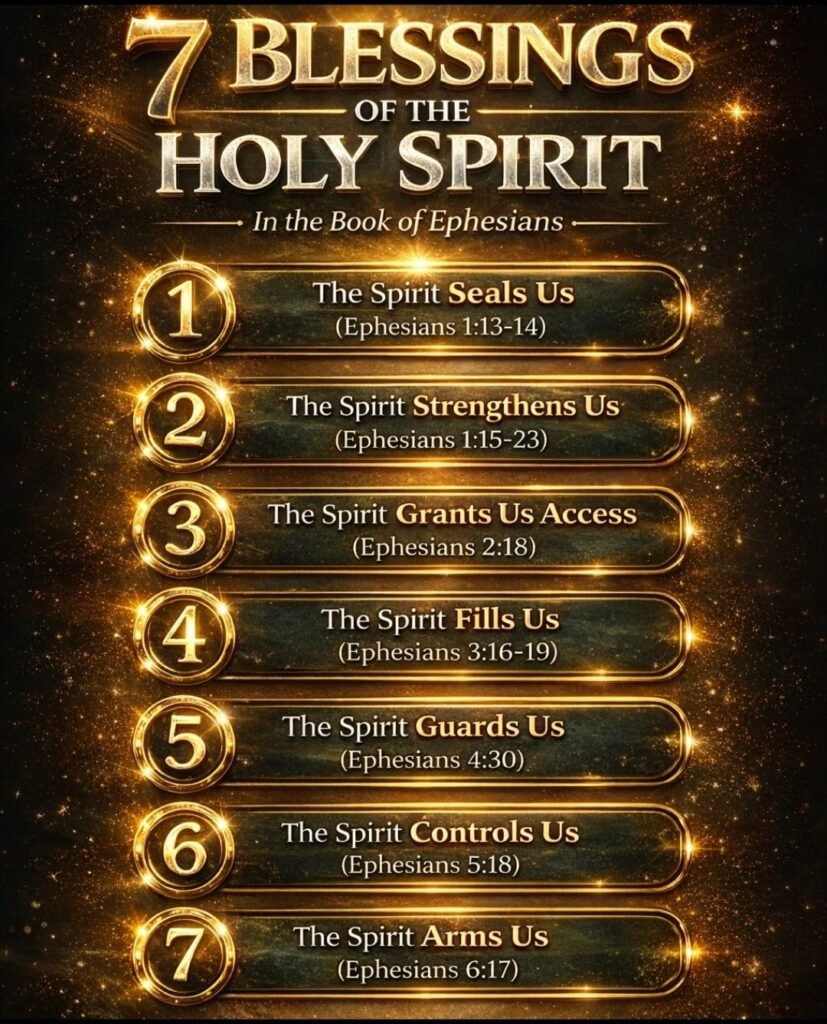
The first and perhaps most critical marker in this investigation is the concept of the divine seal. In the ancient world, a seal represented ownership, authenticity, and an unbreakable legal bond. Paul utilizes this imagery in Ephesians 1:13–14 to describe a transaction that occurs at the precise nanosecond of belief. This is not a secondary “baptism of fire” or an attainment reached through spiritual maturity; it is an immediate, forensic marking by God. The Holy Spirit Himself is the seal. This seal is not contingent upon the believer’s subsequent performance or emotional state. It is a “down payment” or earnest money (arrhabon) that guarantees the final redemption of the “purchased possession.” Investigation of 2 Corinthians 1:22 and Ephesians 4:30 confirms that this security is absolute. The believer is signed, sealed, and delivered over to the custody of Christ, protected by a grace that transcends human failure. The researcher must note that a seal cannot be broken by the object being sealed; it can only be broken by the authority that applied it. Since God is the one who seals the believer “unto the day of redemption,” the believer’s eternal security is as firm as the throne of God itself.
Moving from the legal position to the internal condition, we find the second blessing: a supernatural strengthening that operates independent of physical or circumstantial vitality. In Ephesians 3:16, Paul petitions that believers would be “strengthened with might by his Spirit in the inner man.” This is a crucial investigative distinction. While the “outer man” (the biological body) perishes and decays, the inner man is being fortified through a pneumatic supply of power. This strength is not designed for the performance of physical miracles, but for the endurance of the soul and the stabilization of the mind. It is a metabolic process where the Spirit utilizes sound doctrine to build a “structural integrity” within the believer’s character. As documented in Colossians 1:11, this results in “all patience and longsuffering with joyfulness,” a psychological resilience that remains unmoved by the pressures of a hostile world. This internal “might” is the engine that drives the believer’s walk, providing the “energy” required to live out the Pauline identity in a culture of spiritual exhaustion.
The third blessing involves a radical shift in spiritual geography: the granting of direct, unmediated access to the Creator. In Ephesians 2:18, Paul writes, “For through him we both have access by one Spirit unto the Father.” Historically, under the Mosaic economy, access to God was restricted by a physical veil, a high priestly office, and a complex system of animal sacrifices. The investigation of Pauline truth reveals that these barriers have been structurally dismantled. In the Body of Christ, the Holy Spirit acts as the “access point,” providing a standing of “boldness and access with confidence” (Ephesians 3:12). This is a legal status of “sonship” rather than “servitude.” The Spirit does not merely help us reach God; He constitutes the very environment in which we stand before Him. This direct support bypasses all religious hierarchy, placing the individual believer in an immediate, conversational relationship with the Father based solely on the finished work of the Son. The “middle wall of partition” has been broken down, and the Spirit serves as the perpetual “diplomatic pass” that allows the believer to enter the throne room of grace at any moment.
Fourthly, the investigative record points to a unique state of spiritual satisfaction through the filling of the Spirit. Modern misconceptions often equate “being filled” with a loss of self-control or an ecstatic trance. However, Ephesians 5:18 and Colossians 3:16, when analyzed together, show that being “filled with the Spirit” is functionally synonymous with letting the “word of Christ dwell in you richly.” The Spirit does not fill the believer with “Himself” as a vague energy; He fills the believer with the person and work of Jesus Christ. This produces a state of divine fullness (pleroma) where the believer is settled and satisfied in their identity. This is not a fluctuating emotional high, but a cognitive and spiritual saturation where the truths of grace become the dominant influence over one’s thoughts and actions. It is a satisfaction that renders the “broken cisterns” of worldly philosophy and legalistic religion entirely obsolete. To be Spirit-filled is to be Christ-preoccupied, as the Spirit’s primary objective in this dispensation is to “magnify Christ” in the mortal body of the believer.
The fifth blessing is a safeguard that persists even when the believer falters. Ephesians 4:30 contains a profound investigative insight: “And grieve not the holy Spirit of God, whereby ye are sealed unto the day of redemption.” The word “grieve” (lupeo) implies a personal relationship of love. One can only grieve someone who is present and committed. The legal fact that the Spirit is “grieved” by sin—yet does not depart—proves the permanence of the grace-age union. Unlike King David, who feared the Spirit being taken from him (Psalm 51:11), the Pauline believer is assured that the Spirit remains as a guardian until the physical body is finally redeemed at the Rapture. This safeguarding is a testament to God’s fidelity rather than man’s consistency. The Spirit acts as a persistent advocate, convicting the believer of their high calling while simultaneously protecting their eternal security. The investigation reveals that the Holy Spirit is not a “guest” who leaves when the house is messy, but an “Owner” who stays to clean it up. His presence is the guarantee that God will complete the work He began.
The sixth dimension of the Spirit’s work is the governance of the daily walk, a state of submission to the “law of the Spirit of life.” In Galatians 5:16, Paul provides the operative instruction: “Walk in the Spirit, and ye shall not fulfil the lust of the flesh.” This is not a call to legalistic self-effort, but a call to yield to the influence of the truth that the Spirit has revealed. The investigation of Romans 8:5 suggests that this is a matter of “mindset.” To be Spirit-led is to have a mind that is occupied with the things of the Spirit—specifically the Pauline revelation of the Mystery. When the mind is submitted to these truths, the Spirit naturally produces “fruit” (Galatians 5:22–23). This fruit—love, joy, peace, longsuffering, gentleness, goodness, faith, meekness, temperance—is not “manufactured” by the believer; it is “grown” by the Spirit as the believer rests in their grace-identity. Submission to the Spirit, therefore, is not about following a new set of rules, but about living in the reality of a new nature. The Spirit “controls” the believer not through coercion, but through the irresistible logic of grace.
Finally, the seventh blessing is the provision of spiritual weaponry for the inevitable conflicts of this age. In Ephesians 6:17, Paul identifies “the sword of the Spirit, which is the word of God.” It is significant to note that this is the only offensive weapon listed in the armor of God. Investigative analysis of the Greek term rhema (word) indicates that this refers to a specific, “spoken” or applied portion of Scripture. The Spirit arms the believer by bringing to mind the precise doctrinal truth needed to parry the “fiery darts” of deception. This is not a general knowledge of the Bible, but a “rightly divided” understanding of truth (2 Timothy 2:15). In the spiritual warfare of the mind, the Spirit uses the epistles of Paul to sharpen the believer’s discernment, enabling them to stand firm against the “wiles of the devil.” Victory is not achieved through personal strength, but through the skillful application of the Spirit’s own weapon. The Spirit is the “Armorer” of the Body of Christ, ensuring that every soldier is equipped with a blade that can cut through the most complex philosophies of the world.
To deepen the investigation, we must examine the specific Greek terminology for the “Strengthening” mentioned in Ephesians 3. The word dunamis (power) refers to inherent ability. This pneumatic ability is what allows the believer to “comprehend with all saints what is the breadth, and length, and depth, and height; and to know the love of Christ.” The Spirit’s strengthening is intellectual as much as it is moral. It is an expansion of the believer’s capacity to grasp the “unsearchable riches of Christ.” Without this Spirit-enabled comprehension, the Pauline epistles remain a closed book, dismissed as “difficult” or “irrelevant.” The investigation suggests that spiritual maturity is directly linked to the degree to which a believer allows the Spirit to “enlighten the eyes of their understanding” (Ephesians 1:18). This enlightenment is a foundational blessing that transforms a “babe in Christ” into a “spiritual man” who can judge all things.
The investigation also highlights the “Support” aspect of the Spirit’s role in prayer. Romans 8:26 provides a parallel insight to the Ephesian text, stating that “the Spirit also helpeth our infirmities: for we know not what we should pray for as we ought.” In the dispensation of grace, the Spirit does not provide a “magic language,” but a “divine intercession.” He translates the groans of the believer’s heart into the specific will of God. This support is vital because the believer often struggles with the tension between their heavenly position and their earthly experience. The Spirit bridges this gap, ensuring that the believer’s communication with the Father is always aligned with the “Mystery” program. This gives the believer a “quiet confidence” in prayer, knowing that the Spirit is actively assisting them in every petition.
Furthermore, the “Safeguarding” blessing must be understood in the context of the believer’s “walk.” Ephesians 4:17–32 provides a list of behaviors that are inconsistent with the “new man.” Paul’s appeal to avoid these behaviors is not based on the threat of losing the Spirit, but on the reality of the Spirit’s presence. “Grieve not the holy Spirit… whereby ye are sealed.” The motive for holiness under grace is gratitude, not fear. The Spirit’s safeguarding is what makes this gratitude-based living possible. Because the believer knows they are safe, they are free to “put on the new man” without the paralyzing anxiety of judgment. The Spirit’s presence acts as a “gentle pressure” toward Christlikeness, a constant reminder of whose we are and where we are going.
The investigation into “Submission” and “Control” (Ephesians 5:18) reveals a linguistic parallel to the “influence” of wine. Just as wine alters a person’s behavior by affecting their internal system, the Spirit alters a believer’s behavior by affecting their internal mind. This is why Paul contrasts being “drunk with wine” with being “filled with the Spirit.” The result of Spirit-filling is not chaos or noise, but “speaking to yourselves in psalms and hymns… giving thanks always.” It is a state of “ordered joy.” This governance of the Spirit is what creates harmony in the Body of Christ, as members “submit themselves one to another in the fear of God.” The investigation concludes that the Spirit’s control is the ultimate source of unity in the Church, as He leads all members to focus on the same Head—Jesus Christ.
As the study of the “Armor of God” in Ephesians 6 concludes, the role of the Spirit as the “Supplier” of truth becomes paramount. The “Sword of the Spirit” is effective only when it is “rightly divided.” If a believer tries to use an Old Testament “sword” (the Law) to fight a New Testament “battle” (spiritual deception), they will find themselves ineffective. The Spirit is the one who “sharps” the sword by teaching the believer how to distinguish between God’s program for Israel and His program for the Church. This “cutting” ability is what allows the believer to expose the “empty deceit” of modern religious systems. The investigative findings suggest that a lack of “Spiritual Arming” is the primary reason why so many believers are currently being “carried about with every wind of doctrine.”
In summary, the seven blessings of the Holy Spirit in Ephesians provide a comprehensive framework for the believer’s life under grace. The investigative conclusion is inescapable: the Holy Spirit’s role is one of total, permanent immersion in the life of the believer. He is the seal of our security, the strength of our inner man, and the support of our access to the Father. He is the satisfaction of our soul, the safeguard of our position, and the governor of our walk. Lastly, He is the armorer of our warfare. To view the Spirit through the lens of ancient prophecy or modern sensationalism is to miss the staggering reality of His present work. He is the silent, powerful executive of the Godhead, currently engaged in completing the Body of Christ. The believer who understands these seven blessings moves from a life of spiritual begging to a life of spiritual possession.
As the investigation into Ephesians concludes, the overarching theme is one of “all spiritual blessings in heavenly places.” These are not future rewards to be earned, but present possessions to be believed. The Holy Spirit is the agent through whom these blessings are made real in the human experience. He does not point to Himself; He points to Christ. He does not empower us to live under the Law; He empowers us to live under Grace. He is the internal witness to our external redemption. The “Rightly Divided Design” ensures that the believer is never alone, never unequipped, and never unsecured. He is the “Holy Spirit of promise,” and His presence is the ultimate proof that the Dispensation of Grace is a reality.
The call to action for the reader is a shift in perspective. Cease looking for the Spirit in the spectacular, the noisy, or the temporary. Find Him in the “still, small voice” of the Pauline epistles. Rest in the forensic seal He has placed upon your soul. Draw upon the inner strength He provides for your daily trials. Walk in the direct access He has secured for your prayers. Fill your mind with the doctrine He has authored, and use the sword He has sharpened for your defense. The Holy Spirit is your permanent companion in the dispensation of grace. Recognize His presence, rely on His power, and rejoice in His permanence. The evidence is clear: the Spirit is not a feeling to be chased, but a Fact to be trusted.
Final investigative thoughts: The “Rightly Divided” view of the Holy Spirit is the only view that provides the believer with both absolute peace and absolute power. By understanding that the Spirit’s work is primarily “positional” and “permanent,” the believer is freed from the “performance trap” of religious systems. By understanding that His work is also “practical” and “strengthening,” the believer is equipped for the daily challenges of the 21st century. The Holy Spirit is the Spirit of Truth, and in the Pauline epistles, that truth is revealed in its most glorious form. May the “God of our Lord Jesus Christ, the Father of glory, give unto you the spirit of wisdom and revelation in the knowledge of him.”