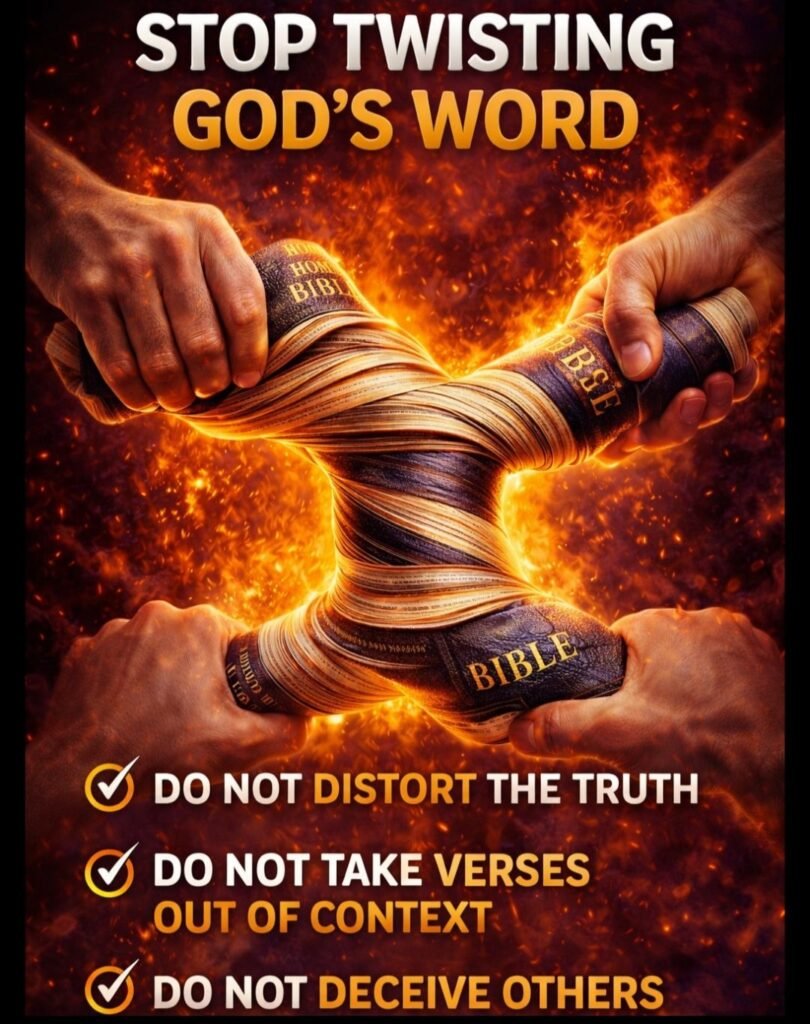
Stop Twisting God’s Word
In nearly every generation of church history, believers have feared the loss of the Bible. Yet the greater danger has rarely been the absence of Scripture. It has been its abuse. Today, the Bible is more accessible than at any other point in history. It is quoted in sermons, shared across social media, printed in countless translations, and referenced constantly in Christian conversation. And yet, despite this abundance, biblical confusion is widespread. Contradictions flourish. Assurance is diluted. Grace is mixed with law. And the gospel itself is often obscured beneath layers of religious interpretation.
We are living not in an age of Bible ignorance, but in an age of Bible twisting.
Scripture is frequently used, but not rightly divided. It is quoted, but not respected. Verses are lifted from their historical and doctrinal setting, reshaped to fit theological traditions, and applied in ways God never intended. In the process, the authority of God’s Word is subtly undermined—not by rejecting it outright, but by redefining how it is handled.
The apostle Paul warned that doctrinal corruption does not typically arrive in dramatic fashion. It spreads quietly. “A little leaven leaveneth the whole lump.” A single misapplied verse may appear harmless. A small doctrinal compromise may seem inconsequential. But over time, distortion multiplies, clarity erodes, and truth becomes difficult to distinguish from error.
In the present Dispensation of Grace, God has given explicit instruction regarding how His Word is to be handled. That instruction is not vague. It is not optional. It is not reserved for scholars alone. Paul commands believers, and especially those who teach, to study diligently and to rightly divide the Word of Truth. This charge, found in 2 Timothy 2:15, stands as one of the clearest mandates in Scripture. It assumes that Scripture contains distinctions that must be recognized and that failure to do so leads to shame rather than approval.
The consequences of ignoring this command are visible across modern Christianity. Believers are placed under obligations God never gave them. Passages written to Israel under the law are applied to the Church under grace. Kingdom instructions are treated as church doctrine. Promises made to a nation are spiritualized and reassigned. The result is a confused faith, burdened consciences, and a gospel diluted by performance.
At the foundation of all faithful teaching lies a proper respect for the authority of Scripture. The Bible does not derive its authority from tradition, consensus, or institutional endorsement. Its authority rests in its origin. Paul declared that all Scripture is given by inspiration of God. The phrase “God-breathed” is not poetic exaggeration; it is theological precision. Scripture originates with God. Because of this, it stands above human opinion, cultural trends, and religious preference.
When Scripture is treated as flexible rather than final, interpretation becomes domination. Teachers begin to decide which passages are binding and which are symbolic, which doctrines are timeless and which are outdated. The text no longer governs the teacher; the teacher governs the text. This inversion is subtle but deadly. Once Scripture is subjected to human judgment, its authority is effectively replaced.
Paul’s declaration in Romans is uncompromising: “Let God be true, but every man a liar.” This is not an insult to humanity; it is a reminder of divine hierarchy. God does not submit His Word to human revision. Men submit themselves to it.
Respect for Scripture also demands fear—fear not of the text, but of mishandling it. Teaching is not a neutral act. Those who speak on behalf of God assume responsibility. James warned that teachers will receive stricter judgment. This is not meant to discourage teaching, but to sober it. Scripture is not a tool for creativity; it is a trust that must be handled carefully.
Rightly handling Scripture requires more than reverence. It requires division. This concept is frequently misunderstood and often resisted, yet it is explicitly commanded. To rightly divide is not to fragment Scripture, but to recognize the distinctions God Himself has placed within it.
Truth twisted is often truth mixed. When passages addressed to different people under different programs are blended together, contradiction arises. Many attempt to resolve these contradictions by allegory, symbolism, or theological abstraction. Paul’s solution is simpler: divide.
God’s dealings with Israel are not identical to His dealings with the Church. The law given through Moses is not the same as the grace revealed through Paul. Earthly promises of land and kingdom do not equate to spiritual blessings in heavenly places. When these distinctions are ignored, Scripture appears inconsistent. When they are honored, Scripture harmonizes.
Paul identifies himself repeatedly as the apostle to the Gentiles and the steward of the dispensation of the grace of God. These are not incidental remarks. They establish authority and context. Doctrine for the Body of Christ today flows through Paul’s epistles. This does not diminish the rest of Scripture; it clarifies its application.
Failure to recognize this Pauline pattern has led to widespread confusion. Believers are taught to strive for what God has already given, to endure for what Christ has already secured, and to work for what grace has already accomplished. The result is a Christianity marked by effort rather than rest, fear rather than assurance.
Another primary method of twisting Scripture is context-stripping. A verse removed from its context becomes a weapon of error. Peter warned that Paul’s writings are often wrested by those who are unstable. The problem is not complexity; it is carelessness.
Context operates on multiple levels. Historical context asks who is speaking and under what circumstances. Doctrinal context asks to whom the instruction is given. Dispensational context asks when the instruction applies within God’s unfolding program. Ignoring any of these invites misapplication.
A command given to Israel under the Mosaic Law cannot be imposed upon the Church under grace without consequence. A warning issued during the tribulation cannot be repurposed as present-day doctrine. When context is ignored, Scripture is forced to conform to theology rather than theology being formed by Scripture.
Paul contrasted honest handling of God’s Word with deceptive methods. Truth does not require manipulation. It does not rely on emotional pressure, theatrical delivery, or psychological coercion. When teaching depends on craftiness, it signals a lack of confidence in truth itself.
Deceptive handling often masquerades as passion. Emotion replaces explanation. Experience overrides exposition. Scripture becomes a backdrop rather than the foundation. Paul rejected this approach, stating that he renounced hidden things of dishonesty and commended himself through open proclamation of truth.
Sound doctrine renews the mind. Paul connected belief directly to transformation. Wrong doctrine produces wrong living—not necessarily immoral living, but unstable living. When grace is mixed with works, believers oscillate between pride and guilt. When assurance is tied to performance, peace evaporates.
Doctrine is not an academic luxury. It shapes how believers pray, worship, suffer, and hope. A distorted gospel produces a distorted Christian life. This is why Paul insisted on sound teaching, describing it as healthy doctrine. Error is not merely incorrect; it is unhealthy.
Grace does not mean silence toward error. Paul’s epistles contain some of the strongest rebukes in Scripture. He pronounced a curse on any gospel that added to faith. He instructed leaders to correct those who contradict. Love does not avoid truth when souls are at stake.
Correction must be rooted in Scripture, not personality. The goal is not humiliation, but restoration. Yet restoration cannot occur without clarity. When error is left unchallenged, it spreads. When truth is spoken, it divides—but that division often reveals what was already present.
Much Scripture twisting serves fleshly motives. Paul warned against those who corrupt God’s Word for profit. When ministry becomes a means of personal advancement, Scripture becomes malleable. Hard truths are softened. Popular errors are tolerated. Offense is avoided at the cost of accuracy.
Faithful teaching removes confidence in the flesh. It exalts Christ, not charisma. It magnifies the cross, not the communicator. Where flesh dominates, Scripture is bent to serve it. Where the Spirit leads, Scripture stands unaltered.
At the center of most doctrinal distortion lies a distorted gospel. Paul’s gospel is explicit and complete. Christ died for sins, was buried, and rose again. Salvation is by grace alone through faith alone. It is not earned, sustained, or proven by works.
Any addition to this gospel destroys its power. Works-based assurance is not assurance at all. Conditional salvation is not salvation. Paul defended the gospel fiercely because eternity depends on it.
Faithful handling of Scripture will be rewarded. Paul wrote that every work will be tested by fire. Popularity will not survive that test. Accuracy will. Many may be saved, yet their work burned, because it was built on confusion rather than truth.
God does not measure success by numbers or influence. He measures faithfulness. Truth endures. Error collapses.
Twisting God’s Word is not a minor issue. It is a serious offense with eternal consequences. God entrusted His Word to be declared, not diluted. To be divided rightly, not blended religiously. To be proclaimed openly, not manipulated subtly.
In an age saturated with voices, the call is clarity. In an age defined by confusion, the call is distinction. In an age of distortion, the call is fidelity to God’s Word as revealed for this present dispensation.
The responsibility is weighty. The instruction is clear. The path is narrow.
Study to show thyself approved. Rightly divide the Word of Truth. Let God be true. And let His Word stand unaltered.
Related posts:
 𝗧𝗛𝗘 𝗥𝗔𝗣𝗧𝗨𝗥𝗘: 𝗙𝗢𝗥 𝗕𝗘𝗟𝗜𝗘𝗩𝗘𝗥𝗦, 𝗡𝗢𝗧 𝗥𝗘𝗟𝗜𝗚𝗜𝗢𝗡
 𝗙𝗔𝗟𝗦𝗘 𝗙𝗥𝗜𝗘𝗡𝗗𝗦: 𝗧𝗛𝗘 𝗗𝗔𝗡𝗚𝗘𝗥 𝗢𝗙 𝗣𝗥𝗘𝗧𝗘𝗡𝗗𝗘𝗗 𝗙𝗘𝗟𝗟𝗢𝗪𝗦𝗛𝗜𝗣
 𝗩𝗔𝗟𝗘𝗡𝗧𝗜𝗡𝗘’𝗦 𝗗𝗔𝗬: 𝗟𝗢𝗩𝗘 𝗨𝗡𝗗𝗘𝗥 𝗚𝗥𝗔𝗖𝗘 𝗢𝗥 𝗟𝗨𝗦𝗧 𝗨𝗡𝗗𝗘𝗥 𝗧𝗛𝗘 𝗙𝗟𝗘𝗦𝗛?
 𝗧𝗛𝗘 𝗣𝗥𝗜𝗢𝗥𝗜𝗧𝗬 𝗢𝗙 𝗧𝗛𝗘 𝗛𝗨𝗦𝗕𝗔𝗡𝗗
 𝗣𝗥𝗔𝗬: 𝗔 𝗣𝗔𝗨𝗟𝗜𝗡𝗘 𝗣𝗔𝗧𝗧𝗘𝗥𝗡 𝗙𝗢𝗥 𝗧𝗛𝗘 𝗕𝗢𝗗𝗬 𝗢𝗙 𝗖𝗛𝗥𝗜𝗦𝗧
 𝗪𝗛𝗢 𝗜𝗦 𝗝𝗘𝗦𝗨𝗦?
 𝗧𝗪𝗢 𝗣𝗘𝗢𝗣𝗟𝗘 𝗖𝗔𝗡 𝗗𝗔𝗠𝗔𝗚𝗘 𝗦𝗢𝗖𝗜𝗘𝗧𝗬
 𝗪𝗢𝗥𝗟𝗗𝗟𝗬 𝗖𝗛𝗥𝗜𝗦𝗧𝗜𝗔𝗡 𝘃𝘀. 𝗦𝗣𝗜𝗥𝗜𝗧𝗨𝗔𝗟 𝗖𝗛𝗥𝗜𝗦𝗧𝗜𝗔𝗡
 𝗜𝗡𝗙𝗟𝗨𝗘𝗡𝗖𝗜𝗡𝗚 𝗢𝗧𝗛𝗘𝗥𝗦 𝗧𝗢 𝗛𝗔𝗧𝗘: 𝗧𝗛𝗘 𝗦𝗣𝗜𝗥𝗜𝗧𝗨𝗔𝗟 𝗗𝗔𝗡𝗚𝗘𝗥
 𝗧𝗛𝗘 𝗕𝗥𝗔𝗜𝗡 𝗠𝗨𝗦𝗧 𝗕𝗘 𝗪𝗔𝗧𝗘𝗥𝗘𝗗 𝗪𝗜𝗧𝗛 𝗧𝗛𝗘 𝗪𝗢𝗥𝗗 𝗢𝗙 𝗚𝗢𝗗 𝗗𝗔𝗜𝗟𝗬
 𝗝𝗘𝗦𝗨𝗦 𝗖𝗛𝗥𝗜𝗦𝗧: 𝗧𝗛𝗘 𝗢𝗡𝗟𝗬 𝗥𝗜𝗦𝗘𝗡 𝗥𝗘𝗗𝗘𝗘𝗠𝗘𝗥
 𝗚𝗢𝗗 𝗔𝗡𝗗 𝗠𝗔𝗡: 𝗥𝗜𝗚𝗛𝗧𝗟𝗬 𝗗𝗜𝗩𝗜𝗗𝗘𝗗 𝗗𝗘𝗦𝗜𝗚𝗡
 𝗧𝗜𝗧𝗛𝗘𝗦 𝗜𝗦 𝗔 𝗦𝗖𝗔𝗠?
 𝗧𝗥𝗨𝗘 𝗦𝗨𝗖𝗖𝗘𝗦𝗦: 𝗪𝗛𝗘𝗡 𝗬𝗢𝗨𝗥 𝗡𝗔𝗠𝗘 𝗜𝗦 𝗪𝗥𝗜𝗧𝗧𝗘𝗡 𝗜𝗡 𝗛𝗘𝗔𝗩𝗘𝗡