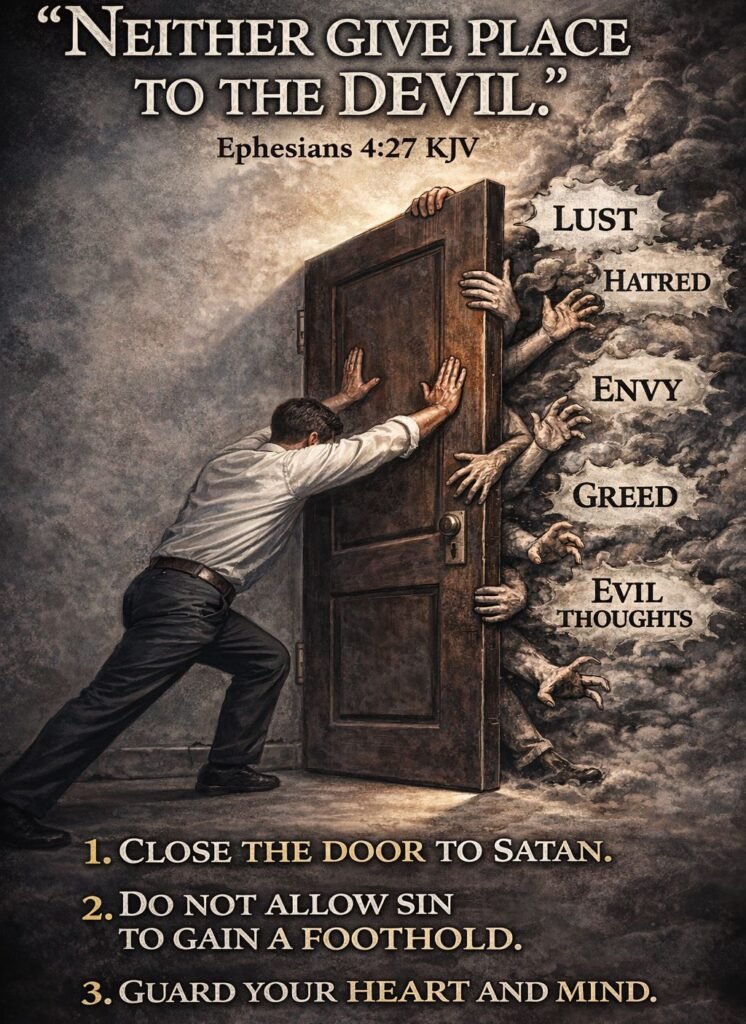
Neither Give Place to the Devil
A Grace-Age Reality Check on Influence, Open Doors, and Everyday Spiritual Vigilance
“Neither give place to the devil.” — Ephesians 4:27 (KJV)
Let’s be honest.
When most people hear teaching about the devil, it swings to extremes. Either everything is blamed on him — the traffic, the headache, the burnt toast — or he’s dismissed entirely as a metaphor for bad vibes.
But tucked inside the practical, deeply pastoral instructions of the Epistle to the Ephesians is a sentence that feels steady, measured, and intensely practical:
“Neither give place to the devil.”
Not fear him.
Not obsess over him.
Not shout at him.
Just… don’t give him space.
That phrasing matters. Paul doesn’t frame believers as fragile victims. He frames us as secure saints who must exercise discernment. And in the Dispensation of Grace, that distinction changes everything.
Let’s talk about what this really means — not theatrically, not emotionally — but doctrinally and practically.
First: What the Devil Cannot Do
Before we talk about “place,” we need to talk about position.
Because if you don’t understand your position in Christ, you’ll misinterpret every spiritual struggle as a threat to your salvation.
Scripture is clear:
- You are sealed by the Spirit (Ephesians 1:13–14).
- You are complete in Christ (Colossians 2:10).
- You are justified freely by grace (Romans 3:24).
- You are under no condemnation (Romans 8:1).
In fact, Romans 8 goes so far as to say nothing — not angels, not principalities, not powers — can separate you from the love of God in Christ.
That includes Satan.
Let that settle in your thinking.
He cannot:
- Unsave you.
- Unseal you.
- Undo the cross.
- Reverse justification.
The cross was not partial. It was final.
So when Paul says, “Neither give place to the devil,” he is not warning believers about losing heaven. He is warning them about losing ground in their walk.
There’s a difference between salvation and stability.
Between security and serenity.
Between position and peace.
Satan cannot remove your position — but he can disturb your peace.
And he doesn’t need ownership to do that.
He only needs opportunity.
Grace Secures You — But Grace Also Trains You
One of the biggest misunderstandings about grace is the idea that it eliminates responsibility.
It doesn’t.
The same apostle who wrote about eternal security also wrote in the Epistle to Titus that the grace of God teaches us to deny ungodliness and worldly lusts.
Grace isn’t passive.
Grace instructs.
Grace matures.
Grace disciplines.
Paul tells believers in Ephesians 4:1 to walk worthy of their calling. In the Epistle to the Galatians 5:16, he says to walk in the Spirit and you won’t fulfill the lust of the flesh.
Notice the pattern: walk.
Your standing is secure.
Your walk is daily.
Security does not remove vigilance. It stabilizes it.
The devil doesn’t need to take your salvation. He just needs to influence your thinking, weaken your focus, or derail your consistency.
And most of the time, that doesn’t begin dramatically.
It begins subtly.
How “Place” Actually Happens
The word “place” in Ephesians 4:27 carries the idea of territory — space, opportunity, foothold.
It’s not about possession. It’s about permission.
And Scripture shows us how that permission often develops.
In the Second Epistle to the Corinthians 2:11, Paul warns that Satan can gain an advantage if we’re ignorant of his devices.
Devices means schemes. Strategies. Patterns.
He studies weaknesses.
He exploits repetition.
He thrives in emotional instability.
Look at the context of Ephesians 4.
Right before verse 27, Paul talks about anger:
“Be ye angry, and sin not: let not the sun go down upon your wrath: Neither give place to the devil.”
That’s not random.
Unresolved anger.
Bitterness.
Unforgiveness.
Those are open doors.
James 1 explains the progression clearly:
- Lust.
- Enticement.
- Sin.
- Consequence.
It begins in the mind.
No one wakes up planning to wreck their spiritual momentum. It happens one rationalized compromise at a time.
A tolerated thought.
A justified resentment.
An unchecked pride.
And slowly, influence expands.
The Battlefield Is the Mind
If you want to understand spiritual warfare in this dispensation, don’t look for dramatic manifestations first.
Look at thinking patterns.
Romans 12:2 tells us transformation happens through renewing the mind.
Philippians 4:8 lists what believers should think on.
Truth.
Purity.
Honesty.
Good report.
When thinking drifts, walking follows.
This is why rightly dividing Scripture matters. When believers mix Law and Grace, they open the door to confusion.
Legalism produces guilt.
Mixture produces instability.
Performance-based acceptance produces anxiety.
And anxiety is fertile soil for spiritual distraction.
When you start believing you must maintain what Christ completed, peace disappears.
Right doctrine stabilizes the mind.
And a stabilized mind closes doors.
Bitterness: The Quiet Door Opener
Let’s slow down here, because this one is common.
Bitterness doesn’t feel dramatic. It feels justified.
You were wronged.
You were overlooked.
You were hurt.
But Ephesians 4 ends with this:
“Let all bitterness, and wrath, and anger… be put away from you.”
Why?
Because bitterness gives place.
It replays offenses.
It distorts perspective.
It magnifies injury.
And over time, it changes your tone, your joy, your witness.
Satan doesn’t need you to deny Christ. He just needs you distracted and emotionally drained.
Unforgiveness is often less about the offender and more about the foothold it creates.
Grace forgave you fully.
Grace empowers you to release others.
Pride: The Door That Looks Like Strength
If bitterness is quiet, pride is subtle.
And dangerous.
Pride rarely announces itself. It disguises itself as conviction, confidence, or even maturity.
But pride says:
“I don’t need correction.”
“I already know.”
“I’m fine.”
Prayer weakens when pride strengthens.
Dependence fades.
Humility erodes.
Self-reliance grows.
And self-reliance is one of the quickest ways to give place.
Philippians 4 reminds us that prayer guards the heart and mind. But pride resists prayer because pride resists dependence.
The more self-sufficient we feel, the more exposed we become.
Under Grace — Not Under Indulgence
Here’s another misconception.
Some assume that being under grace means discipline is optional.
Paul shuts that down in Romans 6:12–14.
Sin shall not have dominion over you, for you are not under the law, but under grace.
Grace doesn’t minimize sin. It dethrones it.
Colossians 3:5 tells believers to mortify — put to death — earthly members.
Not manage them.
Not negotiate with them.
Kill them.
You don’t manage what Christ crucified.
Grace gives power, not permission.
When believers drift into indulgence under the banner of liberty, they open doors they didn’t intend to open.
We are free — but freedom is not recklessness.
Sound Doctrine Is Defensive Armor
Paul ends Ephesians with the armor of God.
But notice something.
The armor isn’t mystical. It’s doctrinal.
Truth.
Righteousness.
Salvation.
Faith.
The Word of God.
In Epistle to the Romans 16:25, Paul speaks about believers being established according to his gospel and the revelation of the mystery.
Stability comes from clarity.
Satan does not fear vague spirituality.
He does not fear motivational sermons detached from the gospel.
He fears believers grounded in:
- The finished cross.
- Justification by grace through faith.
- The believer’s identity in Christ.
- The mystery revealed to Paul.
When you understand who you are and what Christ accomplished, accusations lose their leverage.
You cannot be “in Christ” and under condemnation at the same time.
Clarity shuts doors.
Christ Is Already Victorious
Let’s not forget something essential.
We do not fight for victory.
We fight from victory.
The cross was decisive. The resurrection was triumphant.
Satan is active — but defeated.
Opposing — but overruled.
Present — but not sovereign.
Your responsibility to guard your walk does not mean you are spiritually fragile. It means you are spiritually accountable.
The difference is enormous.
So What Does This Look Like Practically?
If we bring this down from doctrine to daily life, it might look like this:
- Addressing anger quickly instead of nurturing it.
- Refusing to replay offense.
- Guarding what you consume mentally.
- Praying before reacting.
- Staying rooted in Pauline doctrine.
- Refusing mixture between Law and Grace.
- Monitoring pride.
- Cutting off compromise early.
None of this is dramatic.
But it is decisive.
The devil doesn’t need dramatic collapse. He thrives on gradual erosion.
Close the small doors before they become large ones.
Final Thoughts: Close the Door — and Keep It Closed
The devil cannot:
- Unseal you.
- Undo Calvary.
- Remove your justification.
- Rewrite your identity.
But he can:
- Distract you.
- Disturb you.
- Divide you.
- Drain your effectiveness.
“Neither give place to the devil” is not a threat. It’s a wise reminder.
Your position is secure.
Your walk requires vigilance.
Grace teaches discipline.
Right division protects doctrine.
Prayer guards the heart.
Identity fuels holiness.
So ask yourself honestly:
Where have I allowed a foothold?
What thought pattern needs renewing?
What resentment needs releasing?
What pride needs humbling?
Close the door.
Stand in grace.
Walk worthy.
Stay rooted.
And remember — the victory is already settled.