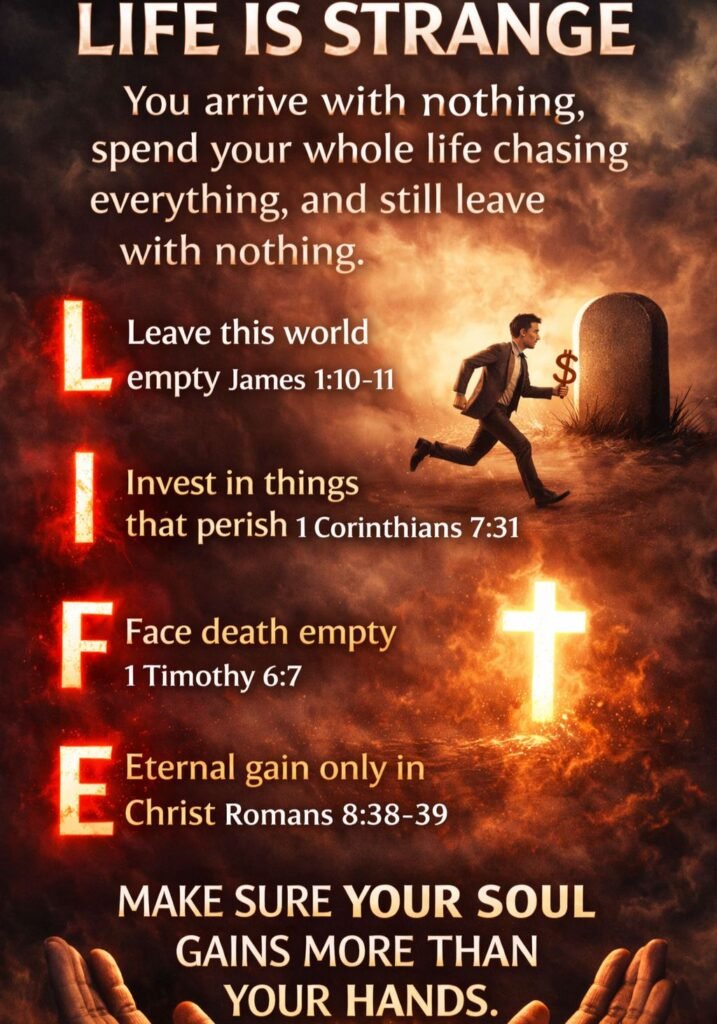
A thorough clinical audit of the human condition reveals a biological and spiritual paradox that defines the existence of every individual traversing the current timeline. In the specialized field of theological forensics, the data suggests that humanity is engaged in a high-stakes race toward a finish line that inevitably strips the participant of every material asset acquired during the journey. This investigative report analyzes the strategic and ontological significance of the Great Eternal Question: why a life lived outside the parameters of the Pauline revelation ends in total insolvency. The diagnostic baseline is established in 1 Timothy 6:7, which records with forensic precision: “For we brought nothing into this world, and it is certain we can carry nothing out.” Under a rigorous dispensational framework, the evidence indicates that while the current administration of Grace offers an infinite credit of righteousness through Christ, the vast majority of the population continues to invest in a worldly system that is scheduled for liquidation.
The investigative baseline begins with the reality of an empty arrival and a corresponding empty departure. Job 1:21 provides the primary administrative data: “Naked came I out of my mother’s womb, and naked shall I return thither.” This establishes that the human experience starts at a zero-balance from a material standpoint. A clinical review of James 1:10–11 confirms that even the most affluent individuals are subject to a rapid “withering” process, where their beauty and wealth fade like the grass of the field. The investigator notes that no amount of human labor can prevent the cessation of biological life; Ecclesiastes 2:18 records the frustration of an individual who realizes that all his labor must be left “unto the man that shall be after me.” The forensic conclusion is that luxury is a non-transferable asset beyond the grave. Psalm 49:17 clarifies this judicial reality: “For when he dieth he shall carry nothing away: his glory shall not descend after him.”
The investigative report shifts to the systemic failure of the “legacy” concept. While society prioritizes the building of a lasting name, Psalm 103:15–16 documents the biological and historical erasure of the individual: “As for man, his days are as grass… the wind passeth over it, and it is gone; and the place thereof shall know it no more.” This data indicates that a legacy on earth is a rapidly decaying signal. More critically, the investigator identifies a spiritual deficit that transcends historical anonymity. John 3:36 issues a warning of judicial consequence: “He that believeth on the Son hath everlasting life: and he that believeth not the Son shall not see life; but the wrath of God abideth on him.” Therefore, a life that concludes without a forensic standing in Christ is not merely empty of wealth, but is spiritually bankrupt before the Creator.
The audit further examines the widespread phenomenon of investing in temporary variables, a behavior identified in the Pauline corpus as a catastrophic strategic error. 1 Corinthians 7:31 provides the tactical warning that “the fashion of this world passeth away.” This suggests that the entire global system—its markets, social hierarchies, and cultural achievements—is a temporary construct. Despite this, the investigation observes a massive allocation of human capital toward wealth that is inherently volatile. Matthew 6:19 identifies the “moth and rust” as the natural agents of decay for earthly investments. Luke 12:20 provides a case study of a “rich fool” who focused on administrative expansion of his barns, only to have his soul “required” of him that same night, rendering his accumulation irrelevant.
The investigation also identifies “fleshly desires” as a high-risk, low-return investment. Galatians 6:8 establishes the biological law of sowing and reaping: “For he that soweth to his flesh shall of the flesh reap corruption.” The corruption mentioned here is not merely moral but ontological—it is the decay of the very thing being invested in. Pride and reputation are similarly identified as liabilities. Proverbs 16:18 notes that “pride goeth before destruction,” and 1 John 2:17 concludes that “the world passeth away, and the lust thereof.” The investigator finds that the majority of human endeavor is dedicated to a passing world system that lacks any long-term viability.
The forensic examination of the “Moment of Transition” reveals that death acts as the ultimate exposure of emptiness. Hebrews 9:27 provides the judicial schedule: “And as it is appointed unto men once to die, but after this the judgment.” This is a non-negotiable appointment that every human being must keep, regardless of their status or resistance. The investigation notes that at the point of death, the individual faces the judgment of God without the shield of their earthly accomplishments. Romans 14:12 states, “So then every one of us shall give account of himself to God.” At this tribunal, the currency of the world is unrecognized. Ecclesiastes 5:15 records that just as a man came forth from the womb, “naked shall he return… and shall take nothing of his labour.”
Death exposes the reality of spiritual lack that many successfully ignore during their biological lifespan. For those who enter eternity without a mediator, the results are catastrophic. Revelation 20:15 documents the final administrative action: “And whosoever was not found written in the book of life was cast into the lake of fire.” The investigator finds that the primary cause of this judgment is not “bad behavior” in a conventional sense, but a failure to resolve the “sin debt” through the authorized Savior. Romans 3:23 provides the universal diagnostic: “For all have sinned, and come short of the glory of God.” Without the imputed righteousness of Christ, the individual faces the full judicial weight of their own insolvency.
However, the investigative report finds a solitary avenue of “Eternal Gain” that is accessible through the Gospel of Grace. In the current Pauline dispensation, the Godhead has provided a mechanism for the permanent transfer of assets into the heavenly realm. The Gospel is defined in 1 Corinthians 15:1–4 as the record that “Christ died for our sins according to the scriptures; And that he was buried, and that he rose again the third day.” This is the only investment with a guaranteed eternal return. Romans 8:38–39 provides the security audit, asserting that neither death, nor life, nor any other creature “shall be able to separate us from the love of God, which is in Christ Jesus our Lord.”
The investigator notes that the “Eternal Home” prepared for the believer is a superior structure compared to the temporary biological “tent” we currently occupy. 2 Corinthians 5:1 states, “For we know that if our earthly house of this tabernacle were dissolved, we have a building of God, an house not made with hands, eternal in the heavens.” This building is not subject to the moth, the rust, or the wind. Furthermore, while salvation is a free gift (Ephesians 2:8–9), the Pauline record indicates that the faithful believer can accumulate “Eternal Rewards.” 2 Corinthians 5:10 describes the Judgment Seat of Christ, where the believer’s works are evaluated for reward. This is the only legacy that truly survives the transition from time to eternity.
The “Eternal Hope” of the believer is anchored in the physical return of the Lord. 1 Thessalonians 4:16–17 describes the tactical extraction of the Body of Christ: “For the Lord himself shall descend from heaven… and the dead in Christ shall rise first: Then we which are alive and remain shall be caught up together with them in the clouds.” This event, often referred to as the Rapture, represents the final vindication of the believer’s investment. The investigator concludes that while the world looks toward an increasingly unstable future, the believer looks toward a “blessed hope” (Titus 2:13) that is anchored in the person of Jesus Christ.
The summary of this forensic audit concludes that life is inherently strange when viewed through a secular lens: you arrive with nothing, you spend decades chasing everything, and you leave with nothing. However, Mark 8:36 poses the ultimate accounting question: “For what shall it profit a man, if he shall gain the whole world, and lose his own soul?” The investigative findings show that the only asset that follows an individual into eternity is their relationship with Christ. All other accumulations are temporary variables that will be discarded at the finish line.
A call to action is issued based on these forensic findings. The investigator recommends that the reader “believe the gospel today” (1 Corinthians 15:1–4) to secure their eternal position. It is essential to “rightly divide the word of truth” (2 Timothy 2:15) to understand God’s specific instructions for the current dispensation of grace. The believer is instructed to “refocus your life on eternal things,” as Colossians 3:2 mandates: “Set your affection on things above, not on things on the earth.” The gift of salvation is available now through faith, apart from the works of the law (Ephesians 2:8–9).
The investigation into the “Briefness of Life” suggests that the average human lifespan, spanning approximately 70 to 80 years, is a statistically insignificant fraction compared to the infinite duration of eternity. The investigator notes that in the 21st century, the average life expectancy for a male in the United States is roughly 74.8 years, while for a female it is 80.2 years. Despite these decades of activity, the “carry-out” rate for material goods remains at exactly 0%. The forensic record shows that the only variable that changes the outcome of the transition is the presence of Christ in the soul.
The report also identifies the “False Security of Wealth.” A clinical audit of the current global economy shows that wealth can be erased by inflation, market crashes, or judicial seizures. However, the “unsearchable riches of Christ” (Ephesians 3:8) are not subject to these market fluctuations. The investigator finds that many people use wealth as a “psychological buffer” to avoid thinking about death. But as the data in Ecclesiastes 5:15 confirms, this buffer is removed the moment the pulse stops. The only true security is found in the “finished work” of the Cross.
Furthermore, the investigation into “Religious Performance” vs. “Grace” finds that many people attempt to “earn” their way into eternity. The Pauline record identifies this as a “legalistic error.” Romans 4:5 clarifies that “to him that worketh not, but believeth on him that justifieth the ungodly, his faith is counted for righteousness.” The investigator concludes that attempting to “pay” for eternal life with human works is like trying to buy a galaxy with a counterfeit penny. The price has already been paid in full by the blood of Christ.
The social impact of a “Christless life” is also documented. Without the internal anchor of the Spirit, the investigator finds that individuals often experience a profound “emptiness of purpose” (Ephesians 2:12). This existential vacuum is frequently filled with addictions, material obsessions, or the pursuit of “vain glory.” The Pauline solution is to be “filled with the Spirit” (Ephesians 5:18) and to find one’s identity in the “New Man.” The investigative report suggests that the peace of God is the only substance that can truly fill the human heart.
The investigation concludes that “Life” is more than a biological sequence; it is a testing ground for the Great Eternal Question. The evidence is overwhelming: everything outside of Christ is temporary, while everything in Christ is eternal. The forensic record is sealed. The testimony of the prophets and apostles is unanimous. The invitation to move from “Empty-Handed Death” to “Eternal Gain” is open to all through the message of Grace.
The final word of this investigation is a reminder of the “sufficiency of Christ.” We arrive with nothing, and we can carry nothing out—but we can be filled with the fullness of Him that filleth all in all (Ephesians 1:23). Do not live only for what your hands can gain; live for what your soul will keep forever. The King of Kings has made a way for the bankrupt to become eternal heirs. Believe the record, receive the gift, and rest in the Savior.
The report identifies that the “dispensation of the mystery” (Ephesians 3:9) is the specific context in which this offer is made. God is not currently counting the world’s trespasses against them (2 Corinthians 5:19), but is rather entreating them to be reconciled. This window of opportunity is the “accepted time” (2 Corinthians 6:2). The investigator warns that to ignore this forensic reality is to gamble with an infinite duration. The choice is yours: an empty eternity or an eternal home.
The findings are summarized as follows:
Leaving This World Empty (James 1:10–11)
Investing in Temporary Things (1 Corinthians 7:31)
Facing Death Empty (Hebrews 9:27)
Eternal Gain Only in Christ (Romans 8:38–39)
The investigation is closed. The truth of 1 Timothy 6:7 remains the defining boundary of our earthly existence. Life is short; eternity is forever. Make the right investment today. Amen.