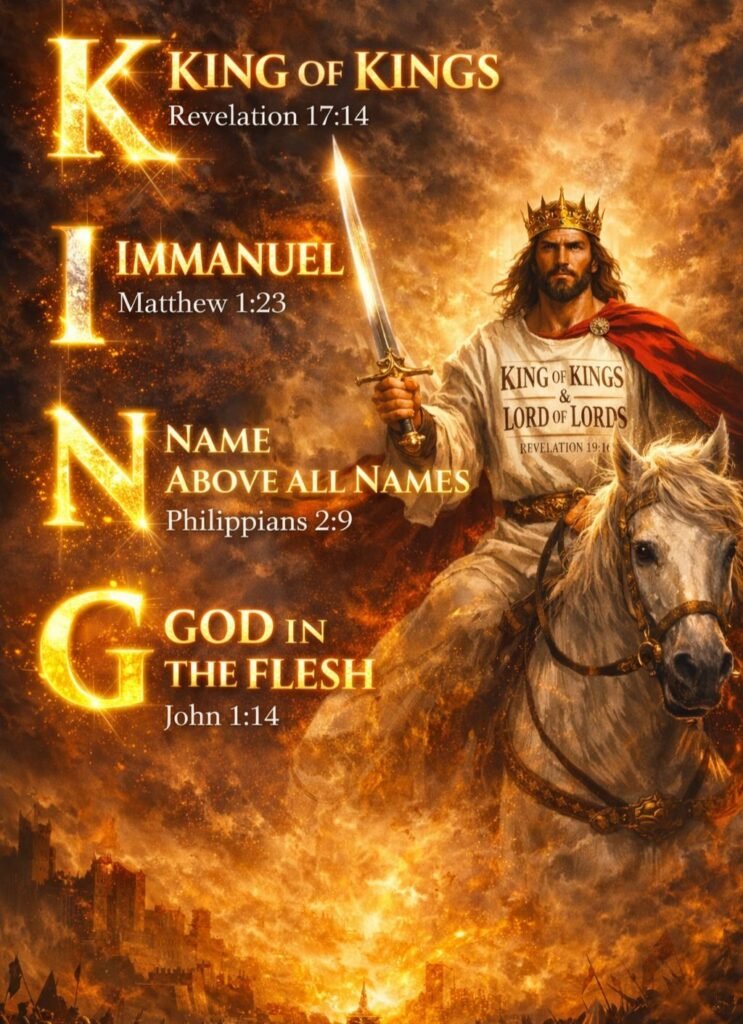
The final book of the New Testament presents a scene that is both political and cosmic in scope. In two climactic passages—Revelation 17:14 and Revelation 19:16—the figure at the center of history is identified not merely as a spiritual guide or moral reformer, but as “King of kings, and Lord of lords.” The language is unapologetically royal. It assumes sovereignty, hierarchy, and the ultimate collapse of all competing claims to authority. The declaration is not poetic flourish; it is presented as a title of fact.
For readers shaped by Pauline theology and a dispensational framework of Scripture, this royal designation must be understood within the broader structure of redemptive history. The New Testament does not blur timelines or offices. It distinguishes between Christ’s humiliation in His earthly ministry, His present exaltation at the right hand of the Father, and His future public manifestation as ruling King. Each phase reveals the same Person, yet in different aspects of divine administration.
The world in which the New Testament was written was no stranger to kingship. The Roman Empire exalted Caesar as sovereign; imperial cults attributed divinity to political rulers. Against that backdrop, the early Christian proclamation that Jesus of Nazareth—crucified under Roman authority—was the true Lord was subversive. The apostle Paul’s letters consistently affirm Christ’s supremacy, yet they do so in a manner that distinguishes between His current heavenly session and His future earthly reign.
In Revelation 17:14, the Lamb is depicted as overcoming earthly powers aligned against Him. The text reads, “These shall make war with the Lamb, and the Lamb shall overcome them: for he is Lord of lords, and King of kings.” The statement is set in the context of global rebellion. Political confederacies gather in defiance, yet the outcome is predetermined. Authority does not rest with coalitions of rulers, but with the One who was once slain.
Later, in Revelation 19:16, the title appears again, this time inscribed upon His vesture and thigh as He returns in visible glory. The scene is martial and decisive. Unlike His first coming, which unfolded in obscurity and rejection, this arrival is public and unambiguous. The same Christ who stood silent before Pilate is now depicted as executing judgment. The text does not present a metaphor for spiritual influence; it describes the assertion of royal prerogative.
Paul’s epistles provide the doctrinal scaffolding for understanding how the crucified Messiah is also the reigning Sovereign. In Philippians 2:9–11, Paul writes that God “hath highly exalted him, and given him a name which is above every name.” The passage traces a deliberate descent and ascent: humiliation precedes exaltation. The One who took the form of a servant and became obedient unto death is now the object of universal acknowledgment. The promise is comprehensive—every knee will bow, every tongue will confess.
Yet in the present dispensation, that confession is not coerced. Salvation is offered through faith, not enforced allegiance. Romans 10:9 ties confession of Jesus as Lord to belief in His resurrection. The authority of Christ is acknowledged willingly by those who respond to the gospel. The day will come when recognition will be universal, but today it is entered through grace.
This distinction is central to dispensational thought. The church age is not the era of enforced kingdom rule; it is the era of proclaimed reconciliation. In 2 Corinthians 5:19–20, Paul describes believers as ambassadors. An ambassador represents a sovereign who is not physically present in the territory. The imagery implies that the King is currently absent from the earth in a visible sense, though enthroned in heaven. His reign is real, but not yet manifested in geopolitical dominance.
The tension between present rejection and future revelation runs throughout the New Testament. In Hebrews 2:8, the writer acknowledges, “But now we see not yet all things put under him.” The authority of Christ is affirmed, yet its visible exercise awaits a later moment. This aligns with 1 Corinthians 15:24–25, where Paul outlines a sequence culminating in the subduing of all enemies. The final adversary, death itself, will be destroyed. The royal program unfolds according to divine timing.
The term “King of kings” implies supremacy over all subordinate rulers. Earthly authorities, no matter how formidable, operate within parameters set by God. Proverbs 21:1 observes that the king’s heart is in the hand of the Lord. Paul echoes this sovereignty in Romans 13, affirming that existing powers are ordained by God. The authority of Christ, therefore, is not reactive; it is foundational. He does not compete for sovereignty. He possesses it inherently.
Central to this claim is the identity of Christ. The New Testament does not present Him as a delegated monarch in the limited sense of a created being elevated to high office. Rather, it identifies Him as pre-existent and divine. John 1:1 declares, “In the beginning was the Word, and the Word was with God, and the Word was God.” The incarnation, described in John 1:14, is the entrance of eternal deity into human history. The King did not originate in Bethlehem; He entered there.
Paul affirms this same truth in Colossians 2:9, stating that in Christ “dwelleth all the fulness of the Godhead bodily.” The fullness of deity is not partially present; it is embodied. This has direct implications for kingship. If Christ is God in the flesh, then His authority is not derivative. It is intrinsic. The resurrection further vindicates this identity. Romans 1:4 describes Him as declared to be the Son of God with power by the resurrection from the dead. The empty tomb functions as divine authentication.
The present position of Christ is described in Ephesians 1:20–23, where Paul writes that God raised Him from the dead and set Him “far above all principality, and power, and might, and dominion.” The language is comprehensive. No spiritual or political force lies outside His authority. Moreover, He is given as head over all things to the church, which is His body. This headship underscores both governance and intimacy. The King is not distant from His people; He is organically connected to them.
The incarnation adds another dimension to the discussion. Matthew 1:23 cites Isaiah in declaring that the child born of Mary would be called Immanuel, meaning “God with us.” The royal identity of Christ does not negate His nearness. In Hebrews 4:15, He is described as one who was tempted in all points like as we are, yet without sin. The King has firsthand knowledge of human frailty. His authority is exercised with understanding, not abstraction.
Romans 5:8 frames the cross as an act of divine initiative: “But God commendeth his love toward us, in that, while we were yet sinners, Christ died for us.” The King intervened not through coercion, but through sacrifice. The propitiatory aspect of His death is emphasized in Romans 3:25, where Christ is set forth as the satisfaction for sin. Kingship, in this context, is inseparable from redemption. The throne is secured through the cross.
This sequence—suffering followed by glory—forms a consistent biblical pattern. Philippians 2 does not move directly from incarnation to exaltation; it passes through obedience unto death. The humiliation was voluntary. The exaltation was granted by the Father. The name bestowed above every name carries universal implications. Acts 4:12 reinforces the exclusivity of that name in matters of salvation. There is no alternative authority capable of reconciling humanity to God.
The future manifestation of Christ’s kingship involves judgment as well as restoration. Revelation 19 portrays not only triumph but accountability. The rebellion of nations culminates in confrontation. The One who once wore a crown of thorns now bears many crowns. The imagery communicates plenary authority. It is not the rise of a new regime among many; it is the culmination of history under rightful rule.
Dispensational theology maintains a distinction between Israel and the church, between promises related to earthly kingdom fulfillment and the current administration of grace. Within this framework, Christ’s return inaugurates a visible reign consistent with Old Testament covenants. The prophetic expectations of a Davidic ruler find their ultimate realization in Him. Yet this future phase does not negate the present spiritual realities experienced by believers.
The current age is characterized by proclamation rather than enforcement. Paul’s ministry was marked by preaching “Jesus Christ, and him crucified” (1 Corinthians 2:2). The emphasis was on the gospel—the death, burial, and resurrection of Christ as articulated in 1 Corinthians 15:1–4. Acceptance of the King is presently a matter of faith. The authority of Christ is acknowledged internally before it is displayed externally.
This dynamic produces an apparent paradox. Christ is already enthroned, yet the world continues in disorder. Scripture anticipates this tension. In 2 Timothy 3, Paul describes conditions in the last days that reflect moral decline rather than immediate transformation. The delay in visible kingdom rule is not evidence of weakness, but of patience. 2 Peter 3:9 speaks of the Lord’s longsuffering, not willing that any should perish.
When Revelation declares Christ to be King of kings, it does so in anticipation of a decisive intervention in history. The title encapsulates supremacy over all rival powers. Political structures, economic systems, and cultural movements rise and fall. None endure indefinitely. The New Testament situates Christ above these fluctuations. His authority is not contingent upon public opinion or electoral process.
The acknowledgment that every knee will bow introduces an eschatological certainty. Philippians 2 does not suggest the possibility of universal recognition; it asserts it. The confession that Jesus Christ is Lord will be made to the glory of God the Father. For believers, that confession is voluntary and joyful. For others, it may be compelled by incontrovertible revelation. The distinction underscores the urgency of present response.
The investigative question remains: what does it mean, practically, to affirm that Jesus is King now? In Pauline thought, it entails allegiance expressed through obedience. Romans 6 describes believers as having been transferred from servitude to sin into service of righteousness. The lordship of Christ is not abstract; it reorients conduct. Colossians 3 instructs believers to set their affection on things above, where Christ sits. The location of the King shapes the priorities of His subjects.
The expectation of future reign also shapes ethical posture. In 1 Corinthians 15:58, immediately after detailing the resurrection program and ultimate victory, Paul exhorts believers to be steadfast and unmovable. Eschatology fuels perseverance. The certainty of Christ’s triumph provides stability amid instability.
The royal theme, therefore, is not confined to apocalyptic imagery. It permeates doctrinal instruction and practical exhortation. Christ’s kingship informs identity, mission, and hope. It also confronts alternative claims to ultimate loyalty. When political ideologies or cultural narratives demand absolute allegiance, the confession of Christ as King introduces a higher standard.
The New Testament does not romanticize the path between confession and consummation. Believers are warned of opposition. In 2 Timothy 3:12, Paul states that all who will live godly in Christ Jesus shall suffer persecution. Allegiance to a rejected King entails cost. Yet the cost is framed within the assurance of ultimate vindication.
The closing chapters of Revelation depict not merely judgment but restoration. The reign of Christ ushers in righteousness and the removal of corruption. The biblical narrative moves from creation to fall to redemption to consummation. Kingship is the thread that unifies these movements. The One through whom all things were created is the One through whom all things will be reconciled.
The investigative lens reveals that the claim “King of kings” is not an ornamental phrase. It carries theological weight and historical consequence. It situates Jesus Christ at the apex of authority. It integrates incarnation, atonement, resurrection, exaltation, and return into a coherent portrait. It demands reckoning.
In the present era, individuals are confronted not by visible throne rooms but by the proclamation of the gospel. The invitation is extended before the imposition of rule. Faith precedes sight. Grace precedes glory. The cross precedes the crown.
The New Testament’s final vision does not end with ambiguity. It concludes with the affirmation of Christ’s sovereign identity and the anticipation of His appearing. The King who was rejected is enthroned. The King who is enthroned will return. The King who returns will reign.
History, in this account, is not cyclical or aimless. It moves toward the open acknowledgment of the One already declared in heaven to be supreme. The designation “King of kings” stands as both assurance and warning. It assures that injustice and rebellion do not have the final word. It warns that neutrality toward Christ is temporary.
For those grounded in Pauline doctrine, the implications are immediate. Salvation is received through faith in the finished work of the crucified and risen Lord. Service is rendered in anticipation of His evaluation. Hope is anchored in His promised manifestation. The royal title is not deferred to a distant horizon; it informs present allegiance.
The investigative conclusion is unavoidable: the New Testament consistently presents Jesus Christ as possessing inherent, comprehensive authority. His humiliation did not negate His kingship; it revealed its character. His exaltation did not create new status; it publicly affirmed eternal reality. His return will not initiate sovereignty; it will unveil it.
The question that remains is not whether He is King. The texts of Revelation, supported by the doctrinal exposition of Paul and the testimony of the wider New Testament, leave little room for ambiguity. The question is how individuals respond in the interval between proclamation and manifestation.
The Bible’s final portrait is clear. The One who walked the roads of Galilee, who stood before earthly governors, who was crucified and raised, is identified as supreme over every ruler and realm. The narrative of Scripture converges upon Him. The title inscribed upon His vesture in Revelation 19 is not subject to revision.
He is King by right. He is acknowledged by faith. He will be revealed by sight.
Related posts:
 𝗝𝗘𝗦𝗨𝗦 𝗖𝗛𝗥𝗜𝗦𝗧 𝗧𝗛𝗘 𝗠𝗘𝗦𝗦𝗜𝗔𝗛 𝗣𝗥𝗢𝗩𝗘𝗡 𝗪𝗜𝗧𝗛 𝗔𝗕𝗦𝗢𝗟𝗨𝗧𝗘 𝗖𝗘𝗥𝗧𝗔𝗜𝗡𝗧𝗬 𝗕𝗬 𝗗𝗔𝗡𝗜𝗘𝗟 𝟵
 𝗪𝗛𝗢 𝗜𝗦 𝗝𝗘𝗦𝗨𝗦?
 𝗙𝗔𝗟𝗦𝗘 𝗙𝗥𝗜𝗘𝗡𝗗𝗦: 𝗧𝗛𝗘 𝗗𝗔𝗡𝗚𝗘𝗥 𝗢𝗙 𝗣𝗥𝗘𝗧𝗘𝗡𝗗𝗘𝗗 𝗙𝗘𝗟𝗟𝗢𝗪𝗦𝗛𝗜𝗣
 𝗧𝗛𝗘 𝗗𝗜𝗩𝗜𝗡𝗘 𝗣𝗔𝗧𝗧𝗘𝗥𝗡 𝗛𝗜𝗗𝗗𝗘𝗡 𝗜𝗡 𝗜𝗦𝗔𝗜𝗔𝗛 𝗪𝗛𝗜𝗖𝗛 𝗔𝗨𝗧𝗛𝗘𝗡𝗧𝗜𝗖𝗔𝗧𝗘𝗦 𝗧𝗛𝗘 𝗪𝗛𝗢𝗟𝗘 𝗕𝗜𝗕𝗟𝗘
 𝗧𝗛𝗘 𝗗𝗢𝗖𝗧𝗥𝗜𝗡𝗘 𝗢𝗙 𝗧𝗛𝗘 𝗧𝗥𝗜𝗡𝗜𝗧𝗬
 𝗠𝗨𝗛𝗔𝗠𝗠𝗔𝗗 𝗩𝗦. 𝗝𝗘𝗦𝗨𝗦 𝗖𝗛𝗥𝗜𝗦𝗧 — 𝗔 𝗠𝗔𝗧𝗧𝗘𝗥 𝗢𝗙 𝗧𝗥𝗨𝗧𝗛, 𝗡𝗢𝗧 𝗧𝗥𝗔𝗗𝗜𝗧𝗜𝗢𝗡
 𝗧𝗛𝗘𝗥𝗘 𝗜𝗦 𝗣𝗢𝗪𝗘𝗥 𝗜𝗡 𝗧𝗛𝗘 𝗕𝗟𝗢𝗢𝗗