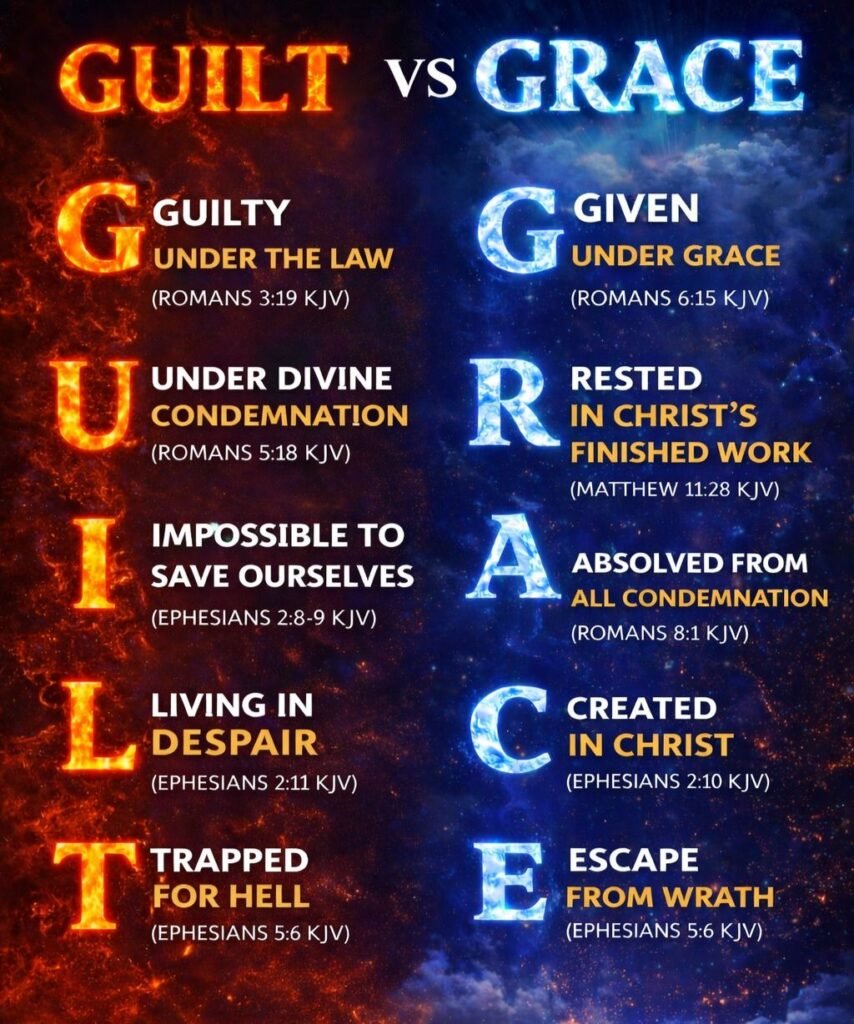
GUILT vs GRACE — From Condemnation to Completion
Why So Many Saved People Still Live Like They’re Lost
“There is therefore now no condemnation to them which are in Christ Jesus…” — Romans 8:1 (KJV)
Introduction: Saved… But Still Ashamed?
It’s one of the quietest struggles inside modern Christianity.
Many believers confess salvation by grace, yet live daily under guilt. They sing about freedom but think like prisoners. They quote Scripture but carry shame. They claim forgiveness yet brace themselves for punishment.
Why?
Because law language is still preached to grace people.
When Scripture is not rightly divided, when Israel’s law program is blended into the Church’s grace position, something shifts inside the believer’s conscience. Guilt replaces grace. Fear replaces faith. Bondage replaces rest.
The apostle Paul warned Timothy to “rightly divide the word of truth” (2 Timothy 2:15). That instruction is not academic—it is pastoral. Without right division, believers attempt to live under commandments that were never addressed to them. They measure their standing by performance instead of position. They interpret correction as condemnation.
Romans 8:1 does not whisper. It declares: “There is therefore now no condemnation to them which are in Christ Jesus.”
Not less condemnation. Not delayed condemnation. Not reduced condemnation.
No condemnation.
Tonight, we contrast two spiritual realities: GUILT—the condition of man under law, and GRACE—the standing of the saint in Christ under this present dispensation.
The difference is not minor.
It is the difference between condemnation and completion.
Guilt vs Gift: Condemned Under Law, Given Under Grace
The law has a voice. And it is not soft.
Romans 3:19 tells us that the law speaks “that every mouth may be stopped, and all the world may become guilty before God.” The law does not rehabilitate—it reveals. It does not comfort—it convicts.
Under the law, guilt is universal and unavoidable. No one keeps it perfectly. The law exposes sin but offers no power to overcome it. It diagnoses but does not cure.
That is why Romans 6:14 draws a bold line: “Ye are not under the law, but under grace.”
Grace does not soften the law; it replaces its jurisdiction. Ephesians 2:8 reminds us salvation is a gift—unearned, unpurchased, undeserved.
Guilt convicts.
Grace grants.
The gospel clarifies this shift. Salvation is apart from works. It is not a wage paid for effort; it is a gift given through faith.
Dispensational truth matters here. The law condemns; grace converts. If believers attempt to live under law after being saved by grace, they will experience constant spiritual whiplash. They will interpret every failure as judicial threat rather than fatherly correction.
The moment a believer understands that their standing before God is a gift, not a performance review, guilt begins to loosen its grip.
Under Condemnation vs Under Christ: Adam’s Sentence or Christ’s Justification?
Paul’s theology in Romans 5 is courtroom language. Through one man—Adam—condemnation came upon all. Through one man—Christ—justification came upon many.
Adam represents humanity in guilt. Christ represents believers in righteousness.
You cannot be represented by both at the same time.
Romans 8:1 settles the matter for those “in Christ.” Condemnation belongs to Adam’s family. Justification belongs to Christ’s Body.
Second Corinthians 5:21 explains how: “For he hath made him to be sin for us… that we might be made the righteousness of God in him.”
This is substitution, not supplementation. Christ did not assist our righteousness—He became our righteousness.
The cross completes the sentence. Condemnation was executed—not on the believer—but on Christ.
To live under guilt after justification is to question the verdict. It is to stand in a courtroom where the gavel has already fallen and act as though the trial is ongoing.
You cannot be “in Christ” and “under condemnation” simultaneously.
Theologically impossible. Spiritually exhausting.
Impossibility vs Immediate Acceptance: From Self-Salvation to Beloved Status
The human instinct under guilt is to attempt self-salvation.
More prayer. More effort. More repentance. More commitment.
But Ephesians 2:8–9 is unambiguous: “Not of works, lest any man should boast.”
Romans 4:5 intensifies the argument: God justifies “him that worketh not, but believeth.”
Self-salvation fails because it misunderstands sin’s depth. Sin is not a behavior problem; it is a nature problem. You cannot reform what must be crucified.
Grace does not improve sinners—it saves them.
The moment a sinner believes the gospel, something radical occurs. Ephesians 1:6 states believers are “accepted in the beloved.”
Not conditionally accepted. Not probationarily accepted. Accepted.
This acceptance is immediate and positional. It does not fluctuate with emotion or performance.
Guilt says, “Do more to be worthy.”
Grace says, “You are accepted because of Christ.”
The difference is life-altering.
Despair vs Deliverance: From Alienation to Reconciliation
Ephesians 2 describes life before grace as “without Christ… having no hope, and without God in the world.” That is despair.
Colossians 1:21–22 speaks of believers as once alienated and enemies in mind by wicked works. That is separation.
Guilt magnifies that alienation. It tells believers they are perpetually one failure away from rejection.
But Romans 5:10 introduces reconciliation. Enemies are reconciled to God by the death of His Son.
Reconciliation is not a negotiation—it is a completed act. The hostility has been addressed. The relationship has been restored.
Grace does not ask you to climb toward God. It brings you near.
Despair says, “You are too far.”
Deliverance says, “You have been brought nigh.”
When believers cling to guilt, they live emotionally in Ephesians 2:12 instead of positionally in Ephesians 2:13.
Grace relocates the believer from alienation to peace.
Trapped vs Transferred: From Wrath to Light
Wrath is real.
Ephesians 5:6 warns of the wrath of God upon the children of disobedience. Divine judgment is not symbolic—it is righteous response to sin.
But believers are not appointed to wrath.
First Thessalonians 1:10 declares that Jesus “delivered us from the wrath to come.” Colossians 1:13 explains believers are delivered from the power of darkness and translated into the kingdom of His dear Son.
Translation is relocation. It is transfer of realm.
Guilt keeps believers feeling as though wrath still hangs overhead. Grace teaches that the believer’s realm has changed.
You are not waiting for wrath. You have been rescued from it.
Under guilt, the Christian life feels like probation. Under grace, it is citizenship.
Wrath belongs to unbelief. Rescue belongs to faith.
Fear vs Finished Work: Performance or Rest?
Law demands performance—and it is never satisfied.
Hebrews 10:14 states, “For by one offering he hath perfected for ever them that are sanctified.”
Perfected forever.
Colossians 2:10 adds, “Ye are complete in him.”
Complete—not incomplete. Finished—not pending.
Matthew 11:28 records Christ’s invitation: “Come unto me… and I will give you rest.”
Rest is foreign to legalism. Under law, there is always another command to obey, another failure to correct, another standard unmet.
Under grace, the believer rests in the finished work of Christ.
If it is finished, stop trying to finish it.
That does not mean passivity—it means confidence. Service flows from rest, not anxiety.
Fear strives. Grace rests.
Identity Lost vs Identity Located: From Old Man to New Creation
Second Corinthians 5:17 declares, “If any man be in Christ, he is a new creature.”
Grace does not reform the old man—it crucifies him (Romans 6:6). The old identity tied to Adam was judged at the cross.
Colossians 3:3 explains that believers’ lives are “hid with Christ in God.”
Guilt clings to the old identity. It defines believers by past sins and present struggles.
Grace locates identity in Christ.
The old man is not improved—he is replaced. The believer is not an upgraded sinner; he is a new creation.
Identity drives behavior. When believers think like condemned sinners, they live defeated lives. When they understand themselves as new creations, behavior aligns with position.
Grace changes who you are, not just what you do.
Law-Minded vs Life-Minded: From Struggle to Spirit
Romans 7 is one of the most emotionally raw chapters in Scripture. “O wretched man that I am!”
That is the cry of law-minded struggle. The desire to do good collides with the inability to fulfill the law’s demand.
Romans 8 shifts the atmosphere: “The law of the Spirit of life in Christ Jesus hath made me free.”
Freedom is not found in trying harder—it is found in recognizing a new governing principle.
Galatians 5:18 clarifies: “If ye be led of the Spirit, ye are not under the law.”
Law produces internal conflict because it addresses the flesh. The Spirit produces life because He operates from position.
Victory flows from identity, not intensity.
Grace does not deny struggle—but it redefines the battlefield.
Guilt-Driven Living vs Grace-Filled Living
Perhaps the most persistent myth about grace is that it produces carelessness.
Paul anticipated that objection in Romans 6:1–2: “Shall we continue in sin, that grace may abound? God forbid.”
Grace teaches holiness—not through fear, but through transformation. Titus 2:11–12 explains that grace teaches us to deny ungodliness.
The motivation shifts.
Under guilt, obedience is fear-based. “If I fail, I will lose favor.”
Under grace, obedience is love-based. “The love of Christ constraineth us” (2 Corinthians 5:14).
Fear controls temporarily. Love compels permanently.
Grace does not excuse sin—it empowers righteousness.
When believers understand they are secure, they serve willingly. When they feel condemned, they either hide or rebel.
Grace produces fruit without fear.
Conclusion: From Condemnation to Completion
Guilt says:
You are condemned.
You must do more.
You will never measure up.
Grace says:
You are forgiven.
Christ paid it all.
You are complete in Him.
Romans 6:14 summarizes the shift: “For sin shall not have dominion over you: for ye are not under the law, but under grace.”
The Christian life was never designed to be a cycle of guilt management. It was designed to be a walk in finished favor.
Condemnation ended at the cross. Completion began at salvation.
To live under guilt after receiving grace is to live beneath your position.
Call to Action
Stop living like you are condemned.
Start believing who you are in Christ.
Rightly divide law and grace.
Rest in Christ’s finished work.
Grace is not fragile. It does not collapse under failure. It does not expire with weakness.
It stands because Christ stands.
Final Thoughts
Guilt condemns — Grace cleanses.
Law accuses — Grace absolves.
Fear controls — Love compels.
Works fail — Christ prevails.
Striving ends — Rest begins.
Old man dies — New man lives.
Bondage breaks — Liberty reigns.
Flesh struggles — Spirit triumphs.
Grace always wins.
“By grace ye are saved.” — Ephesians 2:8
And where grace reigns, guilt has no jurisdiction.
From condemnation to completion—that is the gospel journey.