
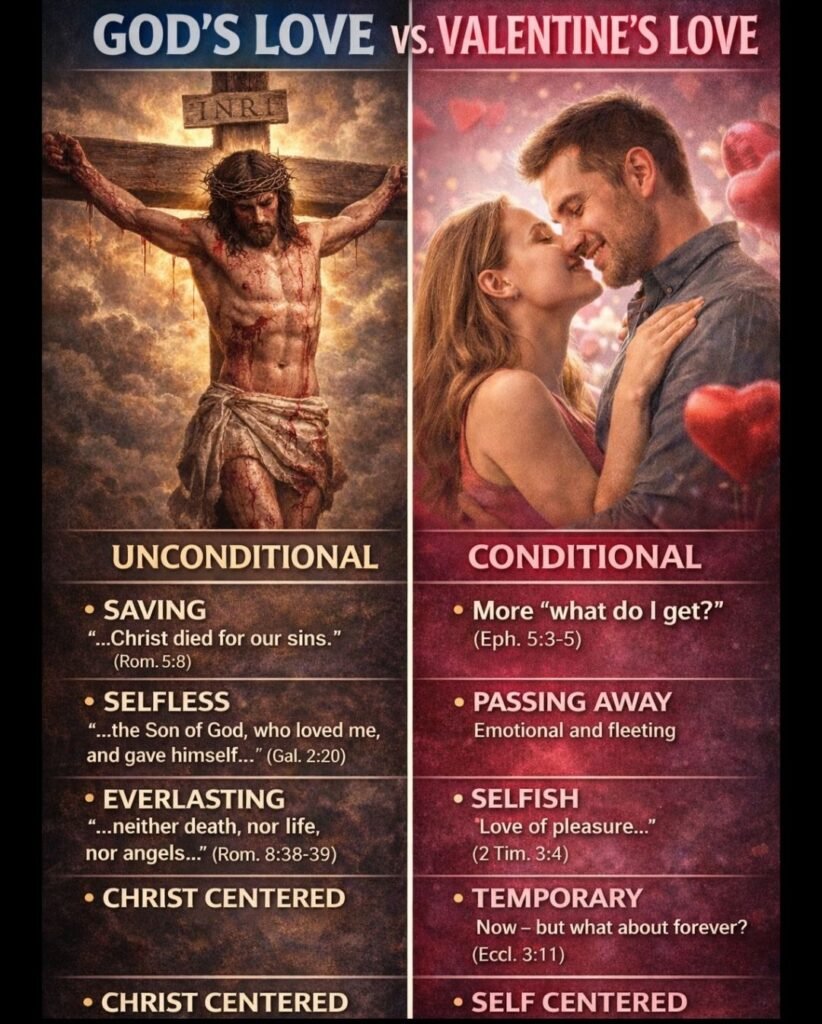
God’s Love vs. Valentine’s Love
Looks Can Be Deceiving
Every February, the world pauses to celebrate love. Storefronts bloom with red and pink. Roses, chocolates, jewelry, and cards flood the marketplace. Advertisements promise fulfillment through romance, intimacy, and emotional connection. For many, Valentine’s Day is portrayed as the highest expression of love—tender, passionate, affirming, and desirable.
Yet Scripture issues a sober warning: not everything that appears beautiful is beneficial, and not everything that feels loving is life-giving. The Apostle Paul cautioned believers that deception often wears an attractive disguise, reminding the Church that “Satan himself is transformed into an angel of light.” In other words, danger does not always look dark. Falsehood does not always announce itself as false. Sometimes, deception smiles.
In the present dispensation of the grace of God, believers are called to discern—not merely to feel. The contrast between God’s love and the world’s version of love is not subtle; it is foundational. One is rooted in sacrifice, truth, and eternal purpose. The other is anchored in emotion, desire, and temporal satisfaction. One rescues the soul. The other often distracts it.
Valentine’s love is not inherently evil. Human affection, romance, and companionship are part of God’s created order. However, when worldly love is elevated above divine love—when sentiment replaces Scripture and emotion replaces truth—it becomes deceptive. What looks loving may actually be spiritually dangerous.
The Bible consistently teaches that believers are not to walk by sight, but by faith. This principle applies not only to doctrine, but also to how love itself is understood. Valentine’s love is marketed through sight—what is attractive, pleasurable, and emotionally stirring. God’s love, by contrast, is revealed through faith—what is true, costly, and redemptive.
Worldly love appeals to feelings. God’s love rests on facts. Feelings are unstable by nature; they rise and fall with circumstances. They intensify in moments of pleasure and evaporate under pressure. Divine love, however, is not reactive. It is settled, deliberate, and unchanging. Scripture teaches that God demonstrated His love not when humanity was lovable, but when humanity was lost.
This distinction exposes a central problem in modern Christianity: many believers have been discipled by culture more than by Scripture. Love is defined by emotion rather than revelation. Acceptance replaces holiness. Tolerance overshadows truth. As a result, God’s love is often reduced to sentimentality—softened, diluted, and stripped of its redemptive power.
Valentine’s love is seasonal. It peaks on a calendar date, then fades into memory. It thrives on novelty and attention. God’s love, by contrast, is eternal. Scripture declares that He has set eternity in the human heart. Divine love is not bound by time, trends, or traditions. It existed before the world began and will endure long after it ends.
Chocolate melts. Flowers wither. Emotions cool. But the love of God remains.
The defining difference between these two loves is sacrifice. Worldly love often seeks reward before commitment. God’s love gives without condition. Romans declares that Christ died for sinners—not after repentance, reform, or improvement, but while humanity was still in rebellion. Divine love moves first. It bleeds before it blesses.
At Calvary, love was not spoken—it was proven. Nails pierced flesh. Blood was shed. Judgment was satisfied. Redemption was secured. This is not romantic love; it is redemptive love. Cupid offers affection. Christ offers atonement.
Worldly love frequently centers on self. It asks, consciously or unconsciously, “What do I gain?” Pleasure, validation, security, and fulfillment become the measuring sticks. Divine love turns the question outward: “How can I give?” Christ did not cling to His own life; He laid it down. Grace teaches believers to die to self, not indulge it.
This contrast exposes why many relationships fracture under pressure. When love is built on emotion and benefit, it collapses when circumstances change. God’s love, however, cannot be separated—not by tribulation, distress, persecution, or death. Romans assures believers that nothing can sever them from the love of God which is in Christ Jesus.
Security is another dividing line. Worldly love is fragile. It breaks under betrayal, hardship, or disappointment. God’s love is secured by blood. The believer’s assurance does not rest on emotional consistency, but on Christ’s finished work. Feelings fail. The blood prevails.
Scripture defines love, not society. “Herein is love,” John writes, “not that we loved God, but that he loved us, and sent his Son to be the propitiation for our sins.” Love is not self-defined; it is God-revealed. And that revelation reaches its clarity through the gospel committed to Paul.
Pauline doctrine strips love of illusion and anchors it in grace. It explains why salvation is not earned through affection or effort, but received by faith. God’s love does not merely comfort the heart—it saves the soul. Christ’s blood justifies the sinner. Eternal life flows from divine love alone.
Valentine’s love excites emotion. God’s love resurrects the dead.
This distinction matters deeply in a culture where love is used to justify sin, excuse compromise, and silence truth. “Love is love” has become a moral mantra, detached from Scripture and immune to correction. Yet love without truth is not biblical love. Grace does not erase righteousness; it fulfills it.
The cross is offensive because it exposes the cost of real love. It confronts sin rather than celebrating it. It demands repentance rather than applause. And yet, it is the greatest demonstration of love the world has ever known.
Believers are called to prove all things—to test, examine, and discern. Romance must never replace redemption. Sentiment must never override Scripture. Culture must never redefine Christ. Choosing God’s love over the world’s version is not rejection of affection; it is submission to truth.
What looks loving may be temporary. What looks painful—the cross—brings eternal life. God’s love is not defined by appearance, but by action. Not by feeling, but by fact. Not by culture, but by Christ.
Looks can be deceiving.
But God’s love is defining.
In the end, feelings fade, time reveals truth, and eternity exposes what was real. The cross still stands as the dividing line. Blood still speaks. Grace still saves. And Christ still loves—with a love that never fails.
Related posts:
 𝗩𝗔𝗟𝗘𝗡𝗧𝗜𝗡𝗘’𝗦 𝗗𝗔𝗬: 𝗟𝗢𝗩𝗘 𝗨𝗡𝗗𝗘𝗥 𝗚𝗥𝗔𝗖𝗘 𝗢𝗥 𝗟𝗨𝗦𝗧 𝗨𝗡𝗗𝗘𝗥 𝗧𝗛𝗘 𝗙𝗟𝗘𝗦𝗛?
 𝗧𝗛𝗘𝗥𝗘 𝗜𝗦 𝗣𝗢𝗪𝗘𝗥 𝗜𝗡 𝗧𝗛𝗘 𝗕𝗟𝗢𝗢𝗗 𝗢𝗙 𝗝𝗘𝗦𝗨𝗦 𝗖𝗛𝗥𝗜𝗦𝗧
 𝗪𝗢𝗥𝗟𝗗𝗟𝗬 𝗖𝗛𝗥𝗜𝗦𝗧𝗜𝗔𝗡 𝘃𝘀. 𝗦𝗣𝗜𝗥𝗜𝗧𝗨𝗔𝗟 𝗖𝗛𝗥𝗜𝗦𝗧𝗜𝗔𝗡
 𝗧𝗛𝗘𝗥𝗘 𝗜𝗦 𝗣𝗢𝗪𝗘𝗥 𝗜𝗡 𝗧𝗛𝗘 𝗕𝗟𝗢𝗢𝗗
 𝗧𝗛𝗘 𝗕𝗟𝗢𝗢𝗗 𝗢𝗡 𝗧𝗛𝗘 𝗗𝗢𝗢𝗥𝗣𝗢𝗦𝗧𝗦
 𝗟𝗨𝗦𝗧 𝘃𝘀 𝗟𝗢𝗩𝗘
 𝗧𝗛𝗘 𝗕𝗟𝗢𝗢𝗗 𝗢𝗙 𝗔𝗡𝗜𝗠𝗔𝗟𝗦 𝘃𝘀 𝗧𝗛𝗘 𝗕𝗟𝗢𝗢𝗗 𝗢𝗙 𝗖𝗛𝗥𝗜𝗦𝗧
 𝗜𝗡𝗙𝗟𝗨𝗘𝗡𝗖𝗜𝗡𝗚 𝗢𝗧𝗛𝗘𝗥𝗦 𝗧𝗢 𝗛𝗔𝗧𝗘: 𝗧𝗛𝗘 𝗦𝗣𝗜𝗥𝗜𝗧𝗨𝗔𝗟 𝗗𝗔𝗡𝗚𝗘𝗥
 𝗦𝗔𝗧𝗔𝗡 𝗛𝗔𝗧𝗘𝗦 𝗧𝗛𝗘 𝗕𝗟𝗢𝗢𝗗 — 𝗦𝗢 𝗣𝗥𝗘𝗔𝗖𝗛 𝗜𝗧 𝗕𝗢𝗟𝗗𝗘𝗥
 𝗪𝗢𝗥𝗞𝗦 𝗢𝗙 𝗧𝗛𝗘 𝗙𝗟𝗘𝗦𝗛 𝘃𝘀 𝗙𝗥𝗨𝗜𝗧𝗦 𝗢𝗙 𝗧𝗛𝗘 𝗦𝗣𝗜𝗥𝗜𝗧
 𝗧𝗛𝗘 𝗧𝗛𝗥𝗘𝗘 𝗧𝗘𝗠𝗣𝗧𝗔𝗧𝗜𝗢𝗡𝗦 𝗢𝗙 𝗧𝗛𝗘 𝗪𝗢𝗥𝗟𝗗
 𝗛𝗘 𝗖𝗛𝗘𝗖𝗞𝗘𝗗 𝗙𝗢𝗥 𝗧𝗛𝗘 𝗕𝗟𝗢𝗢𝗗
 𝗧𝗛𝗘 𝗪𝗢𝗥𝗟𝗗 𝘃𝘀 𝗧𝗛𝗘 𝗪𝗢𝗥𝗗
 𝗚𝗢𝗗 𝗔𝗡𝗗 𝗠𝗔𝗡: 𝗥𝗜𝗚𝗛𝗧𝗟𝗬 𝗗𝗜𝗩𝗜𝗗𝗘𝗗 𝗗𝗘𝗦𝗜𝗚𝗡