The prevailing climate of modern religious thought is one of profound systemic disorientation, an architectural misalignment that often escapes the notice of the casual observer but remains acutely felt by those navigating its internal corridors. This spiritual vertigo is not the result of a lack of sincerity or a deficit in devotion; rather, it stems from a fundamental failure to adhere to the structural blueprints laid out in the earliest records of the Christian faith. To understand why so many seekers find themselves trapped in a cycle of religious exhaustion, one must investigate the mechanics of divine and human design through a specific analytical lens: the Pauline doctrine of right division. In his second letter to Timothy, the Apostle Paul articulates a mandate that serves as the primary investigative tool for this inquiry, urging the student of truth to “rightly divide the word of truth.” This directive is not a mere suggestion for academic rigor; it is the essential operative principle for distinguishing between disparate divine programs and understanding the complex interface between a triune Creator and a threefold humanity. When this division is neglected, the theological landscape collapses into a blurred map where the earthly promises made to Israel are haphazardly stapled to the heavenly calling of the Body of Christ, and the distinct functions of the human spirit, soul, and body are conflated into an imprecise, non-functional interiority.
The investigation begins at the most fundamental level of reality: the nature of the Godhead. While religious tradition often treats the Trinity as a static, monolithic mystery to be acknowledged but not scrutinized, Pauline doctrine presents a dynamic and elegant unity of three distinct persons, each operating with a specific functional role in the economy of grace. As recorded in 1 Timothy 3:16, the “mystery of godliness” is anchored in the reality of God being manifest in the flesh, yet the journalistic clarity required for a professional investigation demands we look closer at the individual members of this divine council. The Godhead is one in essence, yet perfectly distinct in persons, a reality that prevents the confusion of roles that often plagues less precise theologies. By looking at the Father, the Son, and the Holy Spirit through the prism of Paul’s revelations, we find a coherent system where every action has an intended source, a specific means, and a guaranteed result.
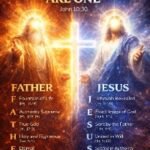
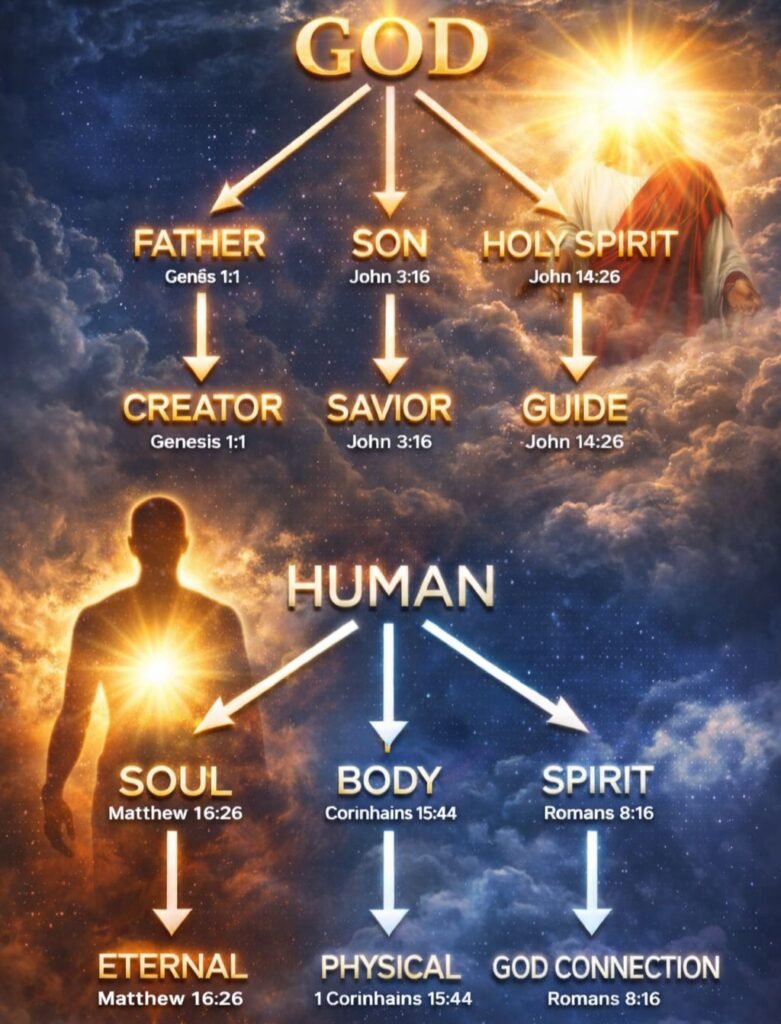
The Father is identified in the Pauline framework as the primary Foreknower, the ultimate source of all creation and the architect of the eternal plan. In 1 Corinthians 8:6, Paul establishes this hierarchy of origin, noting that there is “one God, the Father, of whom are all things.” He is the Planner who drafted the blueprint of existence before the first atom was spun into being. This is not a passive observation; it is an investigative starting point. The Father’s role as Creator initiated the very fabric of time and space, as Genesis 1:1 suggests, but Paul expands this by revealing the internal counsel that preceded the external act. In Ephesians 1:11, we find that the Father “worketh all things after the counsel of his own will.” This implies a meticulous, predetermined strategy—an eternal purpose that is not subject to the whims of human agency. The Father maintains control, sustaining all things through His providential care, a concept Paul echoed to the Athenians in Acts 17:28 when he noted that in Him we live, and move, and have our being. This is the Father as the Originator, the one whose calling is determined not by human merit but according to His own purpose and grace, as 2 Timothy 1:9 clarifies. To miss the Father’s role as the sovereign orchestrator is to view the universe as a series of chaotic accidents rather than a carefully managed stewardship. The investigative depth of Paul’s letters suggests that the Father’s foreknowledge is the bedrock upon which all other doctrine rests. It is the “source code” of the universe, the invisible framework that ensures the Son’s mission and the Spirit’s sealing are not merely reactive measures to a surprise rebellion, but part of a “hidden wisdom” ordained before the world unto our glory.
If the Father is the Architect, the Son is the manifest Agent of that plan. The investigation into the Person of Jesus Christ reveals a shift from the Father’s hidden, eternal counsel to a visible, historical manifestation. In the Pauline record, Christ is not a secondary figure but the “image of the invisible God,” the precise point where the abstract intentions of the Father take on the weight and substance of reality. The Son is revealed as the Savior, the specific member of the Godhead who stepped into the vacuum of human failure to resolve a crisis that humanity could not fix through religion or moral improvement. 1 Corinthians 15:3–4 serves as the core evidentiary document here: “Christ died for our sins according to the scriptures; and that he was buried, and that he rose again the third day.” This is not a religious ritual; it is a substitutionary sacrifice. The Son provided a sufficient satisfaction for the debt of sin, a payment made in full that requires no supplementary effort from the recipient. Hebrews 10:14 notes that by one offering He hath perfected forever them that are sanctified. The successful resurrection of Christ is the objective proof of this victory, ensuring that the design is not merely a theoretical construct but a functional reality. Now seated in supremacy at the right hand of God, the Son occupies a position of authority that governs the current dispensation of grace. This seating is of immense investigative importance; it signifies the cessation of the sacrificial work. Unlike the priests of Israel who stood daily ministering because their work was never done, Christ sat down, indicating that the problem of sin has been legally and eternally resolved for the believer.
Completing this triune structure is the Holy Spirit, whose function in the current era is perhaps the most misunderstood aspect of modern theology. In Israel’s historical program, the Spirit’s activity was often characterized by external empowerment for specific tasks—building a tabernacle, leading an army, or prophesying to a king. However, Paul’s investigative findings in Romans 8:16 and Ephesians 1:13 reveal a radical shift in the Spirit’s role for the Body of Christ. The Spirit now functions as an indwelling presence, a permanent resident within the believer rather than a temporary visitor. This is the “Identifying Witness” who confirms the believer’s sonship, providing an internal assurance that is independent of emotional fluctuations. Furthermore, the Spirit acts as an “Imparted Seal,” a theological “black box” that records and secures the believer’s identity until the day of redemption. As Ephesians 4:30 warns, we are not to grieve the Spirit, yet we are reminded that we are sealed by Him. This seal is the guarantee of eternal security, a structural component of the “Rightly Divided Design” that prevents the loss of salvation. The Spirit also serves as an instructing guide, teaching the believer the “deep things of God” which the natural mind is incapable of perceiving, as 1 Corinthians 2:12 explains. This guidance is not a series of mystical whispers or emotional prompts but is grounded in the “spirit of wisdom and revelation” in the knowledge of Him, working through the written word to enlighten the eyes of the understanding.
Having investigated the nature of the Godhead, the inquiry must logically transition to the subject of this divine attention: the human being. A recurring error in theological anthropology is the reduction of man to a simple duality of physical and non-physical parts. However, the Pauline blueprint provides a much more sophisticated anatomical breakdown. In 1 Thessalonians 5:23, Paul offers a tripartite definition: “I pray God your whole spirit and soul and body be preserved blameless.” This three-part design is not a metaphor; it is the fundamental mechanic of human existence. Each component has a specific function and a specific consciousness. The spirit is the faculty of God-consciousness, the internal organ designed to perceive and interact with the divine realm. The soul is the seat of self-consciousness, encompassing the mind, will, and emotions—the arena of personality. The body is the vessel of world-consciousness, the interface through which the individual interacts with the material universe. This distinction is critical for understanding the “Rightly Divided Design” of man. If one confuses the soul with the spirit, one might mistake emotional ecstasy for spiritual growth or intellectual assent for spiritual life. The investigative reality is that the spirit is the “inner man” that must be strengthened, while the soul is the medium through which that strength is expressed in the world.
The investigative reality of the human condition, however, is that this design has been catastrophically compromised. In the Adamic fall, the human spirit was not annihilated, but it was rendered “dead”—a term Paul uses in Ephesians 2:1 to describe a state of total disconnection from God. To be “dead in trespasses and sins” is to possess a spirit that is non-functional, unable to receive the transmission of divine life. This spiritual deadness is the root cause of the human predicament, a systemic failure that cannot be remedied by physical disciplines or psychological adjustments. Because the spirit is the highest part of man’s design, its failure affects the soul and the body, leading to a life governed by the “flesh”—the fallen nature that arises when the soul and body attempt to function without the guidance of a living spirit. The natural man, as Paul describes in 1 Corinthians 2:14, cannot receive the things of the Spirit of God, for they are foolishness unto him; neither can he know them, because they are spiritually discerned. This “blindness” is not an intellectual deficit but a functional incapacity of the dead spirit.
Salvation, therefore, must begin where the death occurred: in the spirit. In the Pauline “Rightly Divided Design,” the first effect of grace is the “quickening” of the spirit. Ephesians 2:5 states that God hath “quickened us together with Christ.” This is an instantaneous, ontological change. The moment a person trusts the gospel, their spirit is made alive, infused with the life of God, and permanently sealed. This is a crucial investigative distinction: the spirit’s salvation is an accomplished, perfected fact. It is not a process, nor is it subject to the believer’s daily performance. Paul goes as far as to say that we are “seated together in heavenly places in Christ Jesus” (Ephesians 2:6). This is our positional reality—a fixed point in the divine geography that remains true regardless of the chaos in the soul or the body. This “quickened spirit” is the new identity of the believer. It is the part of us that is “created in righteousness and true holiness” (Ephesians 4:24). The investigative evidence suggests that this new creation is not an improvement of the old man, but a completely new entity brought to life by the power of the resurrection.
While the spirit is saved instantly and completely, the soul and the body are subject to a different timeline and a different process. This is the area where religious confusion is most prevalent. Many believers spend their entire lives trying to “save” their souls through works, or “perfect” their bodies through asceticism, failing to recognize the distinct phases of God’s plan. The soul, according to Romans 12:2, is in a state of transformation. It is being “renewed” through the input of truth. This is a metabolic process of replacing old, Adamic thought patterns—the “wisdom of this world”—with the “mind of Christ.” It is a battle, as Galatians 5:17 notes, between the Spirit and the flesh, but it is a battle for the soul’s expression, not for the spirit’s security. The soul is the psychological field where the believer learns to align their thinking and choosing with the reality of their saved spirit. It is the process of “growing up into Him in all things” (Ephesians 4:15).
The body, meanwhile, remains a “vessel” that must be “presented” as a living sacrifice (Romans 12:1), but it is not yet redeemed from the presence of sin. Paul is clear in Romans 8:23 that even we who have the firstfruits of the Spirit groan within ourselves, “waiting for the adoption, to wit, the redemption of our body.” The final phase of the design is glorification, a future event where the physical body is transformed into a likeness of Christ’s glorious body, as 1 Corinthians 15:44 and 52 describe. Until then, the body remains subject to the “law of sin” and physical decay. To expect the body to behave as if it were already glorified is to set oneself up for inevitable failure and guilt. The investigation into the human body reveals it as the “temple of the Holy Ghost,” yet it is a temple that still carries the scars of the fall. The believer’s duty is not to “purify” the body into a state of sinless perfection, which is impossible this side of the resurrection, but to “mortify the deeds of the body” through the Spirit (Romans 8:13).
This brings the investigation to the crucial concept of the “Dispensation of Grace.” To rightly divide the design of God and man, one must recognize that God is dealing with the world today in a manner distinct from His dealings with Israel under the Law. In Ephesians 3:2, Paul refers to “the dispensation of the grace of God which is given me to you-ward.” This is a parenthetical period in the prophetic timeline, a mystery that was “hid in God” and not revealed until the Risen Christ communicated it to Paul. In this current program, the middle wall of partition between Jew and Gentile has been broken down, and God is forming a “new man”—the Body of Christ. This program is characterized by pure grace, apart from the works of the law, the rituals of the temple, or the national promises given to Abraham’s physical descendants. This is not a “replacement” of Israel, but a distinct program that must be kept separate in the investigator’s mind. Israel’s program involves a literal, earthly kingdom with a visible King on David’s throne. Our program involves a spiritual body with an invisible Head in the heavens.
The failure to distinguish between Israel’s program and the Body of Christ is the primary source of theological “mixed-breeding.” When believers attempt to apply the terms of the Mosaic Covenant or the early transitional period of the Gospels and Acts to themselves, they end up with a theology that is part grace and part law, leading to a “perverted gospel” as Paul warns in Galatians. Israel was promised earthly blessings, a literal kingdom, and a Messiah who would reign on David’s throne. The Body of Christ, however, is blessed with “all spiritual blessings in heavenly places” (Ephesians 1:3). Our hope is not the restoration of a geopolitical nation, but the “blessed hope” of the appearing of the glory of our great God and Savior, Jesus Christ. This investigative finding resolves a multitude of biblical apparent contradictions. For instance, why does James say faith without works is dead, while Paul says faith is counted for righteousness without works? The answer lies in the “Rightly Divided Design”: James is writing to the twelve tribes scattered abroad regarding their kingdom program, while Paul is writing to the Body of Christ regarding our grace program.
In this design, clarity replaces the fog of religious tradition. We see a God who is triune in His majesty, a man who is threefold in his complexity, and a salvation that is complete in its inception. The “Rightly Divided Design” is not a dry theological exercise; it is the key to psychological and spiritual rest. To know that your spirit is permanently sealed, that your soul is being renewed by truth, and that your body is a temple destined for glory, is to move from the exhaustion of religion into the “praise of the glory of His grace.” This rest is not a passive inactivity but a confident engagement with life, knowing that the foundation is secure. The believer no longer works for salvation but works from salvation. This is the “walk in the Spirit” that Paul emphasizes—a life where the power of the quickened spirit flows through the renewed soul to govern the mortal body.
To further deepen the investigative record, we must look at the specific nature of the “conflict” described in Galatians 5. Paul identifies a war between the “flesh” and the “Spirit.” It is critical to note that “flesh” (sarx) in Pauline theology is not merely the skin and bones of the physical body. Rather, it is the composite of the unredeemed body and the unrenewed soul, operating under the old Adamic impulse. The “Spirit” (Pneuma) refers to the indwelling Holy Spirit operating through the quickened human spirit. The investigator observes that these two are “contrary the one to the other.” This internal tension is not a sign of spiritual failure, but a sign of spiritual life. Before salvation, there was no conflict because there was no competing life; there was only the flesh. The emergence of this battle is evidence of the “Rightly Divided Design” in action. The solution is not to “try harder” but to “yield” to the Spirit’s lead.
The investigative journey concludes at the feet of the “Dispensation of Grace.” Paul notes in Ephesians 3:2 that this specific stewardship was given to him “to you-ward.” It is a program where the “law of works” has been superseded by the “law of the Spirit of life.” When we rightly divide the Word, we see that we are not living in the shadows of the Old Covenant, nor are we mimicking the early transitional period of the Acts of the Apostles. We are in a unique window of time where God is forming the “Body of Christ.” This investigative reality changes how we view every aspect of our lives—from our finances to our relationships to our view of the future. We are ambassadors of a heavenly kingdom, operating in a world that is currently under the “god of this world,” yet we are secure in our identity and our destination.
The journalist’s duty is to follow the evidence, and the evidence of the Pauline epistles points to a God who has meticulously organized the salvation of man to ensure His own glory and our absolute security. The triune God—Father, Son, and Spirit—has designed a threefold man—spirit, soul, and body—to be the recipient of a grace that is both comprehensive and specific. Salvation begins in the spirit, transforming it from a state of death to a state of eternal life. Sanctification proceeds in the soul, as the mind is renewed by the rightly divided Word. Glorification awaits the body, the final act of a Creator who leaves no part of His design unfinished. To ignore these divisions is to live in a house where the plumbing is connected to the electrical grid; it is a recipe for disaster. But to embrace the “Rightly Divided Design” is to find the harmony that the Creator intended. It is to move from the noise of religion into the quiet confidence of grace. It is to understand that God’s order is not a burden to be borne, but a foundation to be built upon.
As we examine the historical context of Paul’s ministry, we find that he was often the target of “Judaizers”—individuals who sought to blend the grace of the Body of Christ with the requirements of the Mosaic Law. This investigative detail is crucial because it highlights the perpetual human tendency to regress into “religion.” Religion, in this sense, is the attempt by the soul and body to achieve what God has already provided in the spirit. Paul’s response was always a sharp “right division.” In his letter to the Galatians, he asks, “Are ye so foolish? having begun in the Spirit, are ye now made perfect by the flesh?” This is the core question of the investigative report. If salvation is a gift of grace received through faith in the spirit, any attempt to maintain or perfect it through the efforts of the flesh is a denial of the “Rightly Divided Design.” It is a functional return to the law, which Paul identifies as the “strength of sin.”
The theological investigator must also account for the unique terminology Paul uses, such as being “in Christ.” This phrase appears over eighty times in his epistles and represents the pinnacle of the believer’s position. To be “in Christ” is to be positionally removed from the line of Adam and placed into the line of the “Last Adam.” This is a legal transfer that took place the moment the spirit was quickened. In this new position, the believer is identified with Christ in His death, burial, and resurrection. We died with Him to the power of sin; we were buried with Him, marking the end of our old life; and we were raised with Him to walk in “newness of life.” This is not a metaphor for a fresh start; it is a description of a structural change in our spiritual architecture. We are no longer defined by our performance but by our position. This is the ultimate “Rightly Divided Design”—a design that places the believer beyond the reach of condemnation (Romans 8:1) and into the realm of permanent acceptance.
Furthermore, the investigation into the “body” reveals that while it is currently subject to “vile” conditions and decay, it is not an inherently evil part of the design. Greek philosophical thought often viewed the body as a prison for the soul, but Pauline doctrine views the body as a part of the original design that is destined for redemption. The “Rightly Divided Design” recognizes that the body is currently a “earthen vessel” holding a “treasure.” The treasure is the life of Christ manifest in our mortal flesh (2 Corinthians 4:7). The investigative conclusion here is that the believer’s physical life is the platform upon which the grace of God is put on display for the “principalities and powers in heavenly places” to observe. Our daily conduct in this mortal body is the evidence of God’s “manifold wisdom.”
To conclude this investigative inquiry, we must reflect on the “praise of the glory of His grace.” Everything in the “Rightly Divided Design”—from the Father’s foreknowledge to the Spirit’s sealing, from the spirit’s quickening to the body’s future glorification—is designed for one ultimate purpose: the exaltation of God’s grace. When we try to mix the programs, or confuse the parts of our makeup, we inevitably end up taking some of the glory for ourselves, as if our effort or our ritual was the deciding factor. But in the Pauline blueprint, there is no room for boasting. “For by grace are ye saved through faith; and that not of yourselves: it is the gift of God: Not of works, lest any man should boast” (Ephesians 2:8-9). This is the final verdict of the investigation. The “Rightly Divided Design” is a masterpiece of divine engineering that guarantees the success of the project and the peace of the participant. It is a design that calls us to study, to rest, and to walk in the fullness of what we have been given.
In the final analysis, the “Rightly Divided Design” is not just for the theologian or the pastor; it is for every person who has ever felt the exhaustion of trying to be “enough” for God. It is the announcement that the work is finished, the identity is secure, and the future is certain. It is the lens through which the entire Bible becomes a coherent, unified narrative of God’s unfolding purpose. From the first verse of Genesis to the final praise of Ephesians, the message is clear: God has a design, and when we see it clearly, we find the life we were always meant to live. This is the true “mystery of godliness” revealed—not as a puzzle to be solved, but as a person to be known and a position to be enjoyed. The investigation is complete; the design is perfect; and the grace is sufficient.
As the researcher steps back to view the entirety of the Pauline corpus, one final theme emerges with undeniable force: the absolute supremacy of Christ in this design. In Colossians 1, Paul describes Him as the one who “is before all things, and by him all things consist.” This consistency—this holding together of the universe—is reflected in the way the rightly divided word holds together the believer’s life. Without the division of truth, the pieces of our lives feel fragmented and contradictory. We feel like Jews one day and Christians the next; we feel like saints in our spirit and sinners in our flesh. But when we apply the divine division, we see that we are one person with a clear identity, living in a specific time, under a specific set of rules. We see that the conflict is not a contradiction, but a transition. We see that the body’s weakness is not a denial of the spirit’s strength, but an opportunity for grace to be made perfect in weakness.
This investigative report has sought to strip away the layers of religious tradition to reveal the structural integrity of the Pauline revelation. It has found that the triune God is the author of a plan that is as systematic as it is spiritual. It has found that the threefold man is a reflection of that divine order, even in his current fallen state. And it has found that the dispensation of grace is the unique window through which we now see the face of God. To rightly divide is to see with God’s eyes; to walk in that division is to live with God’s power. The “Rightly Divided Design” is the ultimate investigative discovery—a truth that sets the prisoner free and the weary at rest. It is the hallmark of a professional approach to the scripture, and the foundation of a profound experience of the divine. To the praise of the glory of His grace, we rest in this design, knowing that He who began a good work in us will perform it until the day of Jesus Christ.
The implications for the modern believer are vast. In a world characterized by shifting values and systemic instability, the “Rightly Divided Design” provides a fixed point of reference. It allows the individual to navigate the complexities of life with a “sound mind” (2 Timothy 1:7). Because the believer knows that their spirit is already perfected and their identity is already established, they are no longer vulnerable to the identity crises that plague the secular world. They do not look to their career, their relationships, or their physical appearance to define them. They look to the “Rightly Divided Design” and see themselves as God sees them: as members of the Body of Christ, ambassadors of grace, and heirs of eternal glory. This investigative finding is the ultimate antidote to the anxiety of the modern age. It is the peace that passeth all understanding, guarding our hearts and minds through Christ Jesus.
Finally, we must acknowledge that this design is not just a personal comfort; it is a corporate mission. As the Body of Christ, we are called to “make all men see what is the fellowship of the mystery” (Ephesians 3:9). This is the investigative mandate for the church: to communicate the “Rightly Divided Design” to a world that is lost in the fog of religion and the darkness of sin. Our message is not “do better,” but “believe what has been done.” Our message is not “climb the ladder,” but “accept the gift.” When the church rightly divides the word, it becomes a beacon of clarity in a confused world. It offers a design that actually works, a grace that actually saves, and a hope that actually transforms. This is the legacy of Paul, and it is the responsibility of every “workman” who handles the word of truth. The design is laid out before us; the invitation is open; the grace is overflowing. Let us therefore study, let us therefore divide, and let us therefore walk in the light of the “Rightly Divided Design.”