
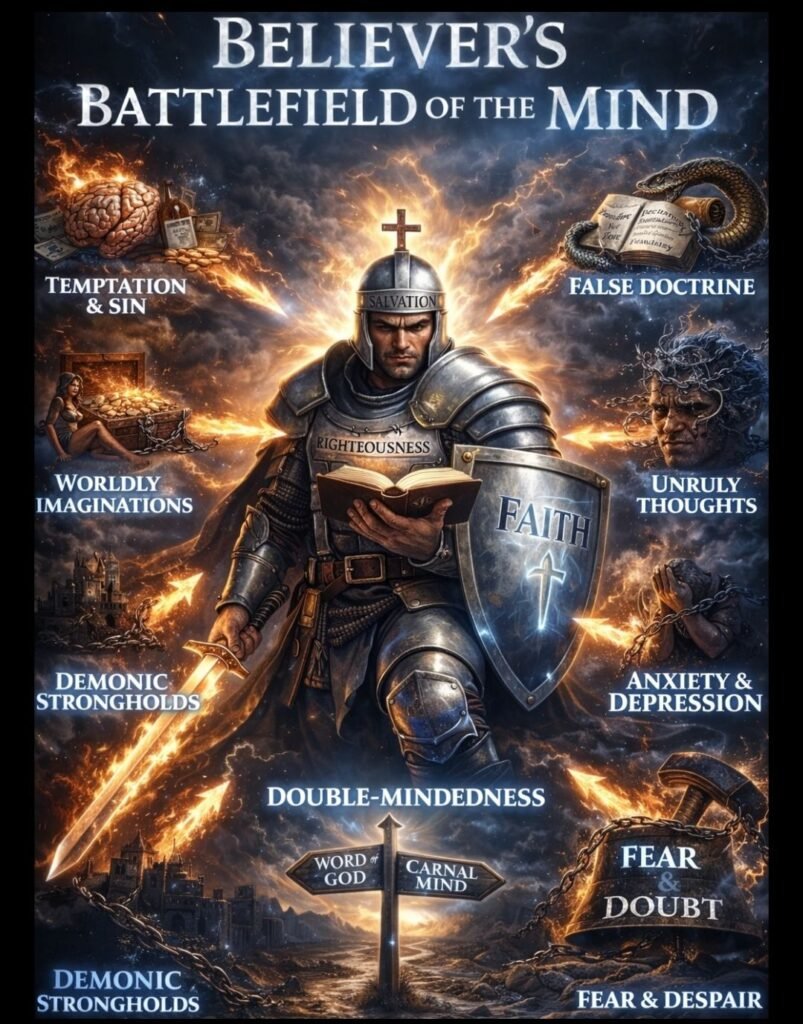
In the specialized theater of eschatological and psychological forensics, the prevailing consensus often directs human attention toward visible geopolitical upheavals or cultural shifts, yet a clinical audit of the Pauline epistles reveals that the primary theater of operation is localized within the human intellect. While the world observes the movements of nations and the volatility of political landscapes, the Scripture identifies a silent, internal conflict of far greater consequence. Under the current administration of the Grace of God, the believer is not engaged in a territorial struggle for earthly land, nor is the objective a social transformation of the secular order. Instead, the focus is an administrative and spiritual engagement localized in the thought life. As documented in 2 Corinthians 10:3–5, “For though we walk in the flesh, we do not war after the flesh: (For the weapons of our warfare are not carnal, but mighty through God to the pulling down of strong holds;) Casting down imaginations, and every high thing that exalteth itself against the knowledge of God, and bringing into captivity every thought to the obedience of Christ.”
The foundational pillar of this investigation recognizes that spiritual warfare in the present dispensation is strictly doctrinal and psychological rather than physical. One must apply the rule of “right division” found in 2 Timothy 2:15 to distinguish between the physical battles of Israel’s prophetic program and the mental standing of the Body of Christ. In this age, we are not fighting to obtain salvation, as Ephesians 2:8–9 confirms that the work is finished and gifted. We are not wrestling against flesh and blood enemies in a military sense, but as Ephesians 6:12 clarifies, our struggle is against principalities and powers in heavenly places. The enemy’s objective is not to steal the believer’s soul—which is already “sealed with that holy Spirit of promise” (Ephesians 1:13)—but to disturb the believer’s stability through temptation, fear, false doctrine, and doubt.
A critical segment of this forensic audit begins with the protection of the intellect, characterized as the “helmet of salvation.” Doubt regarding one’s standing is a primary weapon of psychological attrition. To counter this, the investigator observes that the believer’s position is legally settled. Ephesians 2:6 provides the administrative data, stating that we are already “seated together in heavenly places in Christ Jesus.” This is not a future hope but a present forensic reality. When the mind is anchored in the fact that salvation is “not by works of righteousness which we have done” (Titus 3:5), the ammunition of insecurity is rendered inert. The mind stabilizes when it recognizes that its security is a byproduct of the Spirit’s seal, not the believer’s performance.
Identity serves as the primary defense against the encroaching fog of insecurity. The investigator finds that a significant portion of mental instability stems from a failure to recognize the new identity granted at the Cross. 2 Corinthians 5:21 establishes the clinical exchange: “For he hath made him to be sin for us, who knew no sin; that we might be made the righteousness of God in him.” This is a positional truth that must be “reckoned” as fact. Romans 6:11 instructs the believer to “reckon ye also yourselves to be dead indeed unto sin, but alive unto God through Jesus Christ our Lord.” The term “reckon” is an accounting term; it implies counting a transaction as completed. When the mind is rooted in this new identity, the “old man” of carnal habit loses its psychological grip, and the believer is no longer defined by past failure but by present righteousness in Christ.
The investigation identifies false doctrine as a major source of mental confusion and spiritual weakness. Without the tool of right division, the Bible appears to be a book of contradictions, causing the mind to oscillate between the grace of Paul’s epistles and the legal requirements of other dispensations. Galatians 1:8 warns that even if an angel from heaven preaches “any other gospel” than that which was delivered to Paul, they are to be accursed. This suggests that the enemy uses religious confusion to destabilize the believer’s confidence. By recognizing the specific “mystery” given to Paul for the Body of Christ (Ephesians 3:2–3), the mind finds a baseline for truth that excludes legalism and religious rituals, providing a clear jurisdictional boundary for the believer’s thoughts.
Temptation is another documented variable in this internal battlefield, and the investigative data shows that every act begins as an intellectual seed. 2 Corinthians 10:5 provides the protocol for mental hygiene: “bringing into captivity every thought.” This is a proactive rather than a reactive measure. The battle is won in the realm of the imagination before it ever manifests in the physical world. The investigator observes that God provides a “way to escape” through the reliance on sound doctrine (1 Corinthians 10:13). By turning to “spiritual mindedness,” which Romans 8:6 equates with “life and peace,” the believer starves carnal impulses. The triumph over temptation is thus achieved through the deliberate application of truth to the initial thought, preventing the cycle of desire from reaching fruition.
Fear is identified as a paralyzing agent that stalls spiritual growth and disrupts cognitive clarity. The clinical diagnostic for fear is found in 2 Timothy 1:7: “For God hath not given us the spirit of fear; but of power, and of love, and of a sound mind.” This establishes that fear is an external influence rather than a divine attribute. To face fear, the believer must pivot their focus toward “things above” (Colossians 3:2). When the mind is fixed on the unchanging character of God and the finished work of Christ, the looming threats of the earthly realm shrink in significance. The investigative findings suggest that faith is not an emotion but a focused confidence in grace, as Hebrews 13:6 records: “So that we may boldly say, The Lord is my helper, and I will not fear what man shall do unto me.”
Anxiety is addressed in this audit as a state of “carefulness” or fractured thinking. The forensic solution is provided in Philippians 4:6–7, which instructs the believer to be “careful for nothing” and instead to utilize prayer and supplication with thanksgiving. This administrative hand-off of concerns results in the “peace of God, which passeth all understanding,” acting as a garrison for the mind. This peace is not a vacuum of thought but a guard that protects the intellect from the corrosive effects of worry. By abiding in “sound doctrine”—the healthy words of the Apostle Paul (2 Timothy 1:13)—the mind maintains a calm stability that the world cannot simulate through secular psychology.
Double-mindedness is documented as a carnal stronghold that causes chronic instability. The investigator notes that carnal thinking is essentially a mind divided between the “Spirit” and the “flesh.” Galatians 5:16 provides the decision-making framework: “Walk in the Spirit, and ye shall not fulfil the lust of the flesh.” This walk is not a physical stride but an intellectual alignment. When the believer decides to destroy carnal strongholds—those habitual patterns of thought that exalt themselves against God—the double-mindedness is defeated. Romans 12:2 calls for a transformation “by the renewing of your mind.” This renewal is the process of replacing human reasoning with the “mind of Christ” through the study of the Word of truth.
Demonic strongholds in the present age are primarily doctrinal. The investigation reveals that spiritual opposition manifests through “philosophy and vain deceit, after the tradition of men, after the rudiments of the world, and not after Christ” (Colossians 2:8). Dismantling these strongholds requires the “sword of the Spirit,” which is the Word of God (Ephesians 6:17). This warfare is not about shouting at shadows but about declaring truth boldly. When sound doctrine is applied to a lie, the stronghold collapses under its own lack of structural integrity. The investigator concludes that most “spiritual oppression” experienced by believers today is actually the result of holding onto unbiblical traditions or legalistic concepts that have not been rightly divided.
The ultimate victory in this battlefield is achieved through the Word of God reigning supreme over the intellect. Romans 1:16 identifies the “gospel of Christ” as the power of God, and this power is operational only when it is understood and believed. Victory is not an emotional state but a state of being “grounded and settled” in the truth (Colossians 1:23). The investigator find that the mind wins when it stops looking for signs, wonders, or feelings and starts resting in the finished grace of God. This renewed mind becomes a governable entity that is no longer tossed to and fro by every wind of doctrine.
Dispensational clarity is the clinical differentiator between victory and defeat. We must recognize that the “casting out of demons” and territorial warfare of the Gospels and Acts are not the instructions for the Body of Christ today. Our warfare is the “good fight of faith” (1 Timothy 6:12). Our weapons are doctrine, truth, right division, and the gospel of grace. The battlefield is internal; it is a battle for the governance of the soul. The investigator concludes that while the enemy cannot steal the believer’s salvation—which is hidden with Christ in God (Colossians 3:3)—he can certainly disturb the believer’s peace and productivity by occupying the mind with falsehoods.
The conclusion of this forensic audit finds that the believer’s mind must be guarded, grounded, and governed by grace. The war is real, but the victory has already been legally secured by the Lord Jesus Christ. The “battlefield of the mind” is where the reality of that victory is either enjoyed or obscured. The enemy’s only tool is deception, and his only power is the power we give to his lies. By standing in finished grace and refusing to move from the “hope of the gospel,” the believer effectively wins the war before it even begins.
A call to action is required for all who have reviewed this investigative record. The believer must put on the armor of God daily by reading and rightly dividing the Scriptures. There must be an intentional renewal of the mind, a deliberate decision to rest in identity rather than performance, and a firm rejection of fear. If an individual reading this report has not been saved, the victory begins with the acceptance of the gospel: that Christ died for our sins, was buried, and rose again (1 Corinthians 15:1–4). Faith in this finished work is the only entry point into the “sound mind” that God offers to humanity.
The forensic summary remains firm: Salvation is secured by the blood of Christ. Righteousness is recognized by faith. False doctrine is fought with right division. Temptation is triumphed over by taking thoughts captive. Fear is faced with the spirit of power. Anxiety is answered with the peace of God. Double-mindedness is defeated by walking in the Spirit. Demonic strongholds are dismantled with sound doctrine. Victory is realized through the Word. The battlefield is indeed the mind, but the weapon is the Word, and the victory is eternally in Christ.
The investigation further observes that the “mind of Christ” is not a mystical download but an administrative alignment with the written Word. Paul instructs the Philippians to “let this mind be in you, which was also in Christ Jesus” (Philippians 2:5). This mind is characterized by humility, obedience, and a focus on the Father’s will. In the current age, having the “mind of Christ” means viewing life through the lens of the mystery and the dispensation of grace. The investigator finds that when the mind is occupied with “whatsoever things are true, whatsoever things are honest, whatsoever things are just, whatsoever things are pure, whatsoever things are lovely, whatsoever things are of good report” (Philippians 4:8), there is no psychological room for the adversary to gain a foothold.
Furthermore, the audit suggests that many of the psychological crises faced by modern believers are the result of “spiritual malnutrition”—a lack of sound doctrine that leaves the mind vulnerable to “every wind of doctrine” (Ephesians 4:14). The investigator notes that a robust understanding of Pauline truth acts as a cognitive immune system, identifying and neutralizing viral lies before they can cause emotional or spiritual illness. The “soundness” of one’s mind is directly proportional to the “soundness” of the doctrine one consumes. Just as the physical body requires a specific diet for health, the intellect requires the “words of faith and of good doctrine” (1 Timothy 4:6) to maintain its resilience against the stresses of a fallen world.
The investigation into the “carnal mind” provides additional clinical insights. Romans 8:7 states that “the carnal mind is enmity against God: for it is not subject to the law of God, neither indeed can be.” This mind is the default setting of the human race, focused on self-preservation, pride, and the rudiments of the world. The believer is told not to be conformed to this world but to be transformed. The transformation is not an external “makeover” but an internal “renovation.” The investigator finds that this renovation is the lifelong work of the believer—to systematically replace carnal reasoning with spiritual truth until the intellect is a reflection of the grace that saved it.
The role of the Church, the Body of Christ, in this warfare is also significant. We are told to “speak the same thing” and to be “perfectly joined together in the same mind and in the same judgment” (1 Corinthians 1:10). This corporate mental alignment provides a defensive perimeter for individual members. When the local assembly is grounded in the same sound doctrine, the “wiles of the devil” are easily spotted and rebuffed. The investigator notes that isolation is a common tactic of the enemy; by separating a believer from the corporate mind of the Body, he makes them a soft target for anxiety and false doctrine.
The investigation into the “conscience” adds another layer to the mental battlefield. Paul speaks of the conscience as either “bearing witness,” being “weak,” or even being “seared with a hot iron” (1 Timothy 4:2). A mind that is rightly divided understands that the conscience is no longer under the condemnation of the Law. Hebrews 9:14 describes the blood of Christ as “purging your conscience from dead works to serve the living God.” When the conscience is purged, the mind is free from the debilitating weight of guilt, which the enemy uses to stifle spiritual activity. The investigator concludes that a “clear conscience” is a prerequisite for a “sound mind,” and both are secured by the finished work of Christ.
Finally, the forensic audit addresses the “peace of God” as the ultimate metric of victory in the mental battlefield. This peace is not the absence of external conflict but the presence of internal stability. It is described as a “garrison” that keeps the heart and mind through Christ Jesus. The investigator find that this peace is the natural byproduct of a mind that is “stayed” on God, as the prophet Isaiah anticipated and Paul confirmed in his instructions to the Philippians. In a world characterized by “distress of nations, with perplexity” (Luke 21:25), the believer with a renewed mind stands as a clinical anomaly—a person of peace in a world of panic.
As the forensic report closes, it reiterates that the war for the mind is the only war that truly matters for the believer’s daily experience. The victory was won at the Cross, but the enjoyment of that victory is determined by what we believe. The mind is the bridge between our heavenly standing and our earthly walk. If the bridge is compromised by lies, the walk is unstable. If the bridge is reinforced with truth, the walk is a triumphal procession (2 Corinthians 2:14). Ensure your mind is guarded, grounded, and governed by grace. The King is coming, and His word remains the only reliable intelligence report in a world of deception.
The final summary of the investigation remains: Believe the Gospel. Rightly divide the Word. Renew the mind. Rest in the victory of Christ. The battlefield is the mind, but the weapon is the Word, and the victory is forever.
The investigative findings are complete. The record stands as a testimony to the sufficiency of the Word of God to stabilize the human soul in the midst of any conflict. The believer is equipped with everything necessary for “life and godliness” (2 Peter 1:3), primarily the “sound mind” that comes from knowing the God of all grace. The war for your thoughts is yours to win, provided you use the weapons God has provided. Do not be “ignorant of his devices” (2 Corinthians 2:11), but be “strong in the Lord, and in the power of his might” (Ephesians 6:10). The report is closed, but the battle is daily—stand fast in the liberty wherewith Christ hath made us free.
Related posts:
 𝗟𝗜𝗚𝗛𝗧 𝗦𝗛𝗜𝗡𝗘𝗦 𝗜𝗡 𝗧𝗛𝗘 𝗗𝗔𝗥𝗞𝗡𝗘𝗦𝗦
 𝗦𝗬𝗠𝗕𝗢𝗟𝗦 𝗢𝗙 𝗧𝗛𝗘 𝗪𝗢𝗥𝗗 𝗢𝗙 𝗚𝗢𝗗
 𝗧𝗛𝗘 𝗧𝗥𝗜𝗖𝗛𝗢𝗧𝗢𝗠𝗬 𝗢𝗙 𝗠𝗔𝗡
 𝗧𝗛𝗘 𝗕𝗥𝗔𝗜𝗡 𝗠𝗨𝗦𝗧 𝗕𝗘 𝗪𝗔𝗧𝗘𝗥𝗘𝗗 𝗪𝗜𝗧𝗛 𝗧𝗛𝗘 𝗪𝗢𝗥𝗗 𝗢𝗙 𝗚𝗢𝗗 𝗗𝗔𝗜𝗟𝗬
 𝗧𝗛𝗘 𝗦𝗪𝗢𝗥𝗗 𝗢𝗙 𝗧𝗛𝗘 𝗦𝗣𝗜𝗥𝗜𝗧 — 𝗧𝗛𝗘 𝗪𝗢𝗥𝗗 𝗢𝗙 𝗚𝗢𝗗
 𝗧𝗛𝗘 𝗪𝗛𝗢𝗟𝗘 𝗔𝗥𝗠𝗢𝗥 𝗢𝗙 𝗚𝗢𝗗
 𝗙𝗢𝗨𝗥 𝗦𝗧𝗔𝗚𝗘𝗦 𝗢𝗙 𝗦𝗣𝗜𝗥𝗜𝗧𝗨𝗔𝗟 𝗚𝗥𝗢𝗪𝗧𝗛
 𝗧𝗛𝗘 𝗙𝗜𝗡𝗔𝗟 𝗔𝗨𝗧𝗛𝗢𝗥𝗜𝗧𝗬 — 𝗧𝗛𝗘 𝗪𝗢𝗥𝗗 𝗢𝗙 𝗚𝗢𝗗
 𝗢𝗡𝗟𝗬 𝗢𝗡𝗘 𝗘𝗠𝗣𝗧𝗬 𝗧𝗢𝗠𝗕
 𝗛𝗢𝗪 𝗚𝗢𝗗 𝗗𝗘𝗖𝗟𝗔𝗥𝗘𝗦 𝗔 𝗦𝗜𝗡𝗡𝗘𝗥 𝗥𝗜𝗚𝗛𝗧𝗘𝗢𝗨𝗦
 𝗧𝗛𝗘 𝗛𝗢𝗟𝗬 𝗧𝗥𝗜𝗡𝗜𝗧𝗬
 𝗔𝗟𝗖𝗢𝗛𝗢𝗟 — 𝗗𝗘𝗦𝗧𝗥𝗢𝗬𝗘𝗥 𝗢𝗙 𝗠𝗔𝗡𝗬 𝗟𝗜𝗩𝗘𝗦
 𝗪𝗘 𝗦𝗘𝗘 𝗧𝗛𝗘 𝗪𝗢𝗥𝗟𝗗 𝗧𝗛𝗥𝗢𝗨𝗚𝗛 𝗗𝗜𝗙𝗙𝗘𝗥𝗘𝗡𝗧 𝗟𝗘𝗡𝗦𝗘𝗦
 𝗧𝗛𝗘 𝟳 𝗕𝗟𝗘𝗦𝗦𝗜𝗡𝗚𝗦 𝗢𝗙 𝗧𝗛𝗘 𝗛𝗢𝗟𝗬 𝗦𝗣𝗜𝗥𝗜𝗧