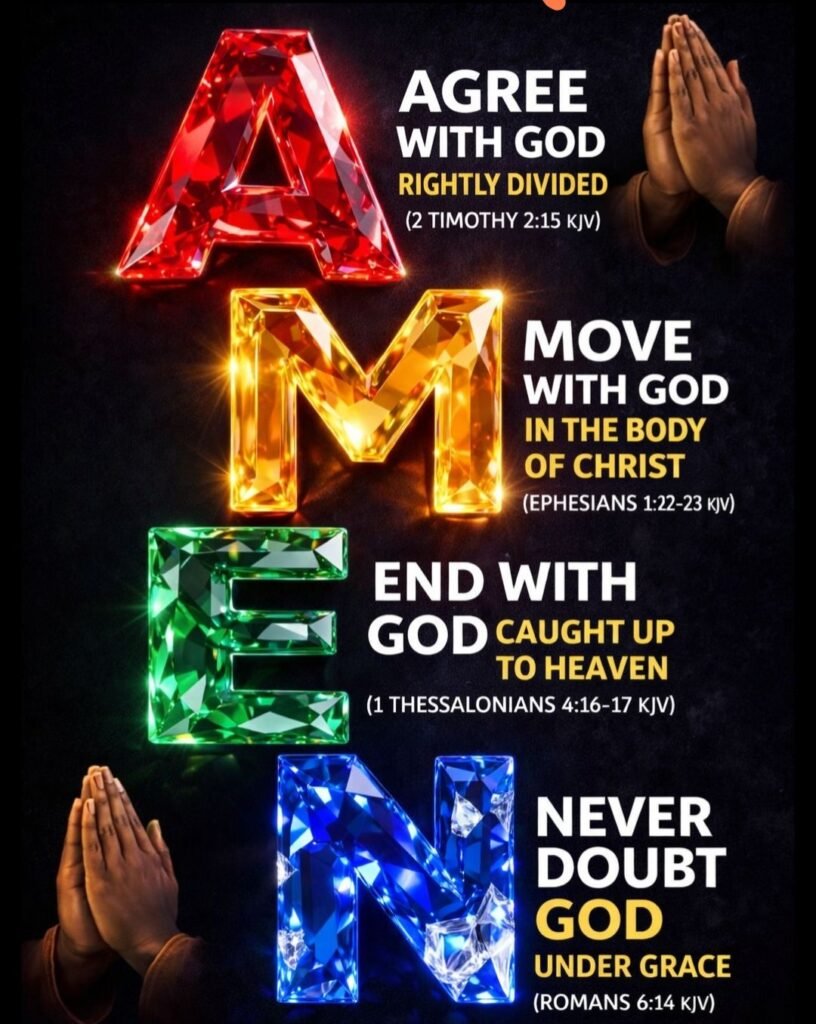
AMEN: THE GRACE PATH OF THE BODY OF CHRIST
Why Agreement with God’s Grace Program Determines Stability, Identity, and Destiny
“For all the promises of God in him are yea, and in him Amen.” — 2 Corinthians 1:20 (KJV)
Introduction: “Amen” Is Not a Closing Word—It Is a Confession of Alignment
In churches, homes, and quiet personal prayers, the word Amen is spoken almost reflexively. It closes prayers. It punctuates sermons. It signals agreement. Yet for most believers, Amen functions more as a religious habit than a doctrinal declaration.
Scripture, however, presents Amen as far more than verbal punctuation. In the context of Paul’s gospel, Amen represents alignment—alignment with God’s Word rightly divided, with God’s current work in the Body of Christ, and with God’s guaranteed conclusion for the Church in glory.
To say Amen is not merely to agree emotionally. It is to stand doctrinally. It is to affirm that God has spoken clearly in this present dispensation and that His instructions, promises, and expectations are not scattered randomly across Scripture, but revealed with precision through the apostle Paul.
In an age of widespread biblical confusion—where Israel’s promises are applied to the Church, where law is mixed with grace, and where fear replaces assurance—the Pauline meaning of Amen restores order.
To say Amen today is to declare four settled convictions:
I agree with God’s Word as He has divided it.
I move with God in the Body of Christ.
I end with God, caught up to heaven.
I never doubt God under grace.
This is not denominational language. It is dispensational truth. And without it, Christianity becomes a cycle of uncertainty rather than a walk of confidence.
Agreeing with God’s Word: Why Right Division Is the Beginning of Stability
Spiritual confusion rarely comes from denying Scripture outright. More often, it comes from misusing it. The Bible is inspired, profitable, and authoritative—but it is not uniform in audience, purpose, or instruction. Paul addresses this directly in 2 Timothy 2:15, urging believers to “rightly divide the word of truth.”
Agreement with God begins by accepting that God Himself makes distinctions in His Word. Not every command applies to every group. Not every promise belongs to the Church. Not every instruction was written to believers living under grace.
Failure to acknowledge this results in contradiction: believers are told they are free from the law, yet commanded to keep it; assured of eternal security, yet warned of losing salvation; promised peace, yet threatened with wrath. The issue is not Scripture—it is division.
Right division recognizes Paul as the apostle to the Gentiles and the divinely appointed steward of the mystery revealed for this present age. Agreeing with Paul is not theological preference; it is obedience to God’s design.
When believers agree with Scripture as God has structured it, stability follows. Assurance replaces anxiety. Doctrine replaces tradition. Confidence replaces confusion.
To say Amen is to stop arguing with God’s order and start resting in it.
Acknowledging the Mystery: The Church Was Revealed, Not Predicted
One of the most revolutionary truths in Pauline doctrine is the concept of the mystery. Ephesians 3 explains that the Church, the Body of Christ, was “hid in God” and “kept secret since the world began.” This is not poetic language—it is a dispensational statement.
The Church was not foretold in Old Testament prophecy. Israel’s prophets spoke of an earthly kingdom, national restoration, and messianic rule from Jerusalem. They did not describe a heavenly Body composed of Jews and Gentiles without distinction, seated in Christ above all principalities.
This mystery was revealed uniquely to Paul. It defines the Church’s identity, calling, and destiny. The Church is not spiritual Israel. It does not inherit Israel’s covenants. It is not promised earthly dominion or national blessing.
Its calling is heavenly. Its position is in Christ. Its destiny is glory.
Acknowledging the mystery resolves countless theological disputes. It explains why the Church is not under the law. It clarifies why water baptism, temple worship, and kingdom signs do not define this age. It establishes why Paul’s epistles—Romans through Philemon—are foundational for doctrine, reproof, and instruction in righteousness today.
To say Amen is to acknowledge that God revealed something new, and that ignoring it is not humility—it is disobedience.
Accepting Grace Without Works: Why Grace Must Stand Alone
Romans 11:6 states the matter with unmistakable clarity: “If by grace, then is it no more of works: otherwise grace is no more grace.” Grace does not coexist with merit. The moment works are added, grace is canceled.
Yet much of modern Christianity operates as though grace were merely a starting point, with human effort completing what Christ began. Salvation is preached as a gift, but maintained by obedience. Acceptance is declared freely given, but subtly threatened by failure.
Paul rejects this framework entirely. Grace saves completely or not at all. It requires no preparation, no improvement, and no contribution. Faith is not a work; it is the means of receiving what Christ has already accomplished.
The law cannot be mixed with grace without destroying both. Law demands performance. Grace supplies righteousness. Law condemns. Grace justifies. Law addresses the flesh. Grace places the believer in Christ.
Accepting grace without works is not spiritual laziness; it is doctrinal accuracy. It honors the sufficiency of the cross and the finality of Christ’s sacrifice.
To say Amen is to stop negotiating with God and start believing Him.
Moving with God in the Body of Christ: Identity Before Activity
Ephesians 1 declares that God has placed all things under Christ’s feet and given Him as Head over all things to the Church, which is His Body. This imagery is not symbolic—it is functional.
The Body of Christ is a living organism, not a religious institution. Believers are not members by attendance, ritual, or affiliation. They are placed into the Body by the baptism of the Holy Spirit at the moment of salvation.
This spiritual placement transcends ethnicity, social status, and religious background. Jew and Gentile are made one, not through assimilation, but through new creation.
Movement within the Body is directed by the Head. Christ governs through doctrine, not hierarchy. Service flows from identity, not obligation. Growth occurs through edification, not coercion.
To move with God is to recognize where God is working today. He is not building an earthly kingdom. He is forming a heavenly Body. He is not restoring Israel nationally—yet. He is calling out a people for His name through grace.
To say Amen is to align with that movement, not resist it by clinging to outdated frameworks.
Maintaining Liberty Under Grace: Freedom Without Fear
Romans 6:14 announces a decisive shift: “Ye are not under the law, but under grace.” This is not conditional. It is positional.
Liberty under grace does not mean the absence of instruction. It means the absence of condemnation. Sin no longer reigns as a master because grace reigns through righteousness.
Law-based living produces fear—fear of failure, fear of judgment, fear of rejection. Grace-based living produces confidence—confidence in Christ’s sufficiency, God’s acceptance, and the Spirit’s work.
Liberty is not license. Grace teaches holiness, not by threat, but by transformation. Obedience becomes fruit, not currency. The believer walks worthy not to remain saved, but because they are saved.
Maintaining liberty requires doctrinal vigilance. Legalism creeps in quietly, often disguised as spirituality. Paul warns repeatedly against returning to bondage after being made free.
To say Amen is to refuse slavery where Christ has given freedom.
Magnifying the Gospel of Grace: The Message That Saves Today
In 1 Corinthians 15, Paul defines the gospel by which believers are saved: Christ died for our sins, was buried, and rose again the third day. This gospel is not one option among many—it is the saving message for this dispensation.
It centers on substitution. Christ died for our sins. His burial confirms the completeness of payment. His resurrection secures justification.
Anything added to this gospel—rituals, commitments, promises of obedience—corrupts it. Anything removed from it—blood atonement, bodily resurrection—empties it of power.
Magnifying the gospel means keeping it clear, central, and uncontaminated. It means resisting the temptation to modify it for cultural acceptance or emotional appeal.
The gospel does not need enhancement. It needs proclamation.
To say Amen is to defend the gospel, not dilute it.
Maturing in Pauline Doctrine: Growth Through Grounded Truth
Colossians 2 describes maturity as being rooted, built up, and established in the faith. This growth does not occur through spiritual experimentation or religious tradition, but through sound doctrine.
Pauline doctrine provides the framework for understanding salvation, sanctification, suffering, service, and hope. Without it, believers remain vulnerable to deception and instability.
Maturity is not measured by years in church, emotional expression, or visible activity. It is measured by doctrinal understanding and spiritual stability.
The epistles from Romans to Philemon are not advanced material—they are foundational. They explain who believers are, where they stand, and how they walk.
To say Amen is to commit to growth through truth, not novelty.
Expecting the Blessed Hope: A Certain Ending for the Church
1 Thessalonians 4 describes the Church’s conclusion—not in wrath, but in glory. The Lord will descend, the dead in Christ will rise, and living believers will be caught up together to meet Him in the air.
This event, often called the Rapture, is not a secondary doctrine. It defines the Church’s destiny. It distinguishes the Body of Christ from Israel’s prophetic program.
The hope is blessed because it is comforting. It is imminent. It is guaranteed.
The Church does not await tribulation, judgment, or purification. It awaits reunion.
To say Amen is to live with expectation, not dread.
Never Doubting God Under Grace: Assurance as a Gift
Romans 8:1 declares no condemnation for those in Christ Jesus. Doubt thrives where assurance is undermined. Grace removes the basis for fear.
Believers are sealed by the Spirit. Judgment has been satisfied. Salvation is secure.
This assurance does not produce complacency; it produces peace. It frees believers to grow honestly, serve joyfully, and endure faithfully.
To doubt grace is to question the sufficiency of Christ. To say Amen is to trust God fully.
Conclusion: Amen Is Alignment, Not Emotion
To say Amen is to agree with God’s grace program without reservation. It is to recognize His order, accept His provision, follow His direction, and trust His conclusion.
Anything less is religious confusion.
Final Thoughts
Agreement brings clarity.
The mystery reveals identity.
Grace secures salvation.
The Body defines the walk.
Liberty replaces fear.
The gospel saves completely.
Doctrine produces growth.
The rapture ends the journey.
Grace removes all doubt.
“Now to him that is of power to stablish you according to my gospel…” — Romans 16:25
Related posts:
 𝗧𝗛𝗘 𝗦𝗘𝗖𝗥𝗘𝗧 𝗧𝗛𝗔𝗧 𝗗𝗘𝗦𝗧𝗥𝗢𝗬𝗘𝗗 𝗦𝗔𝗧𝗔𝗡
 𝗝𝗘𝗦𝗨𝗦 𝗖𝗛𝗥𝗜𝗦𝗧 𝗧𝗛𝗘 𝗠𝗘𝗦𝗦𝗜𝗔𝗛 𝗣𝗥𝗢𝗩𝗘𝗡 𝗪𝗜𝗧𝗛 𝗔𝗕𝗦𝗢𝗟𝗨𝗧𝗘 𝗖𝗘𝗥𝗧𝗔𝗜𝗡𝗧𝗬 𝗕𝗬 𝗗𝗔𝗡𝗜𝗘𝗟 𝟵
 𝗙𝗥𝗢𝗠 𝗣𝗥𝗢𝗣𝗛𝗘𝗖𝗬 𝗧𝗢 𝗠𝗬𝗦𝗧𝗘𝗥𝗬. 𝗧𝗛𝗘 𝗞𝗘𝗬 𝗧𝗢 𝗨𝗡𝗗𝗘𝗥𝗦𝗧𝗔𝗡𝗗𝗜𝗡𝗚 𝗦𝗖𝗥𝗜𝗣𝗧𝗨𝗥𝗘 – 𝗚𝗢𝗗 𝗜𝗦 𝗡𝗢𝗧 𝗧𝗛𝗘 𝗔𝗨𝗧𝗛𝗢𝗥 𝗢𝗙 𝗖𝗢𝗡𝗙𝗨𝗦𝗜𝗢𝗡!
 𝗝𝗘𝗦𝗨𝗦: 𝗢𝗨𝗥 𝗖𝗢𝗠𝗣𝗟𝗘𝗧𝗘 𝗦𝗧𝗔𝗡𝗗𝗜𝗡𝗚 𝗜𝗡 𝗚𝗥𝗔𝗖𝗘
 𝗪𝗛𝗬 𝗔𝗣𝗢𝗦𝗧𝗟𝗘 𝗣𝗔𝗨𝗟?
 𝗜𝗡𝗙𝗟𝗨𝗘𝗡𝗖𝗜𝗡𝗚 𝗢𝗧𝗛𝗘𝗥𝗦 𝗧𝗢 𝗛𝗔𝗧𝗘: 𝗧𝗛𝗘 𝗦𝗣𝗜𝗥𝗜𝗧𝗨𝗔𝗟 𝗗𝗔𝗡𝗚𝗘𝗥
 𝗦𝗧𝗢𝗣 𝗧𝗪𝗜𝗦𝗧𝗜𝗡𝗚 𝗚𝗢𝗗’𝗦 𝗪𝗢𝗥𝗗