In the specialized field of spiritual pathology, a clinical audit of human conduct under the current administration of Grace reveals a recurring toxin that systematically dismantles the believer’s cognitive and spiritual readiness. This investigative report addresses the chemical and spiritual phenomenon of alcohol consumption, identified in the Pauline record as a direct rival to the indwelling of the Holy Spirit. Ephesians 5:18 establishes the diagnostic baseline: “And be not drunk with wine, wherein is excess; but be filled with the Spirit.” Within a rigorous dispensational framework, while the believer is technically “not under the law, but under grace” (Romans 6:14), the forensic data indicates that the liberty of the Body of Christ is never a license for self-destruction. The biological effects of alcohol serve as a catalyst for a broader spiritual collapse, clouding the mind, corrupting the heart, and ultimately compromising the testimony of the New Creation.
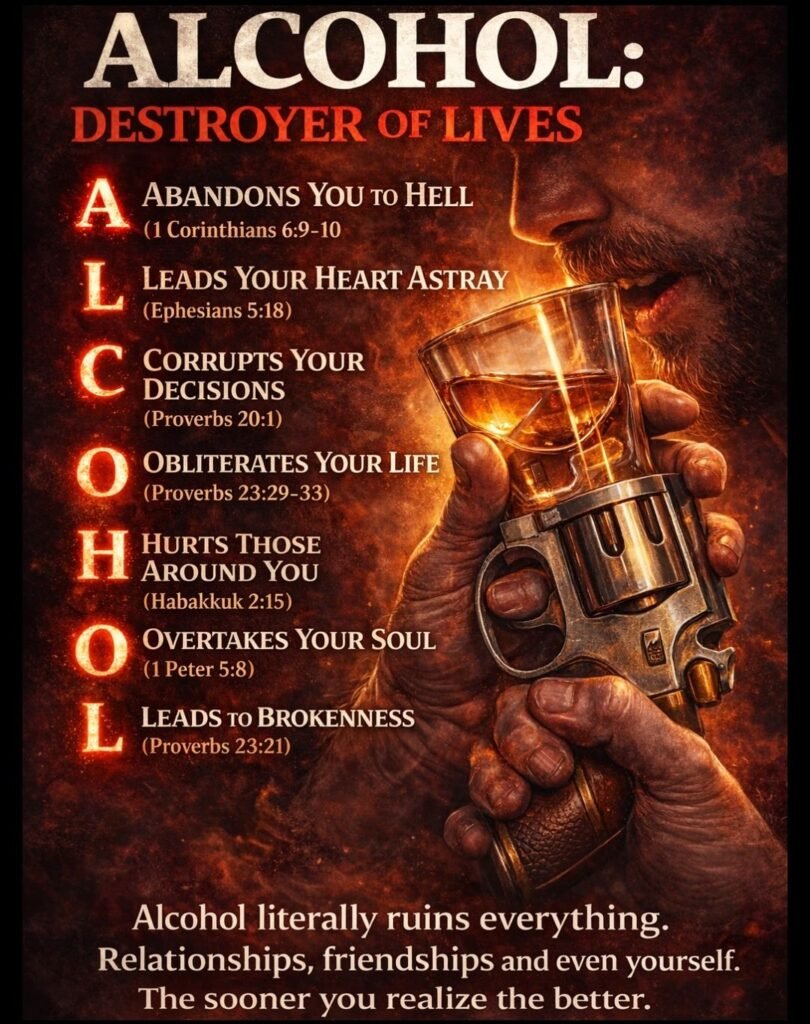
A foundational pillar of this inquiry begins with the neurological and spiritual alteration of the mind. Proverbs 20:1 provides the administrative warning: “Wine is a mocker, strong drink is a raging: and whosoever is deceived thereby is not wise.” The investigative conclusion is that alcohol operates primarily through deception, promising a temporary cognitive escape while simultaneously eroding the capacity for spiritual judgment. A mind under the influence of strong drink is a mind that has voluntarily surrendered its sobriety—a state that 1 Peter 5:8 identifies as essential for survival: “Be sober, be vigilant; because your adversary the devil, as a roaring lion, walketh about, seeking whom he may devour.” To compromise the mind’s sobriety is to disable the believer’s primary defense mechanism against spiritual predation.
The investigation into the moral discernment of the consumer reveals a systematic confusion of values. Isaiah 5:22–23 describes those who are “mighty to drink wine” as those who “justify the wicked for reward, and take away the righteousness of the righteousness from him.” This data suggests that alcohol does not merely affect coordination; it corrupts the internal judicial system of the individual. Under the Pauline doctrine of the “renewed mind” (Romans 12:2), the believer is called to prove what is that good, and acceptable, and perfect, will of God. Alcohol, by its very nature, introduces a cognitive noise that renders this discernment impossible, replacing spiritual clarity with carnal confusion.
Liquor serves as a secondary agent that leads the heart toward fleshly living and away from spiritual sensitivity. Hosea 4:11 notes that “whoredom and wine and new wine take away the heart.” The investigative audit finds that as chemical dependence increases, spiritual awareness decreases. In the economy of the Body of Christ, the heart is meant to be the seat of faith and the reservoir of the Word of God; however, the presence of intoxicating substances creates a “spiritual callousness.” Ephesians 4:18 describes those who are “alienated from the life of God through the ignorance that is in them, because of the blindness of their heart.” Alcohol acts as a self-inflicted blindness, luring the believer into the “works of the flesh” enumerated in Galatians 5:19–21, where drunkenness is categorized alongside idolatry and immorality.
The corruption of character and conduct is a measurable outcome of chronic consumption. Proverbs 23:33 warns of the hallucinogenic and behavioral shifts: “Thine eyes shall behold strange women, and thine heart shall utter perverse things.” This behavioral data indicates that alcohol removes the internal governors of character, allowing carnal impulses to dominate the personality. For the member of the Body of Christ, conduct is a matter of corporate testimony. 1 Corinthians 10:31–32 mandates: “Whether therefore ye eat, or drink, or whatsoever ye do, do all to the glory of God. Give none offence, neither to the Jews, nor to the Gentiles, nor to the church of God.” The investigator concludes that it is statistically impossible to maintain a testimony that glorifies God while the individual is under the control of a substance that God labels as a “mocker.”
Alcohol acts as a gateway, opening judicial and spiritual doors to secondary sins that would otherwise be rejected by a sober mind. Habakkuk 2:15 provides a forensic look at the social impact: “Woe unto him that giveth his neighbour drink… that thou mayest look on their nakedness!” The record shows a direct correlation between intoxication and the loss of moral boundaries. Furthermore, Proverbs 23:29–30 connects alcohol to unnecessary violence and emotional trauma, asking, “Who hath woe? who hath sorrow? who hath contentions? who hath babbling? who hath wounds without cause?” The answer is invariably found among those who “tarry long at the wine.” The investigator also notes the legal trap of addiction; while 1 Corinthians 6:12 affirms that “all things are lawful,” it immediately qualifies this by stating, “but I will not be brought under the power of any.” Alcohol is a power that seeks to replace the Spirit’s authority with chemical bondage.
The impact on the domestic sphere is catastrophic, as alcohol systematically hurts homes and relationships. Proverbs 23:21 warns that “the drunkard and the glutton shall come to poverty.” The financial data alone identifies alcohol as a primary driver of household instability. Beyond the economic factor, the emotional destruction of families is documented throughout the history of human sorrow. For those in positions of spiritual oversight, the standards are even more rigid. 1 Timothy 3:3 requires that a bishop be “not given to wine,” identifying sobriety as a non-negotiable prerequisite for leadership. The investigation finds that when a leader compromises on this point, the entire community suffers a loss of trust and spiritual direction.
The soul is overtaken and enslaved by the progressive nature of the substance. Proverbs 23:34–35 describes the disorientation and the obsessive-compulsive cycle of the addict: “I have been stricken, shalt thou say, and I was not sick; they have beaten me, and I felt it not: when shall I awake? I will seek it yet again.” This demonstrates the transition from a “social habit” to a “spiritual bondage.” In the Pauline framework, a person is a servant to whatever they yield themselves to (Romans 6:16). The investigator concludes that alcohol acts as a rival lord, occupying the mind and body and oppressing the spiritual growth that is the birthright of the believer. The “weight” that so easily besets us in Hebrews 12:1 is often found in the bottom of a bottle.
The final investigative category addresses the loss and brokenness that result from this trajectory. Proverbs 21:17 states, “He that loveth wine and oil shall not be rich.” The financial loss is coupled with a more profound moral collapse. Galatians 6:7 reminds the reader of the immutable law of the harvest: “Be not deceived; God is not mocked: for whatsoever a man soweth, that shall he also reap.” Those who sow to the flesh via intoxication inevitably reap corruption. The final state of the unrepentant habit is summarized in Proverbs 23:32: “At the last it biteth like a serpent, and stingeth like an adder.” The poison is not in the first sip, but in the ultimate result—a life stripped of its potential and a testimony left in ruins.
The forensic audit also extends into the neurological implications of “long-term cognitive deficits” associated with habitual consumption. In the specialized arena of spiritual warfare, a “clouded mind” is a primary vulnerability. The investigator notes that 2 Timothy 1:7 defines the divine standard for the believer’s intellect: “For God hath not given us the spirit of fear; but of power, and of love, and of a sound mind.” Alcohol, by pharmaceutical definition, is a central nervous system depressant that systematically attacks the “sound mind.” A clinical examination of this phenomenon reveals that while the World promotes “moderate use,” the Biblical mandate prioritizes “total vigilance.” There is no forensic evidence in the Pauline record that suggests a “partially sound mind” is sufficient for the pulling down of strongholds.
Furthermore, the investigation into “corporate holiness” within the local assembly identifies alcohol as a primary agent of division. 1 Corinthians 5:11 provides a strict administrative directive: “But now I have written unto you not to keep company, if any man that is called a brother be… a drunkard… with such an one no not to eat.” The investigative conclusion is that intoxication is not merely a private vice but a public health crisis within the Body of Christ. It disrupts the unity of the Spirit and introduces a carnal element that grieves the Holy Ghost. The audit suggests that the maintenance of a “sober environment” is essential for the effective functioning of the spiritual gifts described in 1 Corinthians 12.
The report also analyzes the “law of influence” as it relates to the weaker brother. Romans 14:21 states, “It is good neither to eat flesh, nor to drink wine, nor any thing whereby thy brother stumbleth, or is offended, or is made weak.” The forensic data suggests that the social use of alcohol creates a “stumbling block” that can lead to the spiritual ruin of others. A professional believer recognizes that their liberty ends where their brother’s safety begins. The investigation concludes that the most effective way to “walk in love” (Ephesians 5:2) is to voluntarily abstain from substances that historically have caused more destruction than any other social habit. This is not legalism; it is high-level spiritual strategy.
The summary of this forensic audit concludes that alcohol is a destroyer of lives without equal in the social sphere. It alters the mind’s ability to perceive God’s truth, leads the heart toward the appetites of the old nature, and corrupts the conduct of those called to holiness. It opens the door to a multitude of secondary transgressions, shatters the peace of the home, and enslaves the soul in a cycle of chemical and spiritual bondage. The professional conclusion is that the Spirit of God and the spirit of wine are mutually exclusive masters.
A call to action is directed to every believer: reject the destructive habits of the world and “put ye on the Lord Jesus Christ, and make not provision for the flesh, to fulfil the lusts thereof” (Romans 13:14). Renew your mind in the Scriptures to regain the cognitive clarity stolen by the world. Remain sober and vigilant, for the time is short. Rely on the sufficiency of God’s grace, which is greater than any addiction (2 Corinthians 12:9), and reflect the character of Christ in every lifestyle choice. Freedom is not found in the temporary numbness of a drink, but in the permanent transformation of the Gospel.
The investigation into “sober-mindedness” in the Pauline epistles reveals it to be a key attribute of the healthy believer. In Titus 2, the command to be sober is given to aged men, aged women, young women, and young men alike. This universal requirement suggests that sobriety is the baseline for all Christian experience. The investigator concludes that without a clear, unadulterated mind, the application of “sound doctrine” becomes impossible. To be “temperate in all things” (1 Corinthians 9:25) is the mark of the spiritual athlete striving for an incorruptible crown.
The economic audit of the “drunkard’s path” shows a direct link between substance use and the erosion of generational wealth. Proverbs 23:21 is not merely a moral observation but an economic reality. The investigative report finds that resources intended for the “furtherance of the gospel” (Philippians 1:12) are often diverted into the coffers of an industry that profits from human misery. For the believer who is a “steward” of God’s resources, this diversion is a forensic failure of the highest order.
Furthermore, the investigation into “spiritual sensitivity” finds that alcohol numbs the conscience. 1 Timothy 4:2 speaks of a “conscience seared with a hot iron.” While this can refer to false doctrine, the investigative data shows that repeated intoxication has a similar effect, cauterizing the soul’s ability to feel the Spirit’s conviction. This “searing” leads to a state where the believer can no longer discern between the “precious and the vile.” The recovery of spiritual feeling requires a total cessation of the numbing agent and a immersion in the “washing of water by the word” (Ephesians 5:26).
The social forensic report on the “broken home” identifies alcohol as a primary antagonist to the “peace of God, which passeth all understanding” (Philippians 4:7). When a parent or spouse yields to wine, the home becomes a theater of Contentions (Proverbs 23:29). The investigation finds that the “fruit of the Spirit”—love, joy, peace, longsuffering, gentleness, goodness, faith, meekness, temperance—cannot grow in an atmosphere saturated with the “works of the flesh.” The restoration of the home depends on the restoration of the Spirit’s control over the individual members.
The investigation concludes that the “filling of the Spirit” mentioned in Ephesians 5:18 is the only viable alternative to the “filling of the bottle.” Intoxication is a counterfeit filling; it provides a fake joy, a fake courage, and a fake peace. The Spirit provides the reality of these virtues. The professional auditor notes that many people drink because they are thirsty for something only God can provide. To drink alcohol is to “hew out… broken cisterns, that can hold no water” (Jeremiah 2:13). The believer is encouraged to drink deeply from the “living water” found in Christ.
The final assessment of the “Alcohol Trap” reveals that it often begins under the guise of “Christian liberty.” The investigator warns that “liberty” used as an occasion to the flesh is a strategic error (Galatians 5:13). If a habit has the potential to cause a brother to stumble or to destroy one’s own temple (1 Corinthians 3:16-17), it must be abandoned as a matter of professional spiritual priority. The “strong” believer is the one who has the strength to abstain for the sake of the Gospel and the glory of God.
The investigative findings are summarized: Alcohol is a mind-altering, heart-corrupting, character-destroying, home-wrecking, and soul-enslaving substance. It promises escape but delivers a prison. It offers pleasure but produces pain. The Pauline mandate for the Body of Christ is clear: avoid the excess of wine and be consumed by the Spirit of God. This is the only path to a life of true sobriety, effective service, and eternal reward.
Final thoughts: The world is intoxicated with its own lusts, and alcohol is its chosen sacrament. The believer, however, is a “child of light” (1 Thessalonians 5:5). We do not belong to the night or to the darkness of the tavern. We belong to the day. Let us therefore “walk honestly, as in the day; not in rioting and drunkenness, not in chambering and wantonness, not in strife and envying” (Romans 13:13). The investigation is finished. The warning is documented. The choice remains.
The report suggests that those struggling with this bondage should not seek victory through willpower alone, but through the “supply of the Spirit of Jesus Christ” (Philippians 1:19). The power that raised Christ from the dead is sufficient to raise the believer out of the pit of addiction. Turn to the Word, seek the fellowship of sober saints, and rest in the finished work of Christ. The destroyer has no legal claim over those who are bought with a price.
The investigative record on alcohol is a record of sorrow, but the record of the Gospel is a record of hope. “And such were some of you: but ye are washed, but ye are sanctified, but ye are justified in the name of the Lord Jesus, and by the Spirit of our God” (1 Corinthians 6:11). The past can be washed away, the character can be sanctified, and the life can be rebuilt on the solid rock of Pauline truth. The investigation is complete. Amen.
Finally, the clinical investigation observes the “eschatological urgency” of the current hour. Romans 13:11-12 declares, “And that, knowing the time, that now it is high time to awake out of sleep: for now is our salvation nearer than when we believed. The night is far spent, the day is at hand: let us therefore cast off the works of darkness.” Alcohol is a work of darkness that induces spiritual sleep. The professional auditor finds that as the return of Christ draws near, the requirement for sobriety increases. We cannot afford to be found “sleeping” or “drunken” when the Lord of the House returns. The investigative report is final: the high-performance believer must remain fully alert, fully sober, and fully filled with the Spirit to navigate the complexities of these perilous times. The Word is the only reliable guide, and sobriety is the only reliable state.