THE DISPENSATIONAL DIVIDE: A FORENSIC INVESTIGATION INTO ACTS 2:38 VS EPHESIANS 1:13
The landscape of modern Christendom is often characterized by a profound theological fog, a mist of doctrine that obscures the clear path of the believer. In the midst of this confusion stands a singular, foundational principle that serves as the North Star for the serious student of the Sacred Oracles: the principle of Right Division. As the Apostle Paul, the prisoner of Jesus Christ for the Gentiles, admonished his son in the faith: “Study to shew thyself approved unto God, a workman that needeth not to be ashamed, rightly dividing the word of truth” (2 Timothy 2:15). This investigative report asserts that the failure to observe this administrative boundary is the primary cause of the doctrinal paralysis afflicting the Body of Christ today.
At the heart of this inquiry lies a categorical distinction between two different administrations of God’s dealings with humanity. One is the Prophetic Program concerning the nation of Israel and the earthly Kingdom of the Messiah. The other is the Mystery Program, hidden in God from before the foundation of the world, concerning the Church which is the Body of Christ. To mix these two is to create a hybrid gospel that is neither Law nor Grace, resulting in a people “tossed to and fro, and carried about with every wind of doctrine” (Ephesians 4:14).
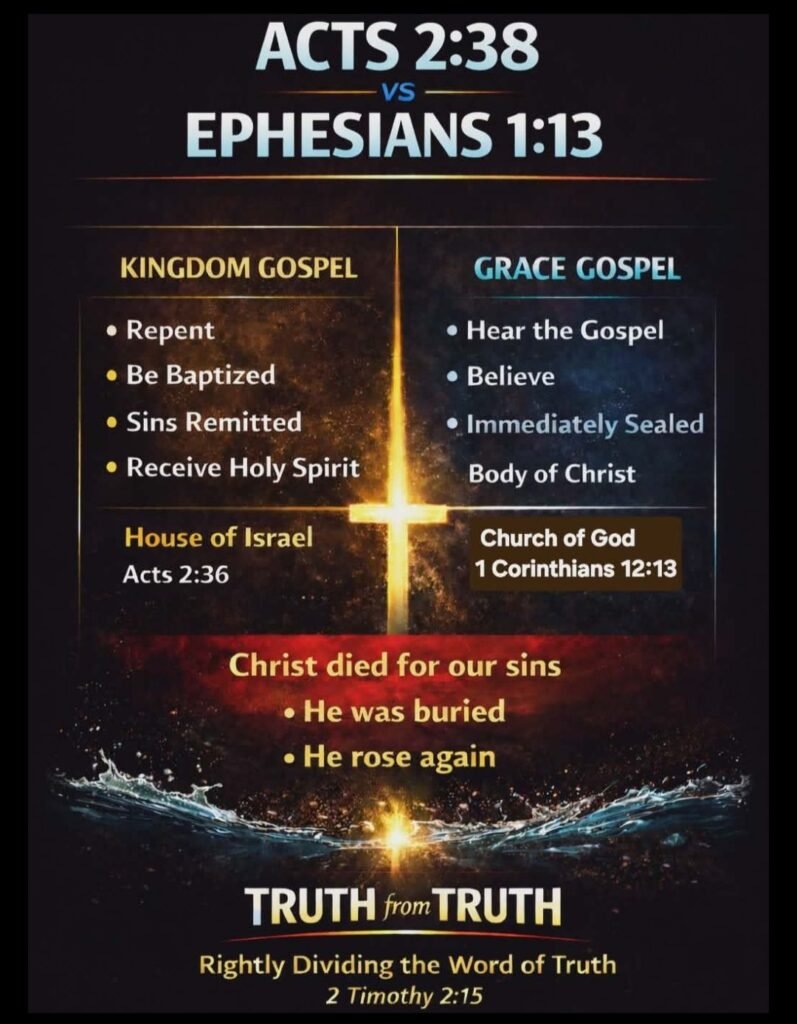
The focal point of our investigation is the stark contrast between the message delivered by the Apostle Peter in Acts 2:38 and the revelation committed to the Apostle Paul in Ephesians 1:13. One was a national call to repentance for the “House of Israel”; the other is a universal call to faith for a “New Creature.” Understanding this difference is not merely an academic exercise; it is a forensic necessity for the soul.
P — THE DISTINCT PROGRAMS OF GOD
The Sovereign Administration of Divine Disclosure
The primary finding of this investigation is that the God of the Universe does not operate under a monolithic, unchanging set of rules throughout human history. Rather, He operates through distinct “dispensations” or administrations. As documented in Romans 16:25, there is a “revelation of the mystery, which was kept secret since the world began.” This secret—this mustērion—stands in direct opposition to the things “which God hath spoken by the mouth of all his holy prophets since the world began” (Acts 3:21).
The Prophetic Program, as outlined in Luke 1:70, was never a secret. It was the subject of every prophet from Moses to Malachi. It concerned a literal, earthly kingdom where Israel would be the head and not the tail. It was “spoken.” In contrast, the Present Mystery Program, revealed solely to Paul, was “hid in God” (Ephesians 3:9). It was not prophesied; it was a divine interruption of the prophetic timeline.
The investigator finds that while all Scripture is for us, not all Scripture is about us or written to us in a jurisdictional sense. To take a command given to Israel under the Prophetic Program and apply it to the Body of Christ today is to engage in a form of spiritual identity theft. Ephesians 1:10 points to a future day when God will “gather together in one all things in Christ,” but until that time, the workman must distinguish between the Prophecy concerning the Earth and the Mystery concerning the Heavenly Places.
I — ISRAEL’S KINGDOM MESSAGE
The National Crisis and the Call of Acts 2:38
The record of the second chapter of the Book of Acts marks a critical juncture in the Prophetic Program. Contrary to popular religious opinion, Pentecost was not the birthday of the Church which is the Body of Christ; it was the final offer of the Kingdom to the “House of Israel.” The audience was not the world at large, but “Ye men of Israel” (Acts 2:22) and “all the house of Israel” (Acts 2:36).
Peter’s message was a forensic indictment of the nation for the murder of their Messiah. When the people were “pricked in their heart” and asked what they should do, Peter did not give them the Pauline gospel of grace. He gave them the Kingdom requirement: “Repent, and be baptized every one of you in the name of Jesus Christ for the remission of sins, and ye shall receive the gift of the Holy Ghost” (Acts 2:38).
The investigator notes several key sub-points in this Kingdom message:
- Instruction to Repent: This was a national change of mind regarding the identity of Jesus.
- Identification with Israel’s Messiah: They were to be baptized in His name to show they no longer rejected Him as their King.
- Indwelling Spirit Promised: The Spirit was given as the “earnest” of the Kingdom promises made to the fathers.
This was a message of national restoration. It required water baptism for the “remission of sins,” a requirement that stands in direct jurisdictional conflict with the “finished work” gospel later revealed to Paul.
G — THE GOSPEL OF THE KINGDOM
Earthly Ambition and the Messianic Throne
To understand Acts 2:38, one must understand the “Gospel of the Kingdom” (Matthew 4:23) that preceded it. This gospel was the “good news” that the long-awaited earthly reign of the Messiah was “at hand.” It was the fulfillment of the prayer: “Thy kingdom come. Thy will be done in earth, as it is in heaven” (Matthew 6:10).
The investigator finds that the Kingdom message was inherently earthly. It involved the gathering of Israel from the four corners of the earth, the restoration of the twelve tribes, and the setting up of thrones for the twelve apostles to judge those tribes (Matthew 19:28). It was the realization of the “Glory of the Kingdom” prophesied in Isaiah 9:7, where the government would be upon the shoulders of the Prince of Peace on the throne of David.
The Kingdom gospel was not about “going to heaven” when you die; it was about “heaven coming to earth” while you live. It required legalistic adherence to the principles of the Sermon on the Mount and physical rituals like water baptism. While these things were true and valid for Israel’s program, they are “weak and beggarly elements” (Galatians 4:9) when compared to the unsearchable riches of Christ revealed in the Mystery.
M — THE MYSTERY REVEALED TO PAUL
The Breaking of the Silence
As the investigation moves from the early chapters of Acts to the later epistles of Paul, we encounter a radical administrative shift. Because Israel, as a nation, rejected the Pentecostal offer and stoned Stephen, God did not bring the wrath of the Tribulation immediately. Instead, he did the “unthinkable.” He saved the leader of the rebellion—Saul of Tarsus—and made him the herald of a brand-new program: the Dispensation of the Grace of God (Ephesians 3:2).
Paul explains in Ephesians 3:9 that his commission was to “make all men see what is the fellowship of the mystery.” This was a “Mystery Previously Hidden” (Colossians 1:26). It was not in the Old Testament; it was not in the four Gospels. It was a secret purpose of God.
The core of this mystery is the “Membership in One Body” (Ephesians 3:6), where Jew and Gentile are “fellowheirs” and “partakers of his promise in Christ by the gospel.” This is a “Message of Grace to the Nations” (Romans 11:13) that does not require the Gentile to become a Jew or to join Israel’s program. It is the revelation of a “New Creature” that is neither Jew nor Greek, but a member of the Body of Christ.
G — THE GOSPEL OF GRACE
The Finished Work of the Cross
In the Mystery Program, the focus shifts from the life and earthly kingdom of Jesus to His death, burial, and resurrection. This is the “Gospel of Grace” (Acts 20:24) which Paul calls “my gospel.” The clearest definition is found in 1 Corinthians 15:1-4: “Moreover, brethren, I declare unto you the gospel… how that Christ died for our sins according to the scriptures; And that he was buried, and that he rose again the third day according to the scriptures.”
The investigator notes the fundamental sub-points of this gospel:
- How Christ Died for Our Sins: This is a substitutionary atonement. The focus is not on national repentance but on personal trust in the blood.
- Christ Was Buried: Proving the reality of His death and the completion of the payment.
- Christ Rose Again: Securing our justification and providing eternal life to all who believe.
In this program, there are no rituals required for salvation. There is no “repent and be baptized for the remission of sins.” There is only “Believe on the Lord Jesus Christ, and thou shalt be saved” (Acts 16:31). The Gospel of Grace is the power of God unto salvation to everyone that believeth.
B — BELIEVING BRINGS SALVATION
The Sealing of the Spirit in Ephesians 1:13
The investigation now reaches the diagnostic baseline of the Grace Program: Ephesians 1:13. In this verse, we see the “Order of Operations” for salvation today. It states: “In whom ye also trusted, after that ye heard the word of truth, the gospel of your salvation: in whom also after that ye believed, ye were sealed with that holy Spirit of promise.”
The investigator finds a three-step forensic process:
- Hearing the Gospel: One must hear the “word of truth” (Romans 10:17).
- Believing the Message: One must place their trust in the finished work of Christ.
- Being Sealed by the Spirit: This is the immediate, sovereign act of God.
Unlike Acts 2:38, where the Spirit was a gift given after water baptism, in Ephesians 1:13, the Spirit is a seal given the moment of belief. This “Sealing of the Spirit” is the believer’s security. It is the “earnest of our inheritance” (Ephesians 1:14) until the redemption of the purchased possession. This sealing is not a feeling; it is a legal reality. It is the divine signature upon the soul, declaring it “Paid in Full.”
C — THE CHURCH: THE BODY OF CHRIST
A New Creation in a New Dispensation
The investigator finds that the “Church” of the Mystery is fundamentally different from the “Congregation” of Israel. According to 1 Corinthians 12:13, “For by one Spirit are we all baptized into one body.” This is not a water baptism; it is a spiritual baptism. It is the act of the Holy Spirit placing the believer into the living organism of Christ.
This Church is:
- Called by the Gospel: Not by national lineage or physical circumcision (2 Thessalonians 2:14).
- Created as One New Body: Breaking down the “middle wall of partition” between groups (Ephesians 2:15).
- Connected by the Spirit: All members are “one in Christ Jesus.”
The Church which is His Body is a heavenly entity with a heavenly destiny (Ephesians 2:6). While Israel’s hope is to inherit the earth and have God dwell with them there, the Church’s hope is to be “caught up… to meet the Lord in the air” (1 Thessalonians 4:17) and reign in the heavenly places. To mix these two hopes is to deprive the believer of their specific comfort and assurance.
D — DIVIDING THE WORD CORRECTLY
The Workman’s Defense Against Confusion
The final finding of this investigation is that the only cure for doctrinal confusion is the diligent application of 2 Timothy 2:15. Right division is not a “choice” for the believer; it is a command. It is the tool that allows us to “Discern Different Dispensations” (Ephesians 3:2) and “Distinguish Israel and the Church” (1 Corinthians 10:32).
Failure to rightly divide leads to “legalism” (trying to keep the Law given to Israel) or “license” (ignoring the instructions for godly living in the Grace epistles). Right division allows us to “Defend Sound Doctrine” (Titus 2:1) by knowing what God is doing now.
The investigator asserts that when we rightly divide, the “contradictions” of the Bible evaporate. We no longer struggle to reconcile Peter’s “repent and be baptized” with Paul’s “believe and be saved.” We simply recognize that they are speaking to different people, under different programs, during different times. Clarity is the fruit of division.
CONCLUSION: THE CLARITY OF THE CROSS
The evidence gathered in this investigation is conclusive. The Bible is a progressive revelation, and the “Word of Truth” must be “Rightly Divided” to be understood. When the mist of tradition is cleared away, the distinction between Acts 2:38 and Ephesians 1:13 becomes the difference between a national ritual and a personal redemption.
We understand why Peter preached the Kingdom: because he was addressing the nation that had rejected its King. We understand why Paul preached Grace: because God had opened a new door of salvation for a world that deserved nothing but judgment. Both are true, but only one is our current jurisdictional reality.
Today, we live in the Dispensation of Grace. The “Kingdom” is currently in abeyance, and the “Mystery” is the order of the day. Salvation is offered freely to all who will “Believe the Gospel.” As stated in Romans 5:1, “Therefore being justified by faith, we have peace with God through our Lord Jesus Christ.”
CALL TO ACTION: THE WORKMAN’S RESPONSE
The investigator leaves the reader with a vital mandate. Do not be a “shameful workman” who mixes the programs of God.
- Study the Word Carefully: Do not rely on tradition; see what the text actually says to whom.
- Believe the Gospel of Grace: Place your total trust in the death, burial, and resurrection of Christ for your sins.
- Trust Christ Alone: Reject any ritual or work that claims to be a requirement for your salvation.
- Share the Gospel: Tell others of the “simplicity that is in Christ” (2 Corinthians 11:3).
The gospel for today is simple, yet profound: Christ died for our sins, He was buried, and He rose again. This is the “Word of Truth” that saves.
FINAL THOUGHTS: THE ARCHIVE OF TRUTH
The Bible contains prophecy and mystery, and to ignore the difference is to wander in a spiritual wilderness. Israel and the Church are distinct, each with its own glory and destiny. The Kingdom message was to Israel, calling them to national repentance. The Mystery message is for the Body of Christ, calling us to a heavenly identification.
Salvation today is by grace through faith, a gift that cannot be earned or improved upon. Believers are sealed by the Spirit the moment they trust the Truth. The Church is the Body of Christ, a new creature in a new age. Right division brings clarity to Scripture, transforming the Bible from a book of rules into a letter of love and an archive of eternal truth.
Related posts:
 𝗜𝗚𝗡𝗢𝗥𝗜𝗡𝗚 𝗧𝗛𝗘 𝗧𝗥𝗨𝗧𝗛 𝗗𝗢𝗘𝗦𝗡’𝗧 𝗖𝗛𝗔𝗡𝗚𝗘 𝗧𝗛𝗘 𝗧𝗥𝗨𝗧𝗛
 𝗚𝗢𝗗 𝗔𝗡𝗗 𝗠𝗔𝗡: 𝗥𝗜𝗚𝗛𝗧𝗟𝗬 𝗗𝗜𝗩𝗜𝗗𝗘𝗗 𝗗𝗘𝗦𝗜𝗚𝗡
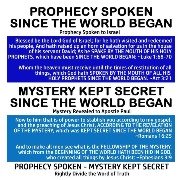 𝗙𝗥𝗢𝗠 𝗣𝗥𝗢𝗣𝗛𝗘𝗖𝗬 𝗧𝗢 𝗠𝗬𝗦𝗧𝗘𝗥𝗬. 𝗧𝗛𝗘 𝗞𝗘𝗬 𝗧𝗢 𝗨𝗡𝗗𝗘𝗥𝗦𝗧𝗔𝗡𝗗𝗜𝗡𝗚 𝗦𝗖𝗥𝗜𝗣𝗧𝗨𝗥𝗘 – 𝗚𝗢𝗗 𝗜𝗦 𝗡𝗢𝗧 𝗧𝗛𝗘 𝗔𝗨𝗧𝗛𝗢𝗥 𝗢𝗙 𝗖𝗢𝗡𝗙𝗨𝗦𝗜𝗢𝗡!
 𝗥𝗜𝗚𝗛𝗧𝗟𝗬 𝗗𝗜𝗩𝗜𝗗𝗜𝗡𝗚 𝗣𝗘𝗧𝗘𝗥 𝗗𝗢𝗖𝗧𝗥𝗜𝗡𝗘 𝘃𝘀 𝗣𝗔𝗨𝗟 𝗗𝗢𝗖𝗧𝗥𝗜𝗡𝗘
 𝗪𝗛𝗔𝗧 𝗖𝗛𝗨𝗥𝗖𝗛 𝗗𝗢 𝗬𝗢𝗨 𝗔𝗧𝗧𝗘𝗡𝗗?
 𝗧𝗛𝗘 𝗥𝗘𝗩𝗘𝗟𝗔𝗧𝗜𝗢𝗡 𝗢𝗙 𝗧𝗛𝗘 𝗧𝗥𝗜𝗡𝗜𝗧𝗬
 𝗧𝗛𝗘 𝟳 𝗕𝗟𝗘𝗦𝗦𝗜𝗡𝗚𝗦 𝗢𝗙 𝗧𝗛𝗘 𝗛𝗢𝗟𝗬 𝗦𝗣𝗜𝗥𝗜𝗧
 𝗥𝗜𝗚𝗛𝗧𝗟𝗬 𝗗𝗜𝗩𝗜𝗗𝗜𝗡𝗚 𝗧𝗛𝗘 𝗚𝗥𝗔𝗖𝗘 𝗚𝗢𝗦𝗣𝗘𝗟 𝗙𝗥𝗢𝗠 𝗧𝗛𝗘 𝗡𝗘𝗪 𝗖𝗢𝗩𝗘𝗡𝗔𝗡𝗧
 𝗧𝗛𝗘 𝗧𝗥𝗜𝗖𝗛𝗢𝗧𝗢𝗠𝗬 𝗢𝗙 𝗠𝗔𝗡
 𝗧𝗛𝗘 𝗞𝗜𝗡𝗚𝗗𝗢𝗠 𝗚𝗢𝗦𝗣𝗘𝗟 & 𝗧𝗛𝗘 𝗚𝗥𝗔𝗖𝗘 𝗚𝗢𝗦𝗣𝗘𝗟
 𝗧𝗛𝗘 𝗗𝗢𝗖𝗧𝗥𝗜𝗡𝗘 𝗢𝗙 𝗧𝗛𝗘 𝗥𝗔𝗣𝗧𝗨𝗥𝗘
 𝗔𝗠𝗘𝗡: 𝗧𝗛𝗘 𝗚𝗥𝗔𝗖𝗘 𝗣𝗔𝗧𝗛 𝗢𝗙 𝗧𝗛𝗘 𝗕𝗢𝗗𝗬 𝗢𝗙 𝗖𝗛𝗥𝗜𝗦𝗧
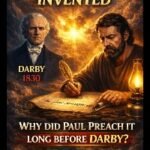 𝗧𝗛𝗘 𝗥𝗔𝗣𝗧𝗨𝗥𝗘: 𝗥𝗘𝗩𝗘𝗔𝗟𝗘𝗗, 𝗡𝗢𝗧 𝗜𝗡𝗩𝗘𝗡𝗧𝗘𝗗
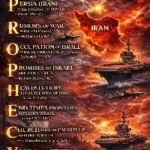 𝗪𝗛𝗘𝗡 𝗡𝗔𝗧𝗜𝗢𝗡𝗦 𝗥𝗜𝗦𝗘… 𝗧𝗛𝗘 𝗣𝗥𝗢𝗣𝗛𝗘𝗧𝗦 𝗔𝗟𝗥𝗘𝗔𝗗𝗬 𝗦𝗣𝗢𝗞𝗘