
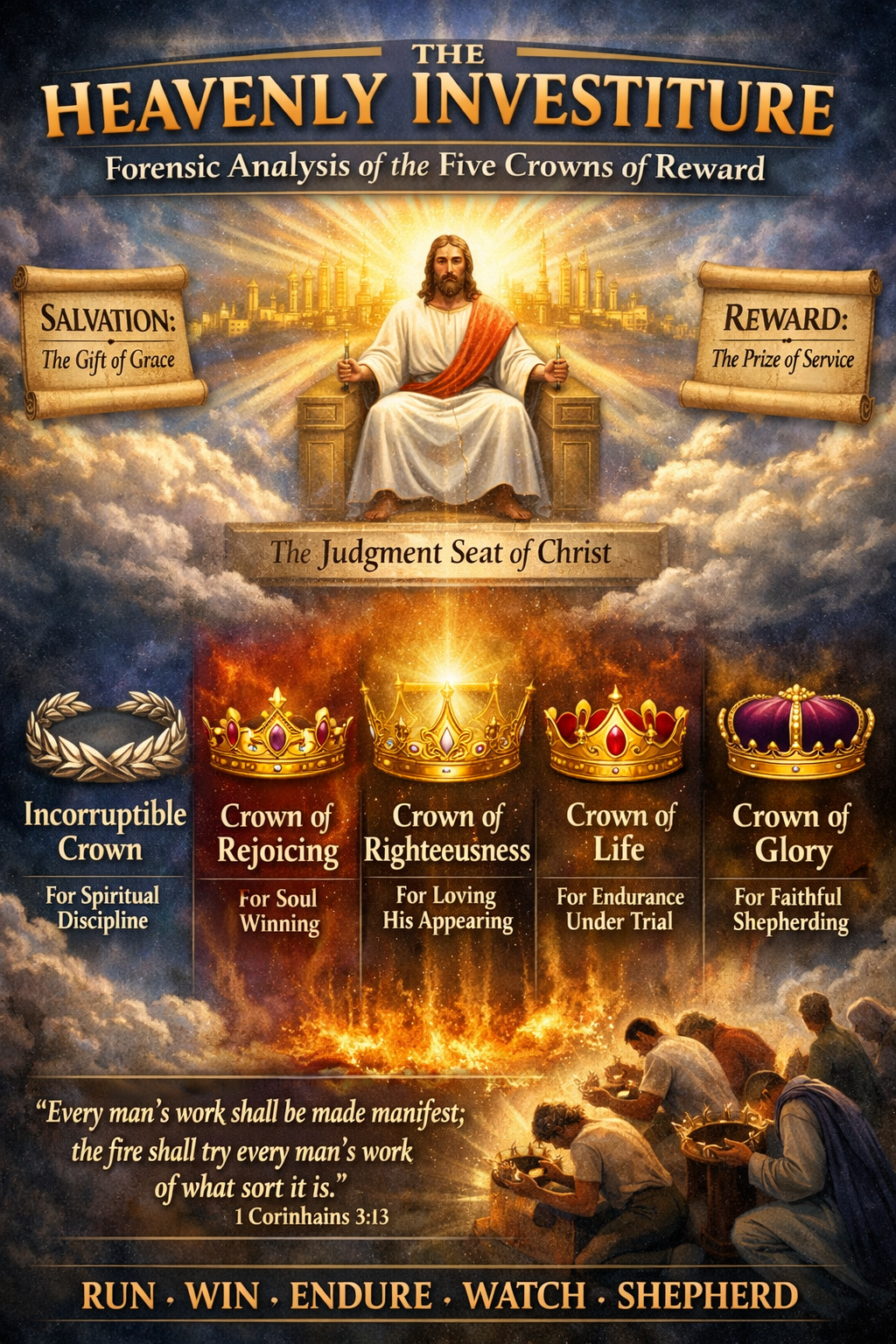
THE HEAVENLY INVESTITURE: A FORENSIC ANALYSIS OF THE FIVE CROWNS OF REWARD
In the grand architecture of the Divine Purpose, specifically within the current Dispensation of the Grace of God, a sharp forensic distinction must be maintained between the “Gift of Salvation” and the “Reward of Service.” This investigative report asserts that while eternal life is a free grant bestowed upon the believer through faith alone (Ephesians 2:8–9), the scriptures outline a secondary tier of celestial recognition: the Five Crowns. According to the Pauline revelation and the general epistles, these are not instruments of salvation, but stephanos (victor’s wreaths) awarded at the Judgment Seat of Christ. The diagnostic baseline for this inquiry is the apostolic decree: “Every man’s work shall be made manifest… and the fire shall try every man’s work of what sort it is” (1 Corinthians 3:13).
As we “rightly divide the word of truth” (2 Timothy 2:15), we find that the Lord Jesus Christ, the “Righteous Judge,” has instituted a system of heavenly incentives to motivate the “New Creature” in his earthly pilgrimage. The investigator finds that these crowns represent different facets of spiritual maturity, endurance, and ministerial fidelity. This inquiry will dismantle the misconceptions of a “participation trophy” eternity and analyze the forensic requirements for each of the five crowns of reward.
I. THE INCORRUPTIBLE CROWN: THE REWARD OF SPIRITUAL DISCIPLINE
Investigating the Forensic Requirement of Temperance
The primary finding of this investigation reveals that the first crown is awarded to those who exercise “Mastery” over the impulses of the “Old Man.” Drawing from the athletic imagery of the Isthmian Games, the Apostle Paul establishes the forensic standard in 1 Corinthians 9:25: “And every man that striveth for the mastery is temperate in all things. Now they do it to obtain a corruptible crown; but we an incorruptible.”
The investigator identifies that this crown is the “Victor’s Wreath” for self-control. Unlike the earthly athlete who subjects his body to rigors for a fading branch of celery or laurel, the believer subjects his “members” to the Spirit for an “Imperishable” reward. The forensic requirement is to “keep under my body, and bring it into subjection” (1 Corinthians 9:27).
The investigator finds that this crown is not for the “perfect,” but for the “persistent”—those who refuse to let the flesh dictate the trajectory of their walk. It is the reward for the disciplined soul who chooses the “Word of God” over the “Wills of the Flesh.” In this present evil world, where the “lust of the flesh, and the lust of the eyes, and the pride of life” (1 John 2:16) seek to disqualify the runner, the Incorruptible Crown stands as the prize for those who finish the race with their testimony intact.
II. THE CROWN OF REJOICING: THE REWARD OF SOUL-WINNING
A Forensic Audit of the Ministry of Reconciliation
The investigation moves from “internal discipline” to “external impact.” A significant finding of this report is that God places a premium on the “Multiplication” of the Body of Christ. The forensic record in 1 Thessalonians 2:19 identifies the converts themselves as the “Crown”: “For what is our hope, or joy, or crown of rejoicing? Are not even ye in the presence of our Lord Jesus Christ at his coming?”
The investigator finds that this is the “Soul-Winner’s Crown.” It is the joy of standing before the Lord and seeing the fruit of one’s witness. Paul, the chief architect of the Gentile mission, viewed his converts not as “statistics,” but as his “glory and joy” (1 Thessalonians 2:20). This reward is available to every believer who engages in the “Ministry of Reconciliation” (2 Corinthians 5:18).
Whether through the public proclamation of the Word or the quiet, persistent witness of a transformed life, the rescue of a soul from the “power of darkness” (Colossians 1:13) results in this celestial accolade. The investigator finds that the “Crown of Rejoicing” is the only reward that consists of other people. It is the forensic evidence of a life that did not “eat its morsel alone” but shared the Bread of Life with a perishing world.
III. THE CROWN OF RIGHTEOUSNESS: THE REWARD OF ETERNAL PERSPECTIVE
Investigating the Forensic Love of the Appearing
This report must address a unique reward promised to those whose hearts are anchored in the “Next Age” rather than the “Present Evil World.” The forensic cornerstone for this reward is 2 Timothy 4:8: “Henceforth there is laid up for me a crown of righteousness, which the Lord, the righteous judge, shall give me at that day: and not to me only, but unto all them also that love his appearing.”
The investigator finds that this crown is for those who live in the light of the “Second Coming” and the “Rapture” of the Church. To “love His appearing” is not merely an emotional sentiment; it is a forensic orientation. It involves living righteously because one expects the “Righteous Judge” at any moment.
The investigator identifies that this crown counters the “Apathy” of the Laodicean mindset. While the world says, “Where is the promise of his coming?”, the believer with this crown says, “Even so, come, Lord Jesus” (Revelation 22:20). This reward honors the “Blessed Hope” that purifies the life of the saint (Titus 2:13). It is the crown for the “Watchman” who refuses to be lulled to sleep by the lullabies of a world destined for judgment.
IV. THE CROWN OF LIFE: THE REWARD OF ENDURANCE UNDER TRIAL
A Forensic Analysis of the Martyr’s Resolve
The investigation identifies a specific reward for those who endure the “Fiery Trial” without “fainting” in their minds. This crown is mentioned in both the general epistles and the revelation of Christ. The forensic baseline is found in James 1:12: “Blessed is the man that endureth temptation: for, when he is tried, he shall receive the crown of life, which the Lord hath promised to them that love him.”
The investigator finds that this is often called the “Martyr’s Crown,” but its scope extends to all who persevere through “tribulation.” The Lord’s message to the church at Smyrna reinforces this: “be thou faithful unto death, and I will give thee a crown of life” (Revelation 2:10).
The investigator identifies that this crown is not a “payment” for life—for life is a gift—but a “decoration” for the quality of that life under pressure. It honors those who “loved not their lives unto the death” (Revelation 12:11) and those who, though not physically martyred, “endured as seeing him who is invisible” (Hebrews 11:27). The investigator finds that the “Crown of Life” is the Divine response to the scars of the saint, proving that present sufferings are “not worthy to be compared with the glory which shall be revealed in us” (Romans 8:18).
V. THE CROWN OF GLORY: THE REWARD OF FAITHFUL SHEPHERDING
Investigating the Forensic Stewardship of the Flock
The final pillar of this inquiry addresses the “Leadership” of the local assembly. While all believers are “priests,” the investigator finds that God holds “Elders” and “Shepherds” to a specific standard of accountability. The forensic record in 1 Peter 5:4 promises: “And when the chief Shepherd shall appear, ye shall receive a crown of glory that fadeth not away.”
The investigator finds that the requirements for this crown are stringent: the leader must feed the flock “not for filthy lucre, but of a ready mind,” and not as “lords over God’s heritage,” but being “ensamples to the flock” (1 Peter 5:2–3).
The investigator identifies that this crown recognizes the “Hidden Labor” of the pastor, the teacher, and the mentor who “watches for souls” (Hebrews 13:17). It is a “Glory” that contrasts with the “fading” applause of men. The investigator finds that while earthly congregations may forget the labor of a faithful shepherd, the “Chief Shepherd” has archived every act of sacrificial service for this eternal investiture. This crown is for the one who poured out their life so that others might grow in the “knowledge of the Son of God” (Ephesians 4:13).
THE INVESTIGATIVE SUMMARY: THE VERDICT OF THE JUDGMENT SEAT
The evidence gathered in this forensic investigation is conclusive: Salvation is a finished work, but the “Prize” is a finishing work. The “Five Crowns” serve as the “divine decorations” for a life lived “unto him which died for them, and rose again” (2 Corinthians 5:15).
The forensic summary identifies the three-fold purpose of the Crowns:
- Motivation: To “run in such a way as to get the prize” (1 Corinthians 9:24).
- Manifestation: To reveal the “sort” of work performed in the body (1 Corinthians 3:13).
- Adoration: To provide the believer with something to “cast before the throne” in worship (Revelation 4:10).
The final verdict is rendered: The “Five Crowns” are not for the “Elite,” but for the “Engaged.” They are the “Well Done” of the Master made visible in the halls of eternity.
CALL TO ACTION: THE AMBASSADOR’S PROTOCOL
In light of the findings of this report, the investigator issues the following forensic mandates:
- Examine Your Motivation: Are you building with “gold, silver, and precious stones,” or “wood, hay, and stubble”? (1 Corinthians 3:12).
- Exercise Temperance: Strive for the “Mastery” over your flesh to secure the “Incorruptible Crown.”
- Engage in Reconciliation: Seek the “Crown of Rejoicing” by sharing the “Gospel of the Grace of God” (Acts 20:24).
- Expect His Return: Cultivate a love for His “Appearing” to qualify for the “Crown of Righteousness.”
- Endure with Patience: Do not “cast away your confidence” in the midst of trials (Hebrews 10:35).
FINAL THOUGHTS: THE ARCHIVE OF THE VICTOR
- The Incorruptible Crown: Given for self-mastery.
- The Crown of Rejoicing: Given for soul-winning.
- The Crown of Righteousness: Given for loving His appearing.
- The Crown of Life: Given for enduring trials.
- The Crown of Glory: Given for faithful shepherding.
The investigator finds that the greatest tragedy of the Christian life is to be “saved; yet so as by fire” (1 Corinthians 3:15), entering eternity without a single crown to lay at the feet of the Savior. In that day, every work will be tested, and only that which was done for Christ—by the power of the Holy Spirit—will remain.
“Behold, I come quickly: hold that fast which thou hast, that no man take thy crown.” (Revelation 3:11)
Related posts:
 𝗟𝗜𝗙𝗘 𝗪𝗜𝗧𝗛𝗢𝗨𝗧 𝗝𝗘𝗦𝗨𝗦 𝘃𝘀 𝗟𝗜𝗙𝗘 𝗪𝗜𝗧𝗛 𝗝𝗘𝗦𝗨𝗦
 𝗔𝗙𝗧𝗘𝗥 𝗧𝗛𝗘 𝗥𝗔𝗣𝗧𝗨𝗥𝗘 — 𝗧𝗛𝗘 𝗖𝗢𝗠𝗜𝗡𝗚 𝗖𝗛𝗔𝗢𝗦 𝗢𝗙 𝗧𝗥𝗜𝗕𝗨𝗟𝗔𝗧𝗜𝗢𝗡
 𝗥𝗘𝗦𝗖𝗨𝗜𝗡𝗚 𝗦𝗢𝗨𝗟𝗦 — 𝗪𝗢𝗥𝗧𝗛 𝗘𝗩𝗘𝗥𝗬 𝗘𝗙𝗙𝗢𝗥𝗧
 𝗥𝗜𝗚𝗛𝗧𝗟𝗬 𝗗𝗜𝗩𝗜𝗗𝗜𝗡𝗚 𝗣𝗘𝗧𝗘𝗥 𝗗𝗢𝗖𝗧𝗥𝗜𝗡𝗘 𝘃𝘀 𝗣𝗔𝗨𝗟 𝗗𝗢𝗖𝗧𝗥𝗜𝗡𝗘
 𝟴 𝗧𝗢𝗫𝗜𝗖 𝗛𝗔𝗕𝗜𝗧𝗦 𝗖𝗛𝗥𝗜𝗦𝗧𝗜𝗔𝗡𝗦 𝗠𝗨𝗦𝗧 𝗟𝗘𝗧 𝗚𝗢 𝗧𝗢𝗗𝗔𝗬
 𝗧𝗪𝗢 𝗧𝗛𝗥𝗢𝗡𝗘𝗦, 𝗧𝗪𝗢 𝗝𝗨𝗗𝗚𝗠𝗘𝗡𝗧𝗦
 𝗧𝗛𝗘 𝗦𝗨𝗙𝗙𝗘𝗥𝗜𝗡𝗚 𝗦𝗔𝗩𝗜𝗢𝗥 — 𝗧𝗛𝗘 𝗦𝗔𝗩𝗜𝗡𝗚 𝗚𝗥𝗔𝗖𝗘
 𝗧𝗪𝗢 𝗖𝗥𝗢𝗪𝗡𝗦
 𝗝𝗘𝗦𝗨𝗦 𝗖𝗛𝗥𝗜𝗦𝗧: 𝗧𝗛𝗘 𝗢𝗡𝗟𝗬 𝗦𝗔𝗩𝗜𝗢𝗥
 𝗧𝗛𝗘 𝗞𝗜𝗡𝗚 𝗜𝗦 𝗖𝗢𝗠𝗜𝗡𝗚
 𝗪𝗛𝗬 𝗧𝗛𝗘𝗥𝗘 𝗔𝗥𝗘 𝗡𝗢 𝗔𝗣𝗢𝗦𝗧𝗟𝗘𝗦 𝗔𝗟𝗜𝗩𝗘 𝗧𝗢𝗗𝗔𝗬
 𝗦𝗔𝗟𝗩𝗔𝗧𝗜𝗢𝗡 𝗜𝗦 𝗡𝗢𝗧 𝗬𝗢𝗨𝗥 𝗚𝗢𝗢𝗗 𝗪𝗢𝗥𝗞𝗦𝗜𝗧 𝗜𝗦 𝗚𝗢𝗗 𝗙𝗜𝗡𝗜𝗦𝗛𝗘𝗗 𝗪𝗢𝗥𝗞 𝗢𝗡 𝗧𝗛𝗘 𝗖𝗥𝗢𝗦𝗦
 𝗢𝗡𝗘 𝗟𝗔𝗦𝗧 𝗖𝗛𝗔𝗡𝗖𝗘 𝗪𝗔𝗦𝗧𝗘𝗗
 𝗧𝗛𝗘 𝗘𝗠𝗣𝗧𝗬 𝗧𝗢𝗠𝗕: 𝗧𝗛𝗘 𝗚𝗥𝗘𝗔𝗧𝗘𝗦𝗧 𝗣𝗥𝗢𝗢𝗙 𝗢𝗙 𝗖𝗛𝗥𝗜𝗦𝗧