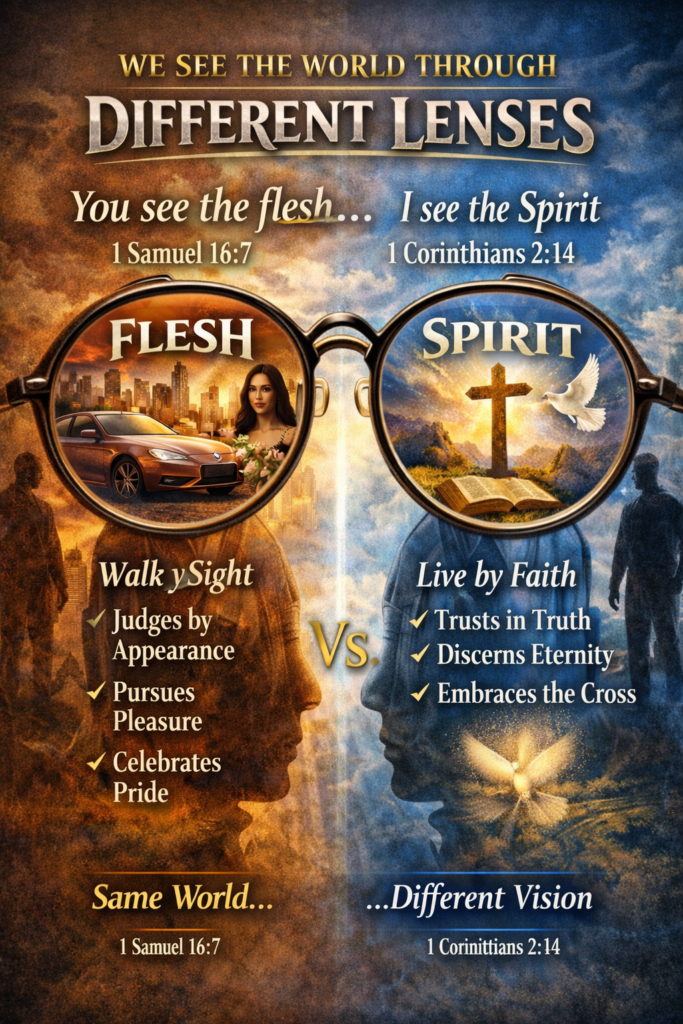
In the field of optical physics, a lens determines the refraction of light, dictating the clarity and focus of the image captured by the observer. In the realm of spiritual anthropology, a similar phenomenon occurs, though the mechanism is not glass and light, but the soul and the Spirit. Forensic investigation of the human experience reveals a profound duality: two distinct populations occupy the same physical geography while inhabiting entirely different perceptual universes. This investigative report examines the structural differences between carnal perception and spiritual discernment, grounded in the Pauline revelation that the human race is fundamentally divided by its capacity for insight. While the natural world emphasizes the reliability of the five senses, the investigative record of Scripture suggests that the physical eye is often the primary conduit for deception. To understand this disconnect, one must evaluate the biological and spiritual “lenses” that govern human judgment, moving beyond the superficiality of appearance into the deep architecture of divine truth.
The investigation begins with a foundational contrast in perspective that has persisted since the dawn of human history. In the historical record of 1 Samuel 16:7, a definitive boundary is drawn: “For man looketh on the outward appearance, but the Lord looketh on the heart.” This observation provides the baseline for our study. The fleshly lens is inherently horizontal; it is calibrated to measure height, weight, social status, and physical symmetry. However, the data confirms that outward appearance is a deceptive metric. Proverbs 31:30 notes that “Favor is deceitful, and beauty is vain.” When a society or an individual relies solely on the carnal lens, they are effectively analyzing a hollow shell. Romans 8:7 further identifies that “the carnal mind is enmity against God.” This means the lens of the flesh is not merely limited—it is biased. It intentionally filters out spiritual reality to protect the autonomy of the self. Conversely, 1 Corinthians 2:15 introduces the spiritual lens, noting that “he that is spiritual judgeth all things.” Spiritual discernment delivers the observer from the tyranny of the visible, allowing for a forensic appraisal of the underlying truth.
To understand why the world is seen so differently, one must analyze the physiological and spiritual condition of the natural man. The investigative findings in 1 Corinthians 2:14 are stark: “But the natural man receiveth not the things of the Spirit of God: for they are foolishness unto him: neither can he know them, because they are spiritually discerned.” This is not a lack of intellectual capacity, but a lack of sensory equipment. The natural man is born with a “blind” lens regarding eternal things. In 2 Corinthians 4:4, the record identifies a deliberate interference in human vision: “In whom the god of this world hath blinded the minds of them which believe not.” This blindness is not physical but cognitive. The natural man looks at the cross and sees a tragedy; he looks at the Gospel and sees an absurdity. Ephesians 4:18 describes this state as “having the understanding darkened, being alienated from the life of God through the ignorance that is in them.” This ignorance is a structural blockage. Without the intervention of the Spirit, the natural man is eternally bound to a monochromatic view of existence, where only the material is real.
The carnal lens of the flesh is characterized by a specific set of distortions that magnify the temporary while shrinking the eternal. Paul describes those who “walk as men” in 1 Corinthians 3:3, indicating a life lived entirely within the confines of human limitation. This lens magnifies three primary elements: beauty, power, and pleasure. Galatians 5:19 provides a forensic list of the “works of the flesh,” showing that when the fleshly lens is the primary guide, it invariably seeks the gratification of appetites. 1 John 2:16 identifies the “lust of the flesh, and the lust of the eyes, and the pride of life” as the components of the world’s visual system. This system celebrates the “pride” of human achievement while rejecting the “foolishness” of the cross. 1 Corinthians 1:18 notes that “the preaching of the cross is to them that perish foolishness.” The carnal lens is incapable of seeing glory in suffering or strength in weakness. It views the sacrifice of Christ as a failure because it lacks the spiritual depth to perceive the payment of a debt.
Clarity is only achieved through the secondary lens of the Holy Spirit. 1 Corinthians 2:10 asserts that “God hath revealed them unto us by his Spirit: for the Spirit searcheth all things, yea, the deep things of God.” This is the investigative “breakthrough.” The Spirit functions as a restorative corrective that reveals what the fleshly lens conceals. Ephesians 1:17 speaks of the “spirit of wisdom and revelation in the knowledge of him,” suggesting that true vision is a gift of grace rather than a product of effort. When the spiritual lens is applied, the observer begins to recognize reality as God defines it. Colossians 1:9 describes this as being “filled with the knowledge of his will in all wisdom and spiritual understanding.” This is the renewal of the mind mentioned in Romans 12:2, where the brain is literally reprogrammed to interpret data through the filter of Scripture. The result is a transformative shift: the believer no longer looks at people or circumstances “after the flesh,” but through the eyes of the Spirit.
The investigation reveals that the Cross of Christ serves as the ultimate dividing line in human perception. It is the prism through which all truth is refracted. 1 Corinthians 1:23 notes, “But we preach Christ crucified, unto the Jews a stumblingblock, and unto the Greeks foolishness.” The cross is an offense to the carnal lens because it exposes the total insufficiency of human merit. Galatians 5:11 refers to the “offence of the cross.” To the flesh, the cross represents the end of self-glory; to the Spirit, it represents the beginning of divine life. Romans 3:25 forensicly identifies the cross as the place where God’s righteousness is declared for the remission of sins. Colossians 1:14 confirms that it is here we have “redemption through his blood, even the forgiveness of sins.” The cross forces every observer to choose a lens. You either see a victim and a defeat, or you see a Victor and a completed transaction. There is no middle ground in the optics of the cross.
The consequences of persistent spiritual blindness are catastrophic in a forensic sense. The investigative evidence suggests that seeing only the flesh results in eternal loss. In John 8:24, the warning is clear: “If ye believe not that I am he, ye shall die in your sins.” To die in one’s sins is the result of failing to see the remedy provided in Christ. The carnal man misjudges reality, prioritizing the accumulation of wealth and status that cannot survive the transition to eternity. Luke 12:15 warns, “A man’s life consisteth not in the abundance of the things which he possesseth.” By focusing on the “things which are seen,” the natural man misses the opportunity for redemption. 2 Corinthians 6:2 emphasizes the urgency of the present moment: “Now is the accepted time; behold, now is the day of salvation.” The final data point in the investigative record is Revelation 20:15, which describes the ultimate outcome for those whose names were not found in the book of life. Spiritual blindness is not merely a different perspective; it is a fatal condition.
The call to spiritual sight is an invitation to move from a life of sight-based reaction to a life of faith-based action. Colossians 3:2 commands, “Set your affection on things above, not on things on the earth.” This requires a deliberate refocusing of the cognitive lens. Believers are instructed to “walk by faith, not by sight” (2 Corinthians 5:7). This walk involves a forensic confidence in the “things which are not seen,” based on the integrity of God’s Word. Philippians 3:20 identifies the believer’s true “conversation” or citizenship as being in heaven. This shift in perspective allows the believer to witness with discernment in a world that is “fast asleep” in the flesh. Colossians 4:5 encourages “walking in wisdom toward them that are without.” The spiritual lens enables the believer to see the “lost” not as enemies to be defeated, but as souls in need of the same light that once cured their own blindness.
Expanding the investigative analysis, one must consider the “mechanics” of how the Spirit enlightens the mind. It is a metabolic process similar to the irrigation of a parched field. When the Word of God is introduced to the intellect, the Spirit uses that truth to dissolve the “scales” of carnal prejudice. The researcher notes that in the book of Acts, when Saul of Tarsus—the ultimate carnal legalist—was converted, “there fell from his eyes as it had been scales” (Acts 9:18). This was a physical manifestation of a spiritual reality. Saul’s lens had been blinded by religious tradition and self-righteousness. To see Christ, his old lens had to be shattered. This confirms that spiritual vision is often a violent transition for the flesh, as it requires the death of the “old man” to allow the “new man” to see.
Furthermore, the “Lens of the Mystery” (the Pauline revelation) provides a specific focal point for the Body of Christ today. Ephesian 3:9 speaks of “making all men see what is the fellowship of the mystery.” This is the highest level of spiritual vision. It is the ability to see the Church not as a building or a social club, but as a heavenly organism joined to a resurrected Head. Without the Pauline lens, the believer is often “short-sighted,” looking back toward the shadows of the Mosaic Law or looking for earthly kingdom signs. The Spirit directs the gaze forward and upward, into the “unsearchable riches of Christ.” The investigation concludes that the “Mystery” is the final corrective lens that brings the entire Bible into sharp, clear focus.
The role of the “Renewed Mind” in maintaining spiritual vision is paramount. Romans 12:2 is the “maintenance manual” for the believer’s optics. If the mind is not consistently “washed by the word,” the pollutants of the world will cloud the lens. The carnal environment is constantly pushing the believer to return to sight-based living. The news media, social pressures, and physical ailments all demand that we “look at the things which are seen.” Resistance requires a daily, intentional immersion in the epistles of Paul. By rehearsing our identity as “blessed with all spiritual blessings” (Ephesians 1:3), we prevent the carnal lens from refocusing on our earthly lack. The investigator finds that spiritual blindness is a “default” state to which the human brain naturally reverts if it is not actively stimulated by truth.
The forensic study also reveals a distinction in the “quality” of sight among believers. Paul speaks of those who are “babes in Christ” and “carnal” (1 Corinthians 3:1). These individuals have the Spirit, but they are still using the fleshly lens. They see the world through the lens of envy, strife, and divisions. This suggests that having the spiritual lens is one thing; using it is another. Maturity is the process of learning to “trust the lens” even when the physical eyes see something different. When the fleshly lens sees a crisis, the spiritual lens sees an opportunity for God’s grace to be “sufficient” (2 Corinthians 12:9). When the carnal lens sees a person who has wronged us, the spiritual lens sees a fellow member of the Body to be forgiven as Christ forgave us (Ephesians 4:32).
The investigation must also address the “Blindness of Israel” as a forensic case study. Romans 11:25 states that “blindness in part is happened to Israel, until the fulness of the Gentiles be come in.” This national blindness was a judicial consequence of rejecting their Messiah. It serves as a stark warning: light rejected is light withdrawn. When a person or a nation consistently chooses the carnal lens over the revelation of God, the “natural” result is a judicial hardening. This confirms that spiritual vision is a stewardship. We must “walk while we have the light” (John 12:35), for the night of carnal darkness is always pressing in. The Pauline believer is called to be a “child of light,” reflecting the “glory of the Lord” in a world that cannot see its own hand in front of its face.
As the investigation reaches its conclusion, the overarching theme is one of two worlds existing in parallel. One world is loud, bright, and temporary; the other is silent, eternal, and substantial. The carnal lens is perfectly adapted to the former, but it is utterly useless for the latter. 2 Corinthians 4:18 provides the final investigative summary: “For the things which are seen are temporal; but the things which are not seen are eternal.” To live by the carnal lens is to invest one’s life in a shadow. To live by the spiritual lens is to build one’s life on the Rock. The difference is not a matter of opinion; it is a matter of forensic reality.
The final investigative results are clear: The world sees beauty, but God sees the corruption of the heart. The world sees success, but God sees the bankruptcy of sin. The world sees life in the biological sense, but God sees death in the spiritual sense for anyone without Christ. Romans 8:6 remains the definitive conclusion of the report: “For to be carnally minded is death; but to be spiritually minded is life and peace.” The choice of lens determines the destination of the soul.
The call to action for the reader is a rigorous examination of their own perceptual habits. Identify the moments when you are judging by “outward appearance.” Consciously reject the fleshly lie that the material world is the only reality. Commit to the daily renewal of your mind through the Pauline epistles. Rely on the Spirit to give you insight into your circumstances and your relationships. Do not be satisfied with eyesight; seek the insight that comes from the “depth of the riches both of the wisdom and knowledge of God” (Romans 11:33).
In the final analysis, we do indeed look at the same world through different lenses. One lens leads to vanity and judgment; the other leads to life and peace. The cross is the point where the lenses are swapped. If you have been blinded by the “god of this world,” there is a cure in the “light of the glorious gospel of Christ.” If you are a believer who has let your lens become clouded, there is a “washing” available in the Word. See with the Spirit—and live with eternity in view. To God be the glory for the gift of sight in a world of darkness.
Related posts:
 𝗟𝗜𝗚𝗛𝗧 𝗦𝗛𝗜𝗡𝗘𝗦 𝗜𝗡 𝗧𝗛𝗘 𝗗𝗔𝗥𝗞𝗡𝗘𝗦𝗦
 𝗚𝗢𝗗 𝗔𝗡𝗗 𝗠𝗔𝗡: 𝗥𝗜𝗚𝗛𝗧𝗟𝗬 𝗗𝗜𝗩𝗜𝗗𝗘𝗗 𝗗𝗘𝗦𝗜𝗚𝗡
 𝗧𝗛𝗘 𝗕𝗥𝗔𝗜𝗡 𝗠𝗨𝗦𝗧 𝗕𝗘 𝗪𝗔𝗧𝗘𝗥𝗘𝗗 𝗪𝗜𝗧𝗛 𝗧𝗛𝗘 𝗪𝗢𝗥𝗗 𝗢𝗙 𝗚𝗢𝗗 𝗗𝗔𝗜𝗟𝗬
 𝗧𝗛𝗘 𝗖𝗥𝗢𝗦𝗦: 𝗚𝗢𝗗’𝗦 𝗣𝗢𝗪𝗘𝗥 𝗙𝗢𝗥 𝗦𝗔𝗟𝗩𝗔𝗧𝗜𝗢𝗡
 𝗧𝗛𝗘 𝗧𝗥𝗜𝗖𝗛𝗢𝗧𝗢𝗠𝗬 𝗢𝗙 𝗠𝗔𝗡
 𝗕𝗘𝗪𝗔𝗥𝗘: 𝗦𝗔𝗧𝗔𝗡 𝗕𝗔𝗜𝗧𝗦 𝗛𝗜𝗦 𝗛𝗢𝗢𝗞 𝗪𝗜𝗧𝗛 𝗬𝗢𝗨𝗥 𝗙𝗔𝗩𝗢𝗥𝗜𝗧𝗘 𝗦𝗜𝗡
 𝗙𝗢𝗨𝗥 𝗦𝗧𝗔𝗚𝗘𝗦 𝗢𝗙 𝗦𝗣𝗜𝗥𝗜𝗧𝗨𝗔𝗟 𝗚𝗥𝗢𝗪𝗧𝗛
 𝗧𝗛𝗘 𝟳 𝗕𝗟𝗘𝗦𝗦𝗜𝗡𝗚𝗦 𝗢𝗙 𝗧𝗛𝗘 𝗛𝗢𝗟𝗬 𝗦𝗣𝗜𝗥𝗜𝗧
 𝗕𝗘𝗟𝗜𝗘𝗩𝗘𝗥’𝗦 𝗕𝗔𝗧𝗧𝗟𝗘𝗙𝗜𝗘𝗟𝗗 𝗢𝗙 𝗧𝗛𝗘 𝗠𝗜𝗡𝗗
 𝗔𝗟𝗖𝗢𝗛𝗢𝗟 — 𝗗𝗘𝗦𝗧𝗥𝗢𝗬𝗘𝗥 𝗢𝗙 𝗠𝗔𝗡𝗬 𝗟𝗜𝗩𝗘𝗦
 𝗧𝗛𝗘 𝗧𝗛𝗥𝗘𝗘 𝗧𝗘𝗠𝗣𝗧𝗔𝗧𝗜𝗢𝗡𝗦 𝗢𝗙 𝗧𝗛𝗘 𝗪𝗢𝗥𝗟𝗗
 𝗧𝗛𝗘 𝗦𝗪𝗢𝗥𝗗 𝗢𝗙 𝗧𝗛𝗘 𝗦𝗣𝗜𝗥𝗜𝗧 — 𝗧𝗛𝗘 𝗪𝗢𝗥𝗗 𝗢𝗙 𝗚𝗢𝗗
 𝗧𝗛𝗘𝗥𝗘 𝗜𝗦 𝗣𝗢𝗪𝗘𝗥 𝗜𝗡 𝗧𝗛𝗘 𝗕𝗟𝗢𝗢𝗗 𝗢𝗙 𝗝𝗘𝗦𝗨𝗦 𝗖𝗛𝗥𝗜𝗦𝗧
 𝗧𝗛𝗘 𝗥𝗘𝗩𝗘𝗟𝗔𝗧𝗜𝗢𝗡 𝗢𝗙 𝗧𝗛𝗘 𝗧𝗥𝗜𝗡𝗜𝗧𝗬