
A WORLD THAT SHAPES DESIRE
The New Testament does not portray moral or spiritual failure as chaotic or unpredictable. Instead, it describes a consistent pattern—one that transcends historical periods and cultural boundaries. In a single sentence, the Apostle John offers what many theologians regard as one of Scripture’s most concise analyses of worldly influence: all that defines the world system operates through three dominant forms of desire.
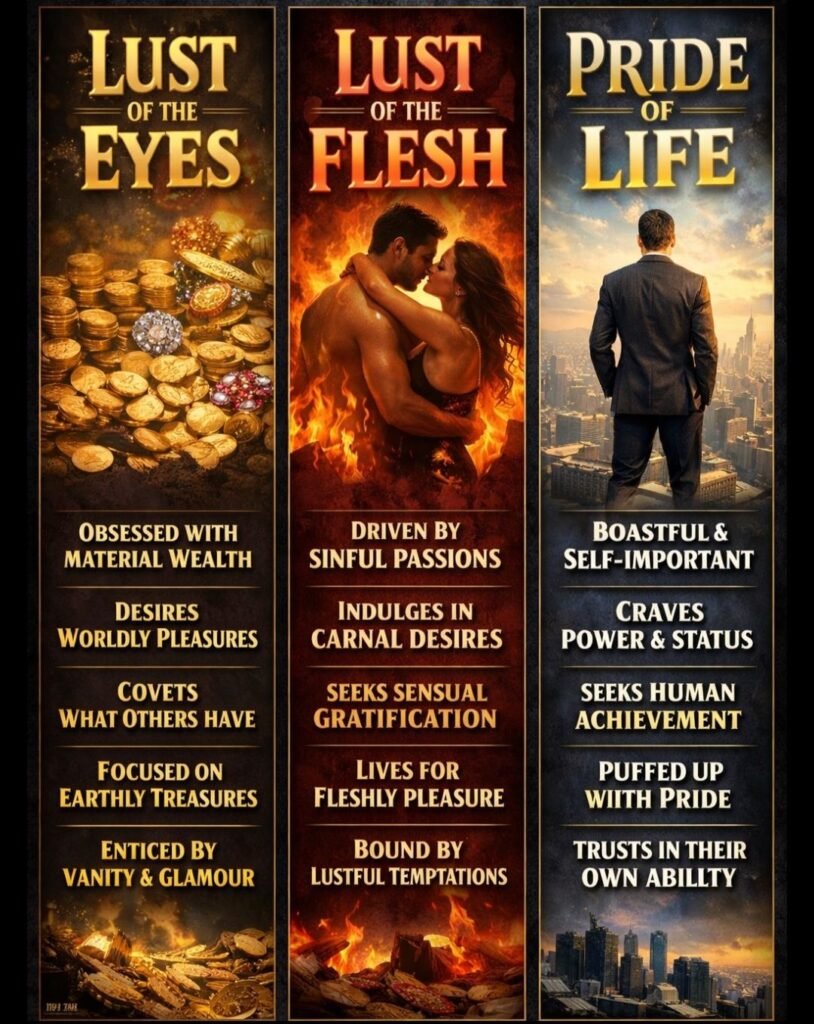
These are not framed as isolated sins or individual moral lapses. Rather, they are presented as structural forces—mechanisms by which values are shaped, priorities reordered, and allegiance subtly redirected away from God. John names them as the lust of the eyes, the lust of the flesh, and the pride of life.
While the language may sound antiquated to modern readers, the concepts themselves remain strikingly contemporary. They correspond to how people perceive reality, pursue satisfaction, and define identity. According to the biblical text, these forces do not originate from God but from what Scripture repeatedly calls “the world”—a term that refers not to the physical planet, but to a value system organized independently of divine authority.
This framework, found in 1 John 2:16, serves as a diagnostic tool rather than a moral checklist. It explains how desire becomes distorted and why spiritual decline often follows predictable trajectories.
A SYSTEM, NOT A MOMENT
Biblical writers consistently treat temptation as systemic rather than accidental. The Apostle Paul describes an ongoing conflict between flesh and Spirit (Galatians 5:17), while John emphasizes that the world’s influence is comprehensive, not selective.
This perspective challenges the modern tendency to isolate moral failure as circumstantial or personality-driven. In the New Testament view, external pressures and internal desires interact continuously. What begins as a preference often matures into a governing principle.
John’s assertion that “all that is in the world” fits within this threefold structure is intentionally expansive. It suggests that beneath countless expressions of behavior lie a limited number of motivating desires.
THE LUST OF THE EYES: DESIRE SHAPED BY PERCEPTION
The first category John identifies is the lust of the eyes—desire stimulated by what is seen. Scripture repeatedly associates visual fixation with misplaced longing. From the opening chapters of Genesis onward, seeing is portrayed not as neutral observation but as a gateway to desire.
In biblical terms, the issue is not appreciation of beauty or recognition of value. It is the loss of discernment when perception is disconnected from spiritual purpose. The eyes begin to dictate desire, rather than serve wisdom.
In contemporary society, this dynamic is amplified. Visual media, advertising, and digital platforms are designed to convert attention into aspiration. Material success, physical appearance, and curated lifestyles become benchmarks of fulfillment. Scripture, however, frames this process as spiritually hazardous.
“For all that is in the world… the lust of the eyes…” (1 John 2:16)
Covetousness and Comparison
The lust of the eyes frequently expresses itself as covetousness—a persistent dissatisfaction with one’s portion. Jesus directly warned against this tendency, emphasizing that abundance does not equate to life itself.
“Take heed, and beware of covetousness…” (Luke 12:15)
Covetousness thrives on comparison. It reframes success as relative rather than substantive and turns contentment into a liability. Biblically, it represents not merely desire for more, but erosion of trust in God’s provision.
Rather than motivating progress, covetousness produces restlessness. The object desired rarely delivers the peace promised, creating a cycle of perpetual dissatisfaction.
Temporary Wealth, Permanent Cost
A further expression of visual desire is fixation on material accumulation. Jesus addressed this explicitly, warning that earthly wealth is inherently unstable.
“Lay not up for yourselves treasures upon earth…” (Matthew 6:19–20)
This teaching does not condemn productivity or ownership, but it challenges misplaced security. When visible assets become the primary measure of success, invisible priorities—character, faithfulness, and spiritual maturity—are marginalized.
The New Testament consistently presents this as a strategic error rather than a moral accident.
THE LUST OF THE FLESH: DESIRE DRIVEN BY FEELING
If the lust of the eyes is external, the lust of the flesh is internal. It arises from bodily appetite, emotional impulse, and psychological craving. Paul describes the flesh not as passive weakness but as an active force opposing spiritual direction.
“For the flesh lusteth against the Spirit…” (Galatians 5:17)
In Scripture, feelings are acknowledged but never granted authority. When emotion becomes the primary decision-maker, restraint diminishes and discernment weakens. The flesh seeks immediate satisfaction, often without regard for consequence.
Modern culture frequently elevates feeling to the level of truth, equating authenticity with emotional expression. The biblical narrative offers a different assessment: unchecked desire, even when sincerely felt, can be profoundly misleading.
Pleasure and Bondage
Paul’s instruction in Romans 6 frames bodily desire in terms of governance.
“Let not sin therefore reign in your mortal body…” (Romans 6:12)
The language of reign suggests authority and control. The concern is not temptation itself, but who governs behavior. Scripture consistently warns that indulgence without restraint leads not to freedom, but to dependency.
Pleasure, in the biblical framework, is not inherently sinful. The danger lies in detachment from divine design. When desire becomes autonomous, it gradually reshapes values and habits, often resulting in spiritual stagnation.
Diminished Spiritual Effectiveness
The New Testament connects flesh-driven living with loss of spiritual vitality. Romans 8:8 states that those who live according to the flesh cannot please God.
“So then they that are in the flesh cannot please God.”
This is not framed as a statement about salvation status, but about relational alignment and usefulness. Persistent carnality dulls discernment, weakens testimony, and invites corrective discipline. Grace, in this context, is presented not as exemption from consequence but as empowerment for change.
THE PRIDE OF LIFE: DESIRE CENTERED ON SELF
The final category John identifies is the pride of life. Unlike the previous two, which focus on acquisition and appetite, this lust concerns identity. It is rooted in self-importance, status, and the pursuit of recognition.
Scripture consistently treats pride as destabilizing. It distorts perspective and creates resistance to accountability.
“Pride goeth before destruction…” (Proverbs 16:18)
The pride of life measures worth by achievement, visibility, and influence. It often manifests subtly, cloaked in ambition or competence. Even religious contexts are not immune.
Self-Sufficiency and Illusion
Paul directly challenges the notion of autonomous ability.
“Not that we are sufficient of ourselves…” (2 Corinthians 3:5)
The pride of life does not deny God outright; it minimizes dependence on Him. Over time, prayer becomes optional, correction unwelcome, and humility inconvenient. The result is spiritual isolation masked as confidence.
Recognition Without Alignment
The ultimate expression of pride is the pursuit of preeminence. Scripture counters this by asserting Christ’s exclusive authority.
“That in all things he might have the preeminence.” (Colossians 1:18)
When personal recognition becomes central, purpose narrows. Community fractures, and faith becomes performative. The New Testament frames this not as leadership, but as misdirected identity.
A SYSTEM WITH AN EXPIRATION DATE
John concludes his analysis with a reminder of impermanence.
“And the world passeth away, and the lust thereof…” (1 John 2:17)
The three lusts—visual covetousness, fleshly indulgence, and self-exalting pride—are temporary forces. They promise fulfillment but deliver erosion. According to Scripture, they do not endure, and neither do the values they promote.
What remains, the text asserts, is alignment with God’s will.
FINAL ANALYSIS
The New Testament’s diagnosis is consistent and comprehensive:
- What people see shapes what they desire
- What they feel influences what they choose
- What they pursue defines who they become
John’s framework does not merely condemn behavior; it exposes a system. In contrast, grace-based living is presented not as moral withdrawal, but as spiritual realignment—one that resists temporary desire in favor of enduring purpose.
“For sin shall not have dominion over you: for ye are not under the law, but under grace.” (Romans 6:14)
In the biblical narrative, grace is not permissive. It is corrective, stabilizing, and ultimately liberating.
The world does not attack believers randomly.
Satan uses three strategic lusts that appeal to:
What we SEE / What we FEEL / What we BECOME
Truth: These lusts oppose grace living and spiritual walking in the Body of Christ (Gal. 5:16).
THE LUST OF THE EYES
PERCEIVING WITHOUT PURPOSE – (Eyes controlling the heart)
Drawn to material wealth / Attracted to outward appearance / Distracted from eternal values / Verse: 1 John 2:16
POSSESSING WITHOUT PEACE – (Covetous desire)
Wants what others have / Never satisfied / Leads to envy and unrest / Verse: Luke 12:15
PURSUING EARTHLY PLEASURE – (Temporary treasures)
Focused on riches / Blinded to spiritual wealth / Ends in loss / Verse: Matthew 6:19–20 THE LUST OF THE FLESH
PASSIONS WITHOUT PROTECTION – (Fleshly cravings)
Driven by sinful desires / Controlled by feelings / Opposes the Spirit / Verse: Galatians 5:17
PLEASURE WITHOUT PURITY – (Carnal indulgence)
Seeks sensual gratification / Rejects holiness / Produces bondage / Verse: Romans 6:12
PRACTICES WITHOUT POWER – (Living for flesh)
Weakens spiritual life / Destroys testimony / Leads to chastening / Verse: Romans 8:8 THE PRIDE OF LIFE
POSITION WITHOUT PERSPECTIVE – (Self-importance)
Boastful attitude / Measures life by status / Ignores dependence on God / Verse: Proverbs 16:18
POWER WITHOUT PERMISSION – (Trusting self)
Relies on ability / Glories in achievement / Rejects grace / Verse: 2 Corinthians 3:5
PREEMINENCE WITHOUT PURPOSE – (Living for self)
Seeks recognition / Competes for glory / Forgets Christ’s Lordship / Verse: Colossians 1:18
CONCLUSION
Lust of the Eyes → Covetousness / Lust of the Flesh → Carnality / Pride of Life → Self-exaltation
These are NOT from the Father. These are from the world
“And the world passeth away…” (1 John 2:17)
CALL TO ACTION
Stop walking by sight / Stop living by feelings / Stop boasting in self / Walk in the Spirit / Rest in God’s grace / Live for eternal glory
“Walk in the Spirit, and ye shall not fulfil the lust of the flesh.”
(Galatians 5:16)
FINAL THOUGHTS
What you SEE can deceive / What you FEEL can enslave / What you BECOME can exalt self / What you BELIEVE in Christ sets you free / One Cross / One Grace / One Victorious Life
LIVE BY GRACE — NOT BY LUST
Romans 6:14
Related posts:
 𝗧𝗛𝗘 𝗧𝗛𝗥𝗘𝗘 𝗧𝗘𝗠𝗣𝗧𝗔𝗧𝗜𝗢𝗡𝗦 𝗢𝗙 𝗧𝗛𝗘 𝗪𝗢𝗥𝗟𝗗
 𝗟𝗨𝗦𝗧 𝘃𝘀 𝗟𝗢𝗩𝗘
 𝗪𝗢𝗥𝗞𝗦 𝗢𝗙 𝗧𝗛𝗘 𝗙𝗟𝗘𝗦𝗛 𝘃𝘀 𝗙𝗥𝗨𝗜𝗧𝗦 𝗢𝗙 𝗧𝗛𝗘 𝗦𝗣𝗜𝗥𝗜𝗧
 𝗩𝗔𝗟𝗘𝗡𝗧𝗜𝗡𝗘’𝗦 𝗗𝗔𝗬: 𝗟𝗢𝗩𝗘 𝗨𝗡𝗗𝗘𝗥 𝗚𝗥𝗔𝗖𝗘 𝗢𝗥 𝗟𝗨𝗦𝗧 𝗨𝗡𝗗𝗘𝗥 𝗧𝗛𝗘 𝗙𝗟𝗘𝗦𝗛?
 𝗚𝗛𝗢𝗦𝗧𝗦 𝗔𝗥𝗘𝗡’𝗧 𝗗𝗘𝗔𝗗 𝗣𝗘𝗢𝗣𝗟𝗘 — 𝗧𝗛𝗘𝗬’𝗥𝗘 𝗗𝗘𝗠𝗢𝗡𝗦
 𝗪𝗘 𝗦𝗘𝗘 𝗧𝗛𝗘 𝗪𝗢𝗥𝗟𝗗 𝗧𝗛𝗥𝗢𝗨𝗚𝗛 𝗗𝗜𝗙𝗙𝗘𝗥𝗘𝗡𝗧 𝗟𝗘𝗡𝗦𝗘𝗦
 𝗙𝗔𝗟𝗦𝗘 𝗙𝗥𝗜𝗘𝗡𝗗𝗦: 𝗧𝗛𝗘 𝗗𝗔𝗡𝗚𝗘𝗥 𝗢𝗙 𝗣𝗥𝗘𝗧𝗘𝗡𝗗𝗘𝗗 𝗙𝗘𝗟𝗟𝗢𝗪𝗦𝗛𝗜𝗣
 𝗜𝗡𝗙𝗟𝗨𝗘𝗡𝗖𝗜𝗡𝗚 𝗢𝗧𝗛𝗘𝗥𝗦 𝗧𝗢 𝗛𝗔𝗧𝗘: 𝗧𝗛𝗘 𝗦𝗣𝗜𝗥𝗜𝗧𝗨𝗔𝗟 𝗗𝗔𝗡𝗚𝗘𝗥
 𝗦𝗧𝗥𝗘𝗡𝗚𝗧𝗛 𝗠𝗘𝗔𝗡𝗦 𝗡𝗢𝗧𝗛𝗜𝗡𝗚 𝗪𝗜𝗧𝗛𝗢𝗨𝗧 𝗦𝗘𝗟𝗙-𝗖𝗢𝗡𝗧𝗥𝗢𝗟
 𝗪𝗢𝗥𝗟𝗗𝗟𝗬 𝗖𝗛𝗥𝗜𝗦𝗧𝗜𝗔𝗡 𝘃𝘀. 𝗦𝗣𝗜𝗥𝗜𝗧𝗨𝗔𝗟 𝗖𝗛𝗥𝗜𝗦𝗧𝗜𝗔𝗡
 𝗚𝗢𝗗 𝗔𝗡𝗗 𝗠𝗔𝗡: 𝗥𝗜𝗚𝗛𝗧𝗟𝗬 𝗗𝗜𝗩𝗜𝗗𝗘𝗗 𝗗𝗘𝗦𝗜𝗚𝗡
 𝗪𝗛𝗘𝗡 𝗟𝗢𝗬𝗔𝗟𝗧𝗬 𝗧𝗢 𝗟𝗘𝗔𝗗𝗘𝗥𝗦 𝗥𝗘𝗣𝗟𝗔𝗖𝗘𝗦 𝗟𝗢𝗬𝗔𝗟𝗧𝗬 𝗧𝗢 𝗧𝗛𝗘 𝗪𝗢𝗥𝗗 𝗢𝗙 𝗚𝗢𝗗
 𝗘𝗫𝗣𝗢𝗦𝗜𝗡𝗚 𝗙𝗔𝗟𝗦𝗘 𝗣𝗥𝗢𝗣𝗛𝗘𝗧𝗦 𝗜𝗦 𝗡𝗢𝗧 𝗦𝗜𝗡, 𝗦𝗜𝗟𝗘𝗡𝗖𝗘 𝗜𝗦
 𝗟𝗜𝗚𝗛𝗧 𝗦𝗛𝗜𝗡𝗘𝗦 𝗜𝗡 𝗧𝗛𝗘 𝗗𝗔𝗥𝗞𝗡𝗘𝗦𝗦