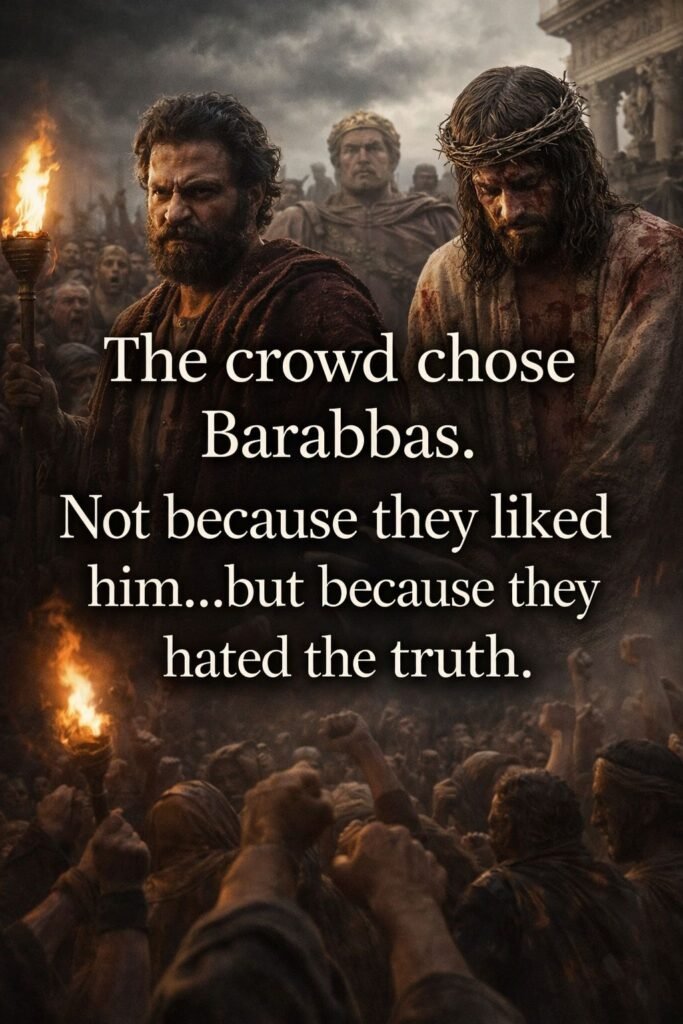
THE CROWD CHOSE BARABBAS
Why Men Reject Truth and Choose Error
INTRODUCTION
On a spring morning in Jerusalem, a crowd was presented with a choice that would echo through history. Before them stood two men—one a convicted criminal, the other a teacher known for healing the sick and speaking of a kingdom not of this world. The Roman governor, following custom, offered to release one prisoner. The people answered without hesitation.
They chose Barabbas.
The decision was not made in ignorance. It was made in full view of the facts. Barabbas was known. Jesus was examined. The contrast could not have been sharper, yet the verdict was unanimous. In that moment, the crowd revealed more than a preference between two individuals; it exposed a pattern of human behavior that continues to define societies, institutions, and belief systems to this day.
The Gospel of John provides a sober explanation:
“And this is the condemnation, that light is come into the world, and men loved darkness rather than light, because their deeds were evil.” — John 3:19 (KJV)
Barabbas represents man’s preference—power, rebellion, and self-justification. Christ represents God’s provision—truth, righteousness, and grace. The choice between them illustrates why truth is routinely rejected when it threatens pride, exposes sin, or disrupts established systems.
This article examines the Barabbas episode as a historical event, a prophetic symbol, and a recurring social phenomenon. Far from being confined to ancient Jerusalem, the same forces that swayed that crowd continue to shape modern religion, politics, and culture.
1. A PROPHETIC EXCHANGE — WHEN JUSTICE WAS OVERTURNED
The release of Barabbas was legally permitted but morally indefensible. Roman custom allowed a prisoner to be freed during Passover as a gesture of goodwill. Pilate, recognizing the innocence of Jesus, appears to have assumed the crowd would choose the harmless teacher over the violent insurgent.
They did not.
According to Matthew’s account, Barabbas was a “notable prisoner” (Matthew 27:16), a term suggesting notoriety rather than ambiguity. Mark clarifies that he had taken part in an insurrection and committed murder. Luke describes him as a rebel. John identifies him as a robber. By any standard, he was guilty.
Jesus, by contrast, stood unconvicted. Pilate declared repeatedly that he found no fault in Him. Even the charge brought against Jesus—claiming kingship—was theological, not criminal. Yet the innocent man was condemned, and the guilty man was released.
This exchange fulfilled ancient prophecy. Isaiah had foretold a servant who would be “despised and rejected of men” (Isaiah 53:3). The rejection of Jesus was not a failure of divine foresight but a revelation of human nature when confronted with moral accountability.
2. WHY THE CROWD PREFERRED BARABBAS
The preference for Barabbas was rooted less in admiration for the man and more in rejection of what Jesus represented.
First-century Judea existed under Roman occupation. Many longed for a political deliverer—someone who would confront power with force. Barabbas, involved in violent resistance, fit that expectation. Jesus did not. He spoke of loving enemies, submitting to God’s will, and addressing sin before systems.
When crowds earlier attempted to make Jesus king by force, He withdrew (John 6:15). His refusal to conform to nationalistic expectations disappointed those seeking immediate political change. Barabbas, though criminal, embodied resistance on human terms.
Additionally, Jesus openly challenged religious hypocrisy. His public rebukes of leaders who valued appearance over integrity struck at the heart of institutional pride. Truth that exposes hypocrisy is rarely welcomed, especially when it threatens authority and reputation.
3. TRUTH AS A THREAT
Jesus Himself explained why hostility followed Him:
“The world cannot hate you; but me it hateth, because I testify of it, that the works thereof are evil.” — John 7:7 (KJV)
Truth does more than inform; it confronts. It challenges self-perception and dismantles carefully constructed justifications. For the crowd, choosing Barabbas meant silencing an uncomfortable voice.
Luke records their unified cry: “Away with this man, and release unto us Barabbas” (Luke 23:18). This was not mob confusion but collective rejection. Faced with light, they chose darkness.
The Apostle Paul later observed that humanity has a persistent tendency to “change the truth of God into a lie” (Romans 1:25). The Barabbas decision stands as a vivid illustration of that exchange.
4. THE CROWD AS A CAUTIONARY TALE
The Barabbas episode undermines the assumption that consensus equals correctness. Crowds can be manipulated, persuaded, and driven by emotion rather than truth.
Matthew notes that religious leaders actively influenced the multitude to demand Barabbas’s release (Matthew 27:20). The result was not justice but collective moral failure.
Scripture offers a blunt assessment of the human condition:
“There is none that seeketh after God.” — Romans 3:11 (KJV)
This is not cynicism; it is diagnosis. Without divine intervention, human judgment consistently favors what aligns with self-interest over righteousness.
5. SUBSTITUTION WITHOUT MERIT
Barabbas did nothing to earn his freedom. He offered no repentance, no apology, no reform. He simply walked free because another took his place.
Matthew summarizes the moment with stark brevity: “Then released he Barabbas unto them: and when he had scourged Jesus, he delivered him to be crucified” (Matthew 27:26).
In theological terms, this exchange illustrates substitution. Paul later explained that God presented Christ as a propitiation—one who satisfies justice on behalf of others (Romans 3:25). The guilty man lived because the innocent man died.
6. NATIONAL REJECTION AND PROPHETIC CONSEQUENCES
The crowd’s decision carried consequences beyond the immediate execution. When leaders declared, “We have no king but Caesar” (John 19:15), they formally rejected the messianic claim of Jesus.
Paul later described this rejection as a partial blindness affecting Israel (Romans 11:25). The promised kingdom was not abolished but postponed, while the message of salvation was extended beyond national boundaries.
Acts records Paul’s declaration that “the salvation of God is sent unto the Gentiles” (Acts 28:28), marking a significant shift in redemptive history.
7. A SHIFT FROM CROWD DECISION TO PERSONAL FAITH
Through the Apostle Paul, a new emphasis emerged: salvation not through national allegiance or collective action, but through individual faith.
Paul described this message as a “mystery” revealed by God (Ephesians 3:3). Unlike the Passover crowd, no one is saved by following majority opinion. Faith is personal, deliberate, and inward.
As Paul wrote, salvation comes through believing and confessing Christ, not aligning with popular sentiment (Romans 10:9).
8. MODERN PARALLELS
The choice between Barabbas and Christ continues in contemporary forms. Many prefer religion built on performance rather than grace. Others gravitate toward leaders who promise affirmation rather than truth.
Paul warned that people would seek teachers who tell them what they want to hear (2 Timothy 4:3). Works-based righteousness remains more appealing than humble dependence on grace (Romans 10:3).
The pattern has not changed—only the packaging.
CONCLUSION
The crowd chose Barabbas.
God chose the cross.
That ancient decision exposes an enduring reality: truth is often rejected not because it is unclear, but because it is costly. Grace remains available, but it must be received deliberately, not inherited from the crowd.
Barabbas walked free. Jesus paid the price.
The question posed in Jerusalem still confronts every generation—not as history, but as a present choice.
“Christ died for our sins.” — 1 Corinthians 15:3 (KJV)
Related posts:
 𝗕𝗔𝗥𝗔𝗕𝗕𝗔𝗦 𝗢𝗥 𝗝𝗘𝗦𝗨𝗦? — 𝗧𝗛𝗘 𝗚𝗥𝗘𝗔𝗧 𝗘𝗫𝗖𝗛𝗔𝗡𝗚𝗘
 𝗪𝗛𝗢 𝗜𝗦 𝗝𝗘𝗦𝗨𝗦?
 𝗝𝗘𝗦𝗨𝗦 𝗖𝗛𝗥𝗜𝗦𝗧 𝗧𝗛𝗘 𝗠𝗘𝗦𝗦𝗜𝗔𝗛 𝗣𝗥𝗢𝗩𝗘𝗡 𝗪𝗜𝗧𝗛 𝗔𝗕𝗦𝗢𝗟𝗨𝗧𝗘 𝗖𝗘𝗥𝗧𝗔𝗜𝗡𝗧𝗬 𝗕𝗬 𝗗𝗔𝗡𝗜𝗘𝗟 𝟵
 𝗙𝗥𝗢𝗠 𝗣𝗥𝗢𝗣𝗛𝗘𝗖𝗬 𝗧𝗢 𝗠𝗬𝗦𝗧𝗘𝗥𝗬. 𝗧𝗛𝗘 𝗞𝗘𝗬 𝗧𝗢 𝗨𝗡𝗗𝗘𝗥𝗦𝗧𝗔𝗡𝗗𝗜𝗡𝗚 𝗦𝗖𝗥𝗜𝗣𝗧𝗨𝗥𝗘 – 𝗚𝗢𝗗 𝗜𝗦 𝗡𝗢𝗧 𝗧𝗛𝗘 𝗔𝗨𝗧𝗛𝗢𝗥 𝗢𝗙 𝗖𝗢𝗡𝗙𝗨𝗦𝗜𝗢𝗡!
 𝗝𝗘𝗦𝗨𝗦 𝗖𝗛𝗥𝗜𝗦𝗧: 𝗧𝗛𝗘 𝗢𝗡𝗟𝗬 𝗥𝗜𝗦𝗘𝗡 𝗥𝗘𝗗𝗘𝗘𝗠𝗘𝗥
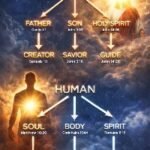 𝗚𝗢𝗗 𝗔𝗡𝗗 𝗠𝗔𝗡: 𝗥𝗜𝗚𝗛𝗧𝗟𝗬 𝗗𝗜𝗩𝗜𝗗𝗘𝗗 𝗗𝗘𝗦𝗜𝗚𝗡
 𝗪𝗛𝗢 𝗦𝗔𝗬𝗦 𝗝𝗘𝗦𝗨𝗦 𝗖𝗛𝗥𝗜𝗦𝗧 𝗜𝗦 𝗚𝗢𝗗?
 𝗙𝗔𝗟𝗦𝗘 𝗙𝗥𝗜𝗘𝗡𝗗𝗦: 𝗧𝗛𝗘 𝗗𝗔𝗡𝗚𝗘𝗥 𝗢𝗙 𝗣𝗥𝗘𝗧𝗘𝗡𝗗𝗘𝗗 𝗙𝗘𝗟𝗟𝗢𝗪𝗦𝗛𝗜𝗣
 𝗧𝗛𝗘 𝗥𝗔𝗣𝗧𝗨𝗥𝗘: 𝗙𝗢𝗥 𝗕𝗘𝗟𝗜𝗘𝗩𝗘𝗥𝗦, 𝗡𝗢𝗧 𝗥𝗘𝗟𝗜𝗚𝗜𝗢𝗡
 𝗧𝗛𝗘 𝗕𝗥𝗔𝗜𝗡 𝗠𝗨𝗦𝗧 𝗕𝗘 𝗪𝗔𝗧𝗘𝗥𝗘𝗗 𝗪𝗜𝗧𝗛 𝗧𝗛𝗘 𝗪𝗢𝗥𝗗 𝗢𝗙 𝗚𝗢𝗗 𝗗𝗔𝗜𝗟𝗬
 𝗩𝗔𝗟𝗘𝗡𝗧𝗜𝗡𝗘’𝗦 𝗗𝗔𝗬: 𝗟𝗢𝗩𝗘 𝗨𝗡𝗗𝗘𝗥 𝗚𝗥𝗔𝗖𝗘 𝗢𝗥 𝗟𝗨𝗦𝗧 𝗨𝗡𝗗𝗘𝗥 𝗧𝗛𝗘 𝗙𝗟𝗘𝗦𝗛?
 𝗪𝗛𝗬 𝗔𝗣𝗢𝗦𝗧𝗟𝗘 𝗣𝗔𝗨𝗟?
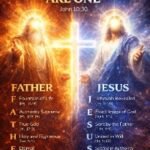 “𝗜 𝗔𝗡𝗗 𝗠𝗬 𝗙𝗔𝗧𝗛𝗘𝗥 𝗔𝗥𝗘 𝗢𝗡𝗘”
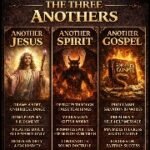 𝗧𝗛𝗘 𝗧𝗛𝗥𝗘𝗘 𝗔𝗡𝗢𝗧𝗛𝗘𝗥𝗦