
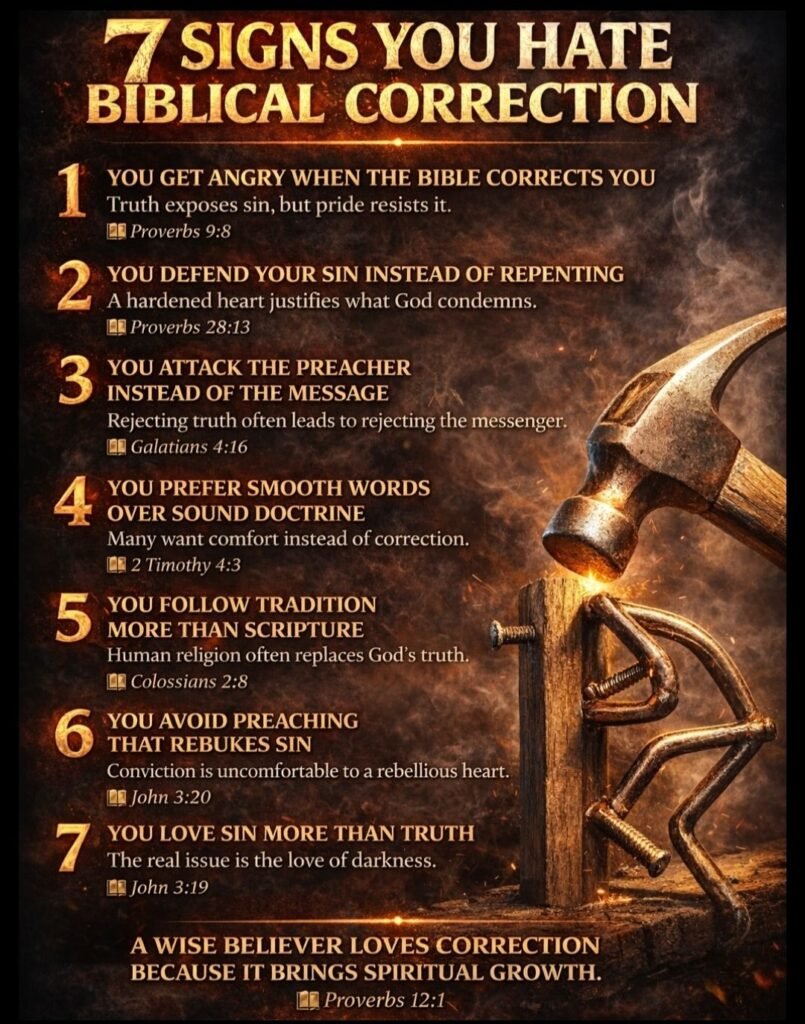
The forensic examination of the human heart within the current Administration of Grace reveals a persistent and structural resistance to the surgical precision of the Holy Scriptures. Within the specialized framework of the Pauline revelation, the believer is not under the condemnation of the Law, yet he remains under the absolute authority of the inspired Word for the purpose of spiritual maturity. 2 Timothy 3:16 provides the diagnostic baseline for this investigative report: “All scripture is given by inspiration of God, and is profitable for doctrine, for reproof, for correction, for instruction in righteousness.” This report asserts that the capacity to receive biblical correction is the primary metric of a soul rightly aligned with the Mystery. Under the light of the revelation committed to the Apostle Paul, the investigator identifies that those who harbor a hatred for correction are not suffering from a lack of information, but from a fortification of pride that seeks to maintain the “old man” against the transformative power of the indwelling Christ.
The first definitive sign of a heart that rejects the divine standard is an Angry Response to Truth. Proverbs 9:8 establishes the clinical profile: “Reprove not a scorner, lest he hate thee: rebuke a wise man, and he will love thee.” The investigator finds that when the Bible exposes the hidden things of dishonesty, the carnal mind reacts with a defensive hostility. This is not a mere emotional flare, but a judicial rejection of the Spirit’s authority. In the record of Acts 7:54, the religious establishment provided the ultimate forensic example of this reaction: “When they heard these things, they were cut to the heart, and they gnashed on him with their teeth.” This raging against truth reveals that the individual values his own reputation above God’s righteousness. The audit shows that a humble heart, established in the grace of God, receives the “wounds of a friend” (Proverbs 27:6) as a means of sanctification, whereas the scorner views the messenger as an adversary.
A secondary finding in this investigative audit involves the Defending of Sin instead of Repenting. Proverbs 28:13 provides the warning: “He that covereth his sins shall not prosper: but whoso confesseth and forsaketh them shall have mercy.” The investigator identifies that a rebellious heart will often utilize “theology” to justify what God clearly condemns. In the Dispensation of Grace, some erroneously claim that because they are “not under law,” they are free to “continue in sin” (Romans 6:1-2). This report asserts that such a mindset is a perversion of Pauline doctrine. Grace does not provide a license for carnality; rather, it provides the power to “deny ungodliness and worldly lusts” (Titus 2:11-12). Clinging to compromise and covering corruption are the forensic fingerprints of a man who is “walking after the flesh” (Galatians 5:16). When a believer spends more energy explaining his sin than he does separating from it, he has effectively rejected the “correction” mentioned in 2 Timothy 3:16.
The investigative report further identifies the tactic of Attacking the Messenger as a primary symptom of truth-rejection. Galatians 4:16 records the Apostle Paul’s own experience with this phenomenon: “Am I therefore become your enemy, because I tell you the truth?” When the message is unassailable, the carnal mind seeks to discredit the medium. The investigator finds that this often manifests as mocking the minister or maligning the character of those who preach the unadulterated Word. 2 Chronicles 36:16 documents the ancient pattern of this failure: “But they mocked the messengers of God, and despised his words, and misused his prophets.” By spreading criticism or misrepresenting the message through selective listening (2 Peter 3:16), the individual attempts to shift the focus from their own guilt to the perceived flaws of the preacher. The audit confirms that the rejection of God’s servant for the sake of his message is, in forensic reality, a rejection of the God who sent him.
A diagnostic review of the “consumerist” church environment reveals the fourth sign: Desiring Smooth Sermons. 2 Timothy 4:3 predicts the current spiritual climate with chilling accuracy: “For the time will come when they will not endure sound doctrine; but after their own lusts shall they heap to themselves teachers, having itching ears.” The investigator finds that a hatred for correction is often masked by a “preference” for positive, motivational, or “encouraging” preaching that intentionally avoids the mention of sin or the necessity of the cross. Isaiah 30:10 records the demand of the rebellious: “Speak unto us smooth things, prophesy deceits.” When a believer selects a teacher based on how well that teacher entertains the flesh rather than how effectively he equips the spirit, the believer has abandoned the “instruction in righteousness.” Sound doctrine is designed to wound the ego before it heals the soul; those who refuse the wound will never experience the true healing of the Spirit.
The fifth diagnostic marker involves Trusting Tradition over Truth. Colossians 2:8 issues the administrative order: “Beware lest any man spoil you through philosophy and vain deceit, after the tradition of men… and not after Christ.” The investigator finds that religious traditions often serve as a “firewall” against biblical correction. By favoring rituals and external forms of godliness (2 Timothy 3:5), the individual creates a false sense of security that is insulated from the penetrating light of Scripture. Mark 7:8 records Christ’s confrontation with this mindset: “For laying aside the commandment of God, ye hold the tradition of men.” In many cult-like or high-control systems, the “unwritten rules” of the organization are given more weight than the “written revelation” of the Almighty. The investigator asserts that any system which forbids the questioning of its traditions by the standard of the Word is a system that hates correction.
The report further emphasizes the sign of Avoiding Rebuking Preaching. John 3:20 provides the forensic explanation: “For every one that doeth evil hateth the light, neither cometh to the light, lest his deeds should be reproved.” The investigator finds that those who harbor secret sins or unyielded areas of life will systematically avoid assemblies where the Word is preached with “reproof and rebuke” (2 Timothy 4:2). This “dodging of conviction” often leads to a pattern of “church hopping,” where the individual departs from sound doctrine (2 Timothy 4:4) the moment their conscience is pricked. Proverbs 12:1 establishes the stark contrast: “Whoso loveth instruction loveth knowledge: but he that hateth reproof is brutish.” Departing from a church because the preaching is “too hard” is frequently a forensic admission that the individual prefers the darkness of their own will to the light of God’s Word.
The seventh and most profound sign is Loving Sin more than Truth. John 3:19 identifies this as the root cause of all spiritual resistance: “And this is the condemnation, that light is come into the world, and men loved darkness rather than light, because their deeds were evil.” The investigator find that the ultimate barrier to biblical correction is not intellectual difficulty but an emotional and volitional attachment to “the pleasures of sin for a season” (Hebrews 11:25). When a person persists in rebellion and refuses to submit to truth (Romans 1:28), they are making a value judgment that the “treasures of Egypt” are more desirable than the “reproach of Christ.” The audit reveals that a true believer, indwelt by the Holy Spirit, is marked by a fundamental shift in affection; he begins to “love the things God loves” and “hate the things God hates.” A persistent love for sin is a clinical indicator of a heart that has not yet bowed to the Lordship of Jesus Christ.
The investigative summary concludes that the Word of God functions as a spiritual “level and plumb line” for the building of the Body of Christ. 2 Timothy 3:16 establishes that doctrine teaches what is right, reproof exposes what is wrong, correction shows how to fix it, and instruction trains us to stay on the right path. The investigator find that a person who hates any one of these functions effectively rejects the whole. Correction is not a sign of God’s anger; it is a sign of His fatherly love and his commitment to our transformation. Proverbs 3:11-12 reminds the believer: “My son, despise not the chastening of the Lord… For whom the Lord loveth he correcteth.” A wise workman understands that his own feelings and opinions are unreliable; therefore, he submits himself to the objective standard of the Word.
A call to action is issued for every saint to conduct a personal forensic audit of their response to the pulpit and the Page. First, ask yourself: Do I react with anger or defense when a sermon confronts my current lifestyle? Second, do I find myself making excuses for “small sins” while judging others for “large” ones? Third, do I value the approval of men more than the approval of God (Galatians 1:10)? James 1:22 issues the administrative decree: “But be ye doers of the word, and not hearers only, deceiving your own selves.” Ask God for a “teachable heart,” as modeled by David in Psalm 139:23: “Search me, O God, and know my heart: try me, and know my thoughts.” Choose today to let the Word of God correct you, even when it hurts, for the “peaceable fruit of righteousness” (Hebrews 12:11) is only harvested by those who are exercised by it.
The forensic data regarding “Spiritual Maturity” (Ephesians 4:13) reveals that the “perfect man” is not one who never fails, but one who is constantly adjusted by the truth. In a life where correction is hated, growth is stunted, and the individual remains a “babe” tossed to and fro (Ephesians 4:14). The investigator find that the most useful vessels in the Master’s house are those that have been “purged” (2 Timothy 2:21) by the washing of water by the Word. The audit shows that the “scorner” eventually becomes “brutish,” losing the ability to discern spiritual reality. Conversely, the “wise” man grows in “grace and in the knowledge of our Lord” (2 Peter 3:18) because he treats correction as a “precious oil” (Psalm 141:5) that does not break his head, but heals his soul.
Furthermore, the investigation into “The Law of Liberty” (James 1:25) confirms that the believer’s freedom in Christ is the freedom to be right, not the freedom to be wrong. The investigator find that those who hate correction are actually in bondage to their own errors. However, when the believer “beholds himself in the glass” of the Word and allows that Word to change him, he finds the “perfect law of liberty.” This is the great paradox of the Pauline walk: total submission to the Word results in total freedom from the power of sin. The investigator concludes that the “hatred of correction” is the primary mechanism by which the adversary keeps the believer ineffective and ashamed.
The audit of “Ministerial Responsibility” shows that the preacher is commanded to be “instant in season and out of season” to “reprove and rebuke” (2 Timothy 4:2). This investigation emphasizes that a preacher who never corrects his flock is a preacher who does not love his flock. He is a “hireling” who cares more for the “wool” than the “sheep” (John 10:12-13). Therefore, the presence of correction in an assembly is a clinical indicator of spiritual health and pastoral fidelity. The investigator find that those who seek out “safe” churches where they are never challenged are actually seeking out “spiritual graveyards.”
The final word of this investigative report is a reminder that the Judgment Seat of Christ (Romans 14:10) is the ultimate venue where all our deeds will be made manifest. The investigator find that it is far better to be corrected by the Word now than to suffer loss (1 Corinthians 3:15) then. The “perilous times” (2 Timothy 3:1) are characterized by a “form of godliness” that denies the “power thereof”—and that power is the power of the Word to change the man. The investigator concludes that the “hatred of correction” is the hallmark of the apostasy. Trust the Word, embrace the rebuke, and stand fast in the liberty of a corrected life.
The investigative findings are summarized for final review:
- Angry Response: Pride reacts with hostility when sin is exposed (Proverbs 9:8).
- Defending Sin: A rebellious heart justifies what the Word condemns (Proverbs 28:13).
- Attacking the Messenger: Discrediting the preacher to avoid the message (Galatians 4:16).
- Desiring Smooth Sermons: Seeking entertainment over edification (2 Timothy 4:3).
- Trusting Tradition: Using human rituals as a shield against Scripture (Colossians 2:8).
- Avoiding Rebuke: Dodging the light to hide the deeds of darkness (John 3:20).
- Loving Sin: The root of all rejection is a preference for pleasure over truth (John 3:19).
The case for “7 Signs You Hate Biblical Correction” is closed. The data is provided for the “perfecting of the saints” (Ephesians 4:12). May the God of all grace grant you a heart that loves the truth more than it loves itself. Amen.
Related posts:
 𝗟𝗜𝗚𝗛𝗧 𝗦𝗛𝗜𝗡𝗘𝗦 𝗜𝗡 𝗧𝗛𝗘 𝗗𝗔𝗥𝗞𝗡𝗘𝗦𝗦
 𝗙𝗔𝗟𝗦𝗘 𝗙𝗥𝗜𝗘𝗡𝗗𝗦: 𝗧𝗛𝗘 𝗗𝗔𝗡𝗚𝗘𝗥𝗦 𝗢𝗙 𝗣𝗥𝗘𝗧𝗘𝗡𝗗𝗘𝗗 𝗙𝗘𝗟𝗟𝗢𝗪𝗦𝗛𝗜𝗣
 𝗦.𝗪.𝗢.𝗥.𝗗. — 𝗧𝗛𝗘 𝗪𝗢𝗥𝗗 𝗢𝗙 𝗚𝗢𝗗
 𝗜𝗚𝗡𝗢𝗥𝗜𝗡𝗚 𝗧𝗛𝗘 𝗧𝗥𝗨𝗧𝗛 𝗗𝗢𝗘𝗦𝗡’𝗧 𝗖𝗛𝗔𝗡𝗚𝗘 𝗧𝗛𝗘 𝗧𝗥𝗨𝗧𝗛
 𝗦𝗬𝗠𝗕𝗢𝗟𝗦 𝗢𝗙 𝗧𝗛𝗘 𝗪𝗢𝗥𝗗 𝗢𝗙 𝗚𝗢𝗗
 𝟴 𝗪𝗔𝗬𝗦 𝗧𝗢 𝗣𝗨𝗧 𝗚𝗢𝗗 𝗙𝗜𝗥𝗦𝗧 𝗜𝗡 𝗬𝗢𝗨𝗥 𝗟𝗜𝗙𝗘
 𝗧𝗛𝗘 𝗦𝗪𝗢𝗥𝗗 𝗢𝗙 𝗧𝗛𝗘 𝗦𝗣𝗜𝗥𝗜𝗧 — 𝗧𝗛𝗘 𝗪𝗢𝗥𝗗 𝗢𝗙 𝗚𝗢𝗗
 𝗧𝗛𝗘 𝗧𝗥𝗜𝗖𝗛𝗢𝗧𝗢𝗠𝗬 𝗢𝗙 𝗠𝗔𝗡
 𝗧𝗛𝗘 𝗙𝗜𝗡𝗔𝗟 𝗔𝗨𝗧𝗛𝗢𝗥𝗜𝗧𝗬 — 𝗧𝗛𝗘 𝗪𝗢𝗥𝗗 𝗢𝗙 𝗚𝗢𝗗
 𝗕𝗘𝗟𝗜𝗘𝗩𝗘𝗥’𝗦 𝗕𝗔𝗧𝗧𝗟𝗘𝗙𝗜𝗘𝗟𝗗 𝗢𝗙 𝗧𝗛𝗘 𝗠𝗜𝗡𝗗
 𝗛𝗢𝗪 𝗚𝗢𝗗 𝗗𝗘𝗖𝗟𝗔𝗥𝗘𝗦 𝗔 𝗦𝗜𝗡𝗡𝗘𝗥 𝗥𝗜𝗚𝗛𝗧𝗘𝗢𝗨𝗦
 𝗧𝗛𝗘 𝗖𝗥𝗢𝗦𝗦: 𝗚𝗢𝗗’𝗦 𝗣𝗢𝗪𝗘𝗥 𝗙𝗢𝗥 𝗦𝗔𝗟𝗩𝗔𝗧𝗜𝗢𝗡
 𝗢𝗡𝗟𝗬 𝗢𝗡𝗘 𝗘𝗠𝗣𝗧𝗬 𝗧𝗢𝗠𝗕
 𝗔𝗟𝗖𝗢𝗛𝗢𝗟 — 𝗗𝗘𝗦𝗧𝗥𝗢𝗬𝗘𝗥 𝗢𝗙 𝗠𝗔𝗡𝗬 𝗟𝗜𝗩𝗘𝗦